
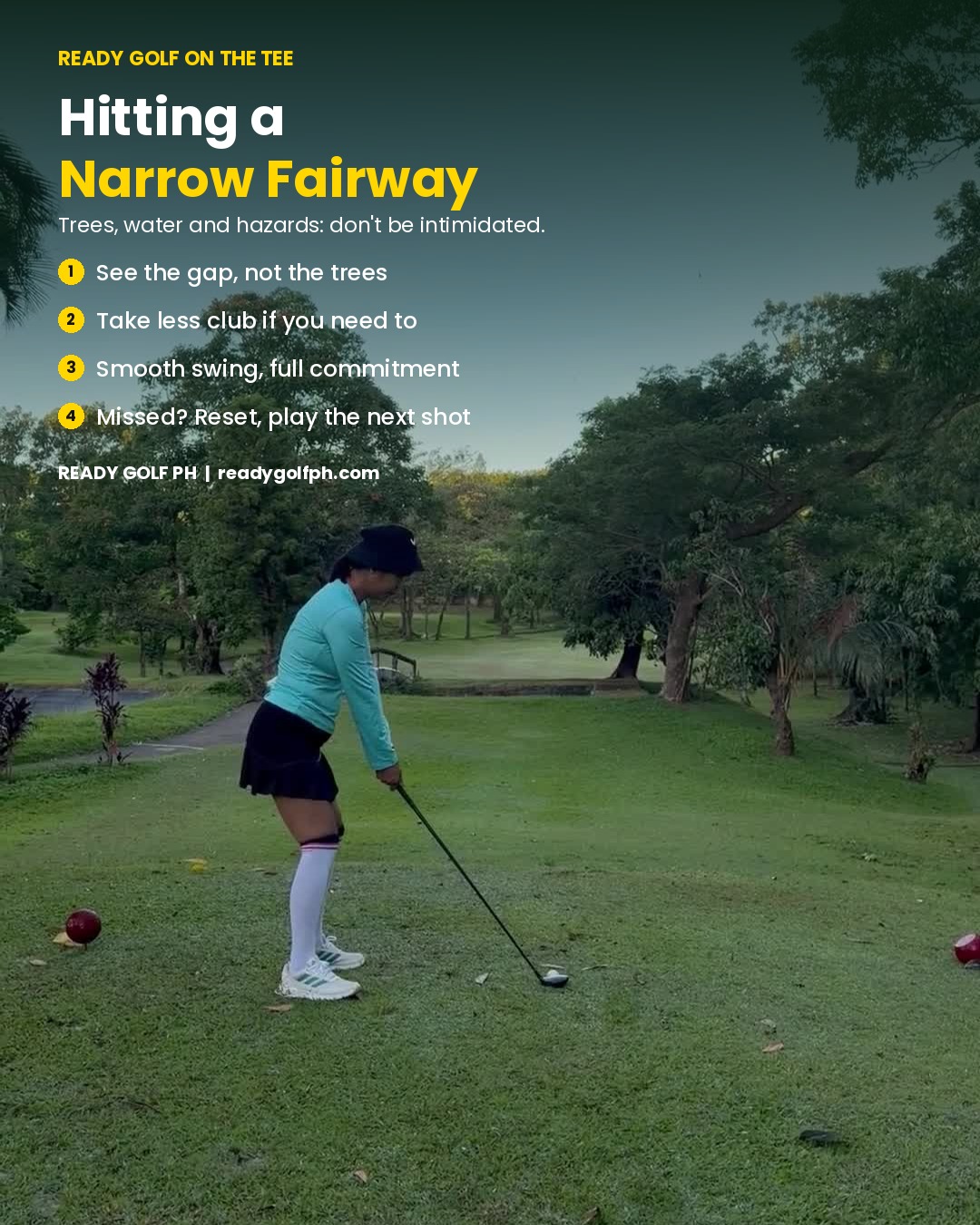
I’m not a pro or an expert. I’m a weekend golfer, and narrow fairways used to scare me. When I stood on a tee with trees on both sides, water on one side or a bunker waiting where my drive usually lands, all I could see was trouble. I’d tense up, steer the club, and the ball would go exactly where I was afraid it would. I’ve learned that the trees, water and hazards don’t get closer just because I’m worried about them. How I think about the shot matters as much as the swing.
This is what I try to do now when the fairway looks narrow, and how I keep from being intimidated by everything around it.
What You See in My Video
In my video, I’m on the tee of a tree-lined hole early in the morning. There are trees on both sides, and the fairway looks like a narrow green lane between them. Before I set up, I hold my club out toward the fairway to pick my line. Then I set up, make a smooth swing, hold my finish and watch my ball. Afterward, I pick up my tee and get ready to move on.
That routine is part of ready golf for me. When I have a simple plan on the tee, I don’t stand over the ball worrying, and my group doesn’t wait for me.
My Goal on a Narrow Hole
My goal isn’t a perfect drive. It’s to put the ball somewhere I can play my next shot from. On a narrow hole, the middle of the fairway, even a little shorter, is a great result for me. Some days I still end up in the trees. When that happens, I take my medicine and keep going. Every narrow hole teaches me something about the course and about myself.
The Mistakes I Made on Narrow Fairways
- Staring at the trouble. I’d look at the trees, the water or the out-of-bounds stakes right before I swung. My eyes went to the trouble, and so did my ball.
- Steering the swing. I tried to guide the ball down the middle with a short, careful swing. It almost always came out worse.
- Always hitting driver. I used my driver because it was a par 4, even when a shorter club would have kept me in play.
- Swinging harder to “get past” the trouble. Swinging harder made my misses bigger.
- Taking forever on the tee. I’d stand over the ball thinking about everything that could go wrong, while my group waited.
- Letting one bad shot ruin the hole. After hitting into the trees, I’d try a hero shot through a tiny gap and make things worse.
Tips I Use for a Narrow Fairway
1. See the gap, not the trees. Before I tee up, I stand behind the ball and pick a small target in the fairway, like a dark patch of grass, a tree far in the distance or the edge of a bunker I want to stay away from. Then I keep my eyes on that target. The fairway looks wider when I focus on where I want the ball to go instead of where I don’t.
2. Choose your side of the tee box. I tee up on the side of the tee box that helps me aim away from the biggest trouble. If the trees are worse on the right, I tee up on the right and aim toward the left-center of the fairway. I shared more about this in choose your spot in the tee box.
3. Take less club if you need to. I don’t have to hit driver. A hybrid, fairway wood or long iron that I hit straighter is often the smarter choice. Being in the fairway a little shorter is better than being in the trees a little longer. I wrote about learning my honest distances in choosing the right club at the range.
4. Make your normal, smooth swing. I try to swing exactly the way I would on a wide fairway. Same tempo, same finish. When I steer or rush, my misses get bigger. A smooth swing that I commit to gives me the best chance.
5. Commit before you swing. Once I pick my target and my club, I stop debating. I take one practice swing, set up and go. Doubt in the middle of the swing is what usually sends my ball sideways.
6. Hold your finish and watch the ball. I hold my finish and watch where the ball lands, especially near trees or water. If I’m not sure it’s safe or findable, I hit a provisional ball so my group doesn’t wait while I walk back.
Don’t Let the Obstacles Intimidate You
Trees. Trees look like walls, but there’s more space between them than it seems from the tee. Even when my ball goes in, I can often punch out back to the fairway and still make a decent score.
Water. Water feels scary because the ball is gone. I aim away from it, choose a club that keeps me short of it if I need to, and accept that a penalty stroke isn’t the end of my round.
Bunkers and other hazards. A bunker is just another shot. I pick a target that keeps me out of it, but I don’t let it take over my thinking.
Out-of-bounds. I respect the stakes, but I don’t stare at them. I look at my target, not the line I’m afraid of crossing.
What helps me most is a simple thought: the obstacles are part of the course, not part of my swing. I can’t move them, but I can choose my target, my club and my tempo.
Managing My Nerves on the Tee
- Breathe out before I set up. One slow breath helps my shoulders relax.
- Say my target in my head. “Left-center, dark patch.” It gives my mind something positive to hold.
- Remember it’s one shot. A miss into the trees is one stroke, maybe two. It isn’t the whole round.
- Don’t compare myself to others. If someone else hits it long and straight, good for them. I play my own game.
- Reset after a miss. If I find trouble, I accept it, choose the safe way out and take my medicine. I wrote more about this in accepting misses.
If the first tee makes you nervous too, read beat the first-tee jitters.
How This Helps Me Play Ready Golf
When I have a plan for narrow holes, I’m quicker on the tee. I pick my target and club while others hit, step up when it’s my turn and swing with commitment. If I miss, I already know my next move: find the ball, choose the safe shot, and keep my group moving.
Questions I Had About Narrow Fairways
Should I always use a shorter club on a narrow hole? Not always. If I hit my driver straight that day, I use it. If my driver is wild, I choose the club I trust most.
Where should I aim if there’s trouble on both sides? I aim at the widest part of the fairway and pick a small target in the middle. If one side is worse, like water or out-of-bounds, I favor the safer side.
What if I keep hitting into the trees? That happens to me too. I check my setup and alignment, slow my tempo, and try a club I hit straighter. On the course, I focus on getting back into play rather than fixing my swing.
Is it okay to lay up off the tee? Yes. Leaving myself a longer second shot from the fairway is often better than a shorter one from the trees.
What I’m Taking Away
- See the gap, not the trees. Pick a small target.
- Tee up on the side that helps me aim away from trouble.
- Take less club if I hit it straighter.
- Make my normal, smooth swing and commit to it.
- Obstacles are part of the course, not part of my swing.
- Every narrow hole teaches me something.
Which hole on your course looks the narrowest from the tee? Share it with me in the comments. New to golf? Start here, and see my guide to holding your finish.
For a new tip from me every day, follow Ready Golf PH on Facebook and visit readygolfph.com for more guides for everyday golfers.