
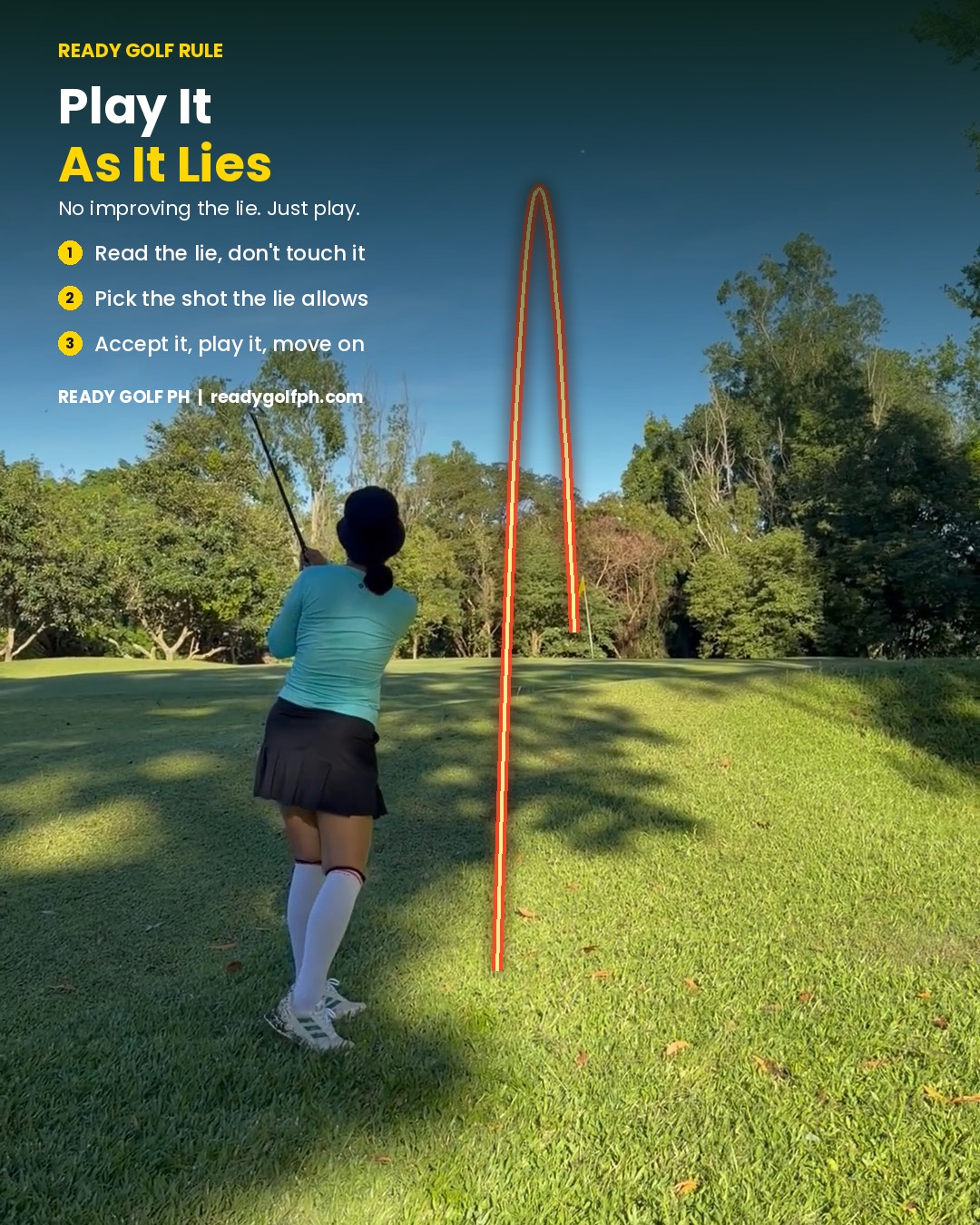
I’m not a pro or an expert. I’m a weekend golfer, and for a long time I didn’t really understand “play it as it lies.” When my ball sat down in the grass, landed next to a tree root or settled in a patch of leaves, I wanted to nudge it, press the grass behind it, or move it “just a little.” I’ve learned that playing the ball as it lies is one of golf’s oldest rules, and it also makes the game simpler and faster.
This is how I try to play it as it lies now, what I’m allowed to do and not do, and how it fits into ready golf.
What You See in My Video
In my video, my ball is sitting down in the grass on the fairway, right at the edge of the tree shade. I zoom in first so you can see the lie: the ball is nestled in the grass, not sitting up nicely. I don’t touch it. I set up, make a smooth swing and pitch it toward the flag, then walk on to my next shot. The red line shows the path of my ball. After that, you’ll see three more of my shots, each played from wherever the ball ended up, in the open, in the shade and among the leaves.
That’s ready golf for me: look at the lie, decide, play, and keep moving.
What “Play It As It Lies” Means
It means I play my ball where it comes to rest, in the condition it’s in. I don’t move it, lift it, or change the ground around it to make my shot easier. The idea is simple: the course is part of the challenge, good bounces and bad ones included.
What I Can’t Do
- Move the ball to a better spot, even a few centimeters, unless a rule allows it.
- Press down the grass behind the ball with my club or my foot.
- Bend or break branches or growing grass to clear my swing.
- Build a stance, like piling up leaves or dirt to stand on.
- Remove sand or loose soil in front of my ball on the fairway or in the rough.
What I Can Do
- Take a fair stance. I can set my feet firmly, even if that bends some grass.
- Remove loose impediments like leaves, twigs and stones, as long as my ball doesn’t move. If it moves, there’s a penalty, so I’m careful near the ball.
- Take free relief when the rules allow it, like from a cart path, ground under repair or standing water. I wrote about some of these in know the rain rules.
- Declare a ball unplayable with a one-stroke penalty when the lie is impossible.
Some courses or groups use “preferred lies” during wet seasons, which allows lifting, cleaning and placing the ball in the fairway. I only do that when the course or my group has agreed on it before we start.
The Mistakes I Made
- Tapping the ball onto a nicer tuft of grass. It felt harmless, but it’s not playing the course.
- Pressing down the grass behind the ball with my club during setup.
- Spending too long looking for a “better” way around a bad lie while my group waited.
- Getting upset about bad luck. A divot or a bare patch isn’t personal. It’s golf.
- Trying a hero shot from a bad lie instead of the safe one.
How I Read the Lie
Before I choose my club, I look at how the ball is sitting. I shared more in read your lie first.
- Sitting up on the grass: I can make a normal swing, and I’m careful not to slide under it.
- Sitting down in the grass, like in my video: I play it a little back in my stance, focus on hitting the ball first, and keep my tempo smooth. The ball may come out lower and run more.
- In the rough: I take a more lofted club and accept a shorter shot.
- On a slope: I adjust my balance first. See find your balance on a slope.
- Next to a tree or a root: safety first. If I could hurt myself or my club, I take the unplayable option or chip out sideways.
Choose the Shot the Lie Allows
The lie decides what’s possible. A tight or buried lie doesn’t allow a high, soft shot. A ball deep in the rough won’t go as far. Instead of fighting it, I choose the shot that gives me the best chance at clean contact, even if it’s not the shot I wanted. When I’m in real trouble, I take my medicine and get back into play.
The Mindset That Helps Me
- The lie is part of the game. Everyone in my group plays the course the same way.
- Look, decide, commit. Once I’ve read the lie and picked my shot, I stop second-guessing.
- Accept the result. Some lies are unlucky. I play the best shot I can and move on. I wrote about this in accepting misses.
- Count it honestly. If I touch or move the ball by accident, I count the penalty. See count every stroke.
How It Helps Me Play Ready Golf
Playing the ball as it lies saves time. I don’t spend minutes trying to make the lie better or debating whether I’m allowed to move the ball. I walk up, look at the lie while others are hitting, choose my club, and play when it’s my turn. Fewer decisions means a faster, calmer round for everyone.
Questions I Had About Playing It As It Lies
Can I move a leaf behind my ball? Yes, leaves are loose impediments, and I can remove them. But if my ball moves while I do it, I add a penalty stroke and put it back.
What if my ball is in a divot? I play it as it lies. There’s no free relief from a divot under the standard rules. I play the ball a little back and hit down on it.
Can I clean my ball in the fairway? Only when preferred lies are in effect, or when a rule lets me lift the ball. Otherwise, I play it as it is.
What if I really can’t play it? I can declare it unplayable for a one-stroke penalty and take relief. It’s often better than two or three wasted swings.
What I’m Taking Away
- Play the ball where it lies, in the condition it’s in.
- Read the lie, don’t improve it.
- Pick the shot the lie allows, not the one I wish I had.
- Accept the lie, play it, and keep moving.
- Every lie teaches me a little more about the course and my game.
What’s the worst lie you’ve had to play? Share it with me in the comments. New to golf? Start here, and see my guide to the pitch shot.
For a new tip from me every day, follow Ready Golf PH on Facebook and visit readygolfph.com for more guides for everyday golfers.