
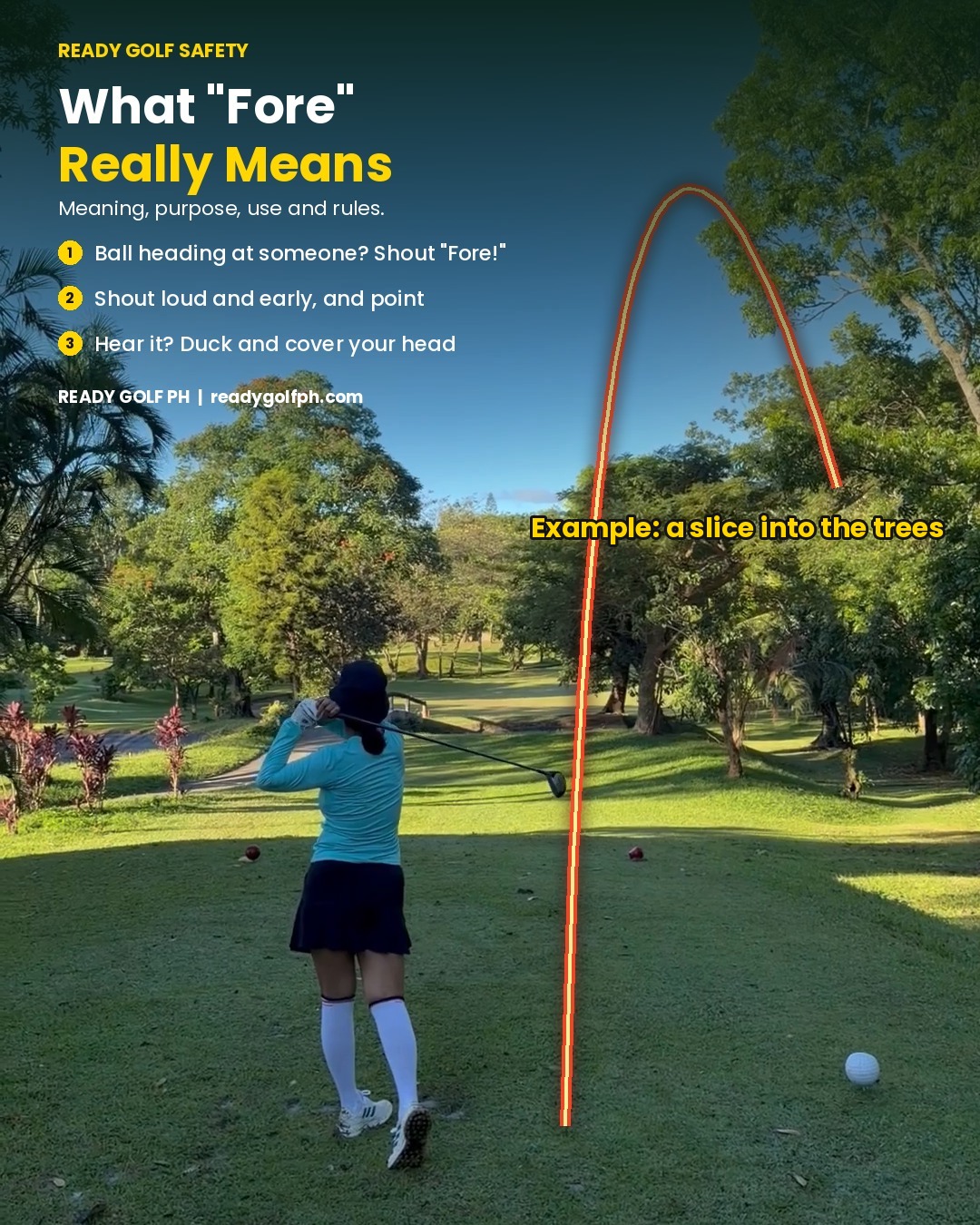
I’m not a pro or an expert. I’m a weekend golfer, and the first time I heard someone shout “Fore!” on the course, I didn’t know what to do. I looked up to see where the shout came from, which is exactly the wrong thing. Later, when my own ball curved toward the next fairway, I froze and said nothing. I’ve learned that “fore” is one of the most important words in golf, and knowing when to say it, and what to do when you hear it, keeps everyone safe.
This is what I’ve learned about “fore”: what it means, why we use it, when to shout it, and the etiquette around it.
What You See in My Video
In my video, I’m on the tee of a tree-lined hole. Trees run along the right side, and another fairway sits just beyond them, where other golfers could be playing. I make my swing, and the red line shows what a slice would look like: the ball starting straight, then curving right into the trees and toward that other fairway. The line is an example, not my actual ball. That kind of miss is exactly when “fore” matters.
Being safe is part of ready golf for me. Playing quickly never means playing carelessly.
What “Fore” Means
“Fore” is a warning. It means: watch out, a ball is coming toward you. It’s shouted when a ball might hit or come close to someone, whether they’re in my group, another group, a caddie, a greenskeeper or someone walking near the course.
Nobody is completely sure where the word comes from. Two common explanations are that it’s short for “forecaddie,” a caddie who used to stand ahead to spot balls, or that it comes from an old word meaning “ahead” or “in front.” Whatever its origin, every golfer understands it.
Why It Matters
A golf ball travels fast and it’s hard. Being hit can cause a serious injury. Shouting “fore” gives people a second or two to protect themselves. That small warning can prevent a big accident.
When I Shout “Fore”
- When my ball is heading toward people, even if I’m not sure it will reach them.
- When my ball goes toward another hole, a cart path, a maintenance area or a house.
- When I can’t see where my ball is going, like over a hill, around a dogleg or into trees, and people could be there.
- When I hit a shot that bounces off a tree or anything else and changes direction.
If in doubt, I shout. An unnecessary “fore” is much better than a missing one.
How I Shout It
- Loud. It has to carry. A soft “fore” doesn’t help anyone.
- Early. As soon as I see the ball going the wrong way, not when it’s about to land.
- More than once if the ball is still traveling toward people.
- Point. I stretch my arm toward where the ball is going. Many golfers point left or right so others know which side it’s on.
- Help my flightmates. If a flightmate doesn’t see their ball or freezes, anyone in the group can shout it.
What I Do When I Hear “Fore”
This is the part that surprised me most.
- Don’t look up to find the ball. That puts my face at risk.
- Duck and cover my head with my arms and hands. If I’m close to a cart or a tree, I move behind it.
- Turn away from the direction of the shout.
- Wait a moment before moving again, until I’m sure the ball has landed.
The Mistakes I Made
- Staying silent when my ball curved toward another hole, because I was embarrassed.
- Shouting too softly or too late.
- Looking up when I heard “fore,” trying to find the ball.
- Hitting before the group ahead was out of range. Now I wait before I swing until they’re clearly beyond my reach.
- Not watching my ball. If I don’t watch where the ball lands, I can’t warn anyone.
Fore and the Rules of Golf
The Rules of Golf expect every player to play in the spirit of the game and to care for the safety of others. Shouting “fore” isn’t a scoring rule. Nobody adds a penalty stroke for it. But it’s the accepted warning everywhere golf is played, and courses expect every player to use it. Shouting “fore” also doesn’t change how my ball is played: I still find it, play it as it lies, or take relief if a rule allows it. If I’m not sure it can be found, I hit a provisional ball.
It’s also good etiquette to apologize to anyone near where my ball landed, and to check that they’re okay.
How It Fits Ready Golf
Ready golf is about being prepared and keeping the round moving. But “ready” always includes safety. I hit when it’s my turn and when it’s safe, never before the group ahead is out of range, and I’m always ready to shout if my ball goes the wrong way. I shared more about this in ready golf on the tee.
Questions I Had About “Fore”
Should I shout fore at the driving range? Usually not, because everyone is hitting in the same direction. But if a ball is heading toward someone walking in the range area, a warning helps.
What if my ball is going toward a house or a road? I shout anyway, in case someone is outside. Then I tell the course staff if I think it hit something.
Is it rude to shout fore at another group? Not at all. It’s the polite and safe thing to do. Not shouting is what’s rude.
What if I’m not sure the ball will reach them? I shout anyway. Better safe than sorry.
What I’m Taking Away
- “Fore” means a ball is coming your way. Watch out.
- Shout it loud, early and more than once if needed, and point.
- If I hear it, I don’t look up. I duck and cover my head.
- I wait until the group ahead is out of range before I hit.
- Every round, I try to be a safer player as well as a faster one.
Have you ever had to shout “fore,” or had to duck from one? Share it with me in the comments. New to golf? Start here, and see my guide to hitting a narrow fairway.
For a new tip from me every day, follow Ready Golf PH on Facebook and visit readygolfph.com for more guides for everyday golfers.