
I’m not a pro or an expert. I’m a weekend golfer, and for a long time my range sessions had no plan. I’d grab whatever club felt right, usually the driver, and hit until the bucket was empty. On the course, I’d stand over a shot with no idea which club to choose. I’ve learned that the driving range is the best place to figure that out, if I practice with a sequence and a purpose.
This is how I try to practice choosing the right club at the range: the order I use my clubs, the drills I do, the goal I set, and how I handle the mindset and emotions that come with it.
What You See in My Video
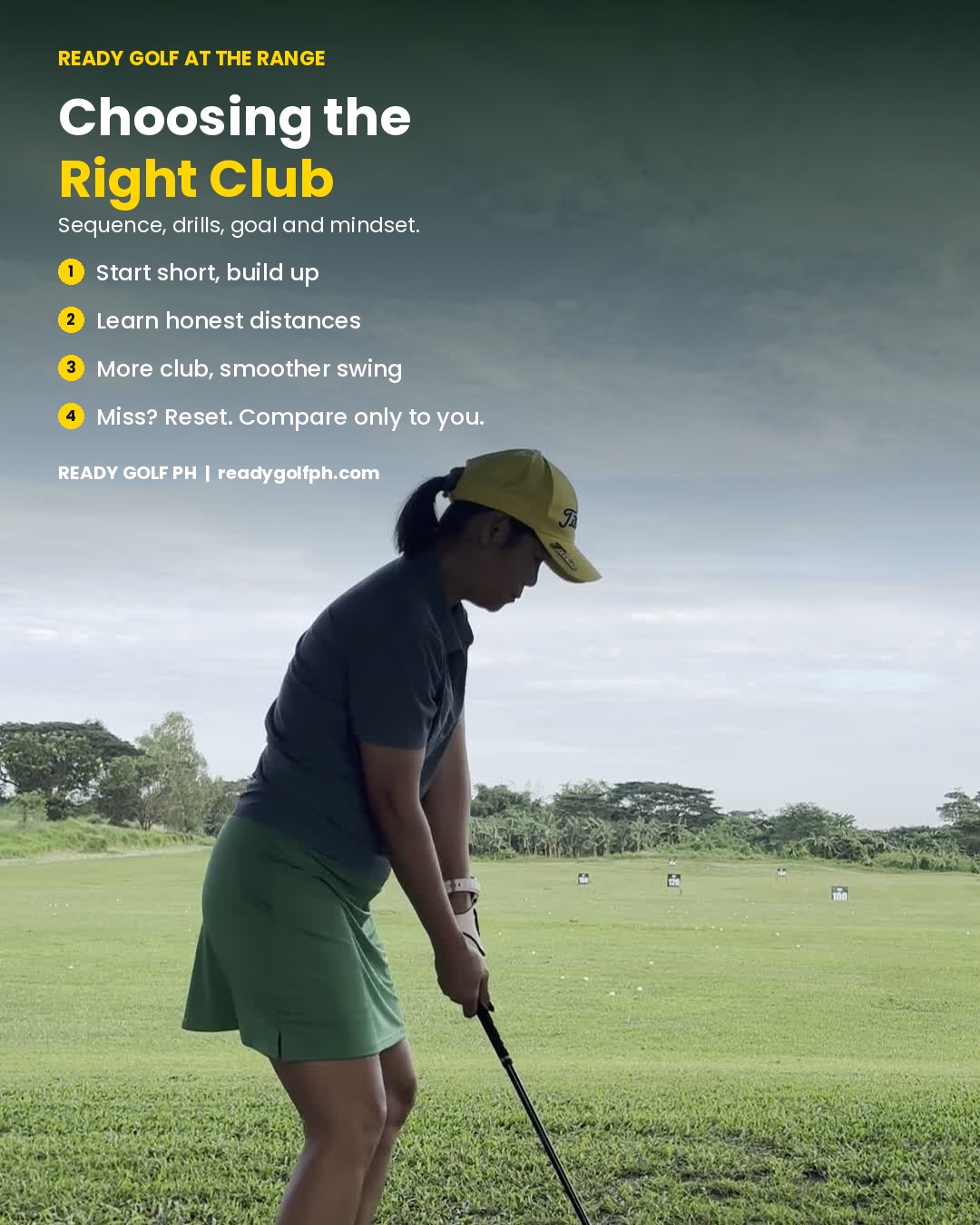
In my video, I’m on a mat at the driving range with an iron. I set up, make my swing, hold my finish and watch the ball. Then I pull another ball over, reset, and go again. Nothing fancy. Just one ball, one target and one club at a time, which is how I try to practice now.
That habit connects directly to ready golf. When I know my clubs from the range, I can choose quickly on the course, and my group doesn’t wait for me.
My Goal at the Range
My goal isn’t to hit every club perfectly. It’s to learn my honest distance with each club, the distance I hit most of the time, not my best shot ever. When I know that number, choosing a club on the course becomes much simpler. Some sessions my distances are all over the place, and that’s okay. Every session gives me a little more information.
The Mistakes I Made With Club Selection
- Starting with the driver. It’s the hardest club to hit, and starting with it made me tense and frustrated within minutes.
- Hitting only my favorite clubs. I’d hit my 7-iron and driver and never touch my hybrid or wedges. Then those were the clubs I didn’t trust on the course.
- Remembering only my best shots. One great 7-iron became “my 7-iron distance.” Most of my shots fell short of it.
- Swinging harder instead of taking more club. When the target felt far, I tried to muscle a short club there.
- Never aiming at anything. Without a target, I had no idea how far each club actually went.
- Changing clubs after every bad shot. I’d blame the club instead of giving it a fair chance.
The Sequence I Use
Following a simple order helps me warm up, build rhythm and learn every club. This is the sequence I try to follow:
- Wedges first. Small, easy swings to warm up and find solid contact.
- Short irons (9, 8). A little longer swing, still smooth.
- Mid irons (7, 6). My “measuring” clubs. I spend the most time here.
- Hybrid or fairway wood. Only after my rhythm feels good.
- Driver. A few balls, not half the bucket.
- Back to a wedge. I finish with short, easy shots so I leave on a good note.
Going from short to long lets my body warm up gradually, and my confidence builds as I go. If I’m short on time, I skip a few clubs but keep the order.
Drills That Help Me Choose the Right Club
1. The range-marker distance drill. Most ranges have markers at set distances, like 50, 100, 150 and 200 yards. I pick one club and hit five balls at one marker. I note roughly where most of them land, not just the best one. Then I move to the next club. Over a few sessions, I build my own distance list.
2. The same target, different clubs drill. I pick one marker, say the 100-yard flag, and hit it with two or three different clubs: a full swing with one, a smooth three-quarter swing with the next one up. It teaches me that there’s often more than one way to reach a target, and that an easy swing with more club usually works better for me.
3. The gap drill. I hit five balls each with two clubs next to each other, like a 7-iron and an 8-iron, and notice the gap between them. If two clubs go almost the same distance, I learn which one I trust more.
4. The “call your club” drill. For the last part of my session, I imagine a hole. I say the distance out loud, choose the club, go through my routine and hit. Then I imagine a new distance and switch clubs. It feels more like the course, where every shot is different. I wrote about this in play a round on the range.
5. Write it down. After the session, I note my rough carry distance for each club on my phone. Even an approximate list helps. Over time, I update it as my swing changes.
Mindset: Choosing for the Target, Not for My Ego
The biggest change for me was mental. I used to choose the club I wanted to hit, not the one the shot needed. Now I try to:
- Trust my honest numbers, not my best day.
- Take more club and swing smoothly when I’m between two clubs.
- Focus on contact, not distance. Solid contact with a shorter club beats a wild swing with a longer one.
- Remember the range isn’t the course. Range balls and mats can fly differently, so my numbers are a guide, not a promise.
This is the same thinking I shared in choosing my club before it’s my turn and choose the right club.
The Emotions That Come With It
The range can bring up a lot of feelings, especially with the longer clubs.
Frustration with long clubs. My driver and hybrid still frustrate me some days. When they do, I go back to a mid-iron for a few balls to find my rhythm again, then try once more. If it’s still not working, I let it go for that session.
Disappointment with distance. When I learned my real distances, they were shorter than I hoped. At first that felt discouraging. Now I see it as freeing: knowing my real numbers means fewer shots end up short in trouble.
Comparing myself to others. There’s always someone in the next bay hitting it farther. I remind myself that their distances don’t help me choose my club. Only mine do.
Wanting to fix everything at once. After a few bad shots, I’m tempted to change my grip, stance and swing all at once. I try to change one thing, or nothing, and simply reset with a breath.
Ending well. I finish with a club I trust, usually a wedge. Leaving on a good shot makes me look forward to the next session.
I wrote more about staying calm in starting at the driving range and accepting misses.
How This Helps Me on the Course
When I know my distances, I choose my club as I walk to my ball. I bring two or three clubs when I’m unsure, so I don’t walk back to the cart. I commit to my choice and swing, instead of standing over the ball wondering. That keeps my group moving and keeps me calmer. It’s one of the simplest ways the range helps me play ready golf.
Questions I Had About Choosing Clubs
How many balls should I hit with each club? For me, five to ten per club is enough to see a pattern. I’d rather hit fewer balls with attention than many without.
Should I practice with every club in my bag? Over a few sessions, yes. I don’t need every club every time, but I make sure the ones I rarely use get some attention.
My distances change from day to day. Is that normal? Yes. Weather, tiredness and range balls all affect distance. I look for my usual range, not an exact number.
What if two clubs go the same distance? That happens to me. I choose the one I hit more solidly and more consistently, and I keep checking the gap in later sessions.
Do I need a launch monitor? Not for me. The range markers and my own notes are enough to start.
What I’m Taking Away
- Start short, build up, and finish with a club I trust.
- Use range markers to learn honest distances, not best-ever ones.
- Practice the same target with different clubs, and call my club like on the course.
- Choose for the target, not for my ego. More club, smoother swing.
- Notice my emotions, reset, and compare only to myself.
- Every range session gives me a little more to trust on the course.
Which club do you find hardest to choose? Share it with me in the comments. New to golf? Start here, and see my guide to par 72 and golf scoring.
For a new tip from me every day, follow Ready Golf PH on Facebook and visit readygolfph.com for more guides for everyday golfers.