
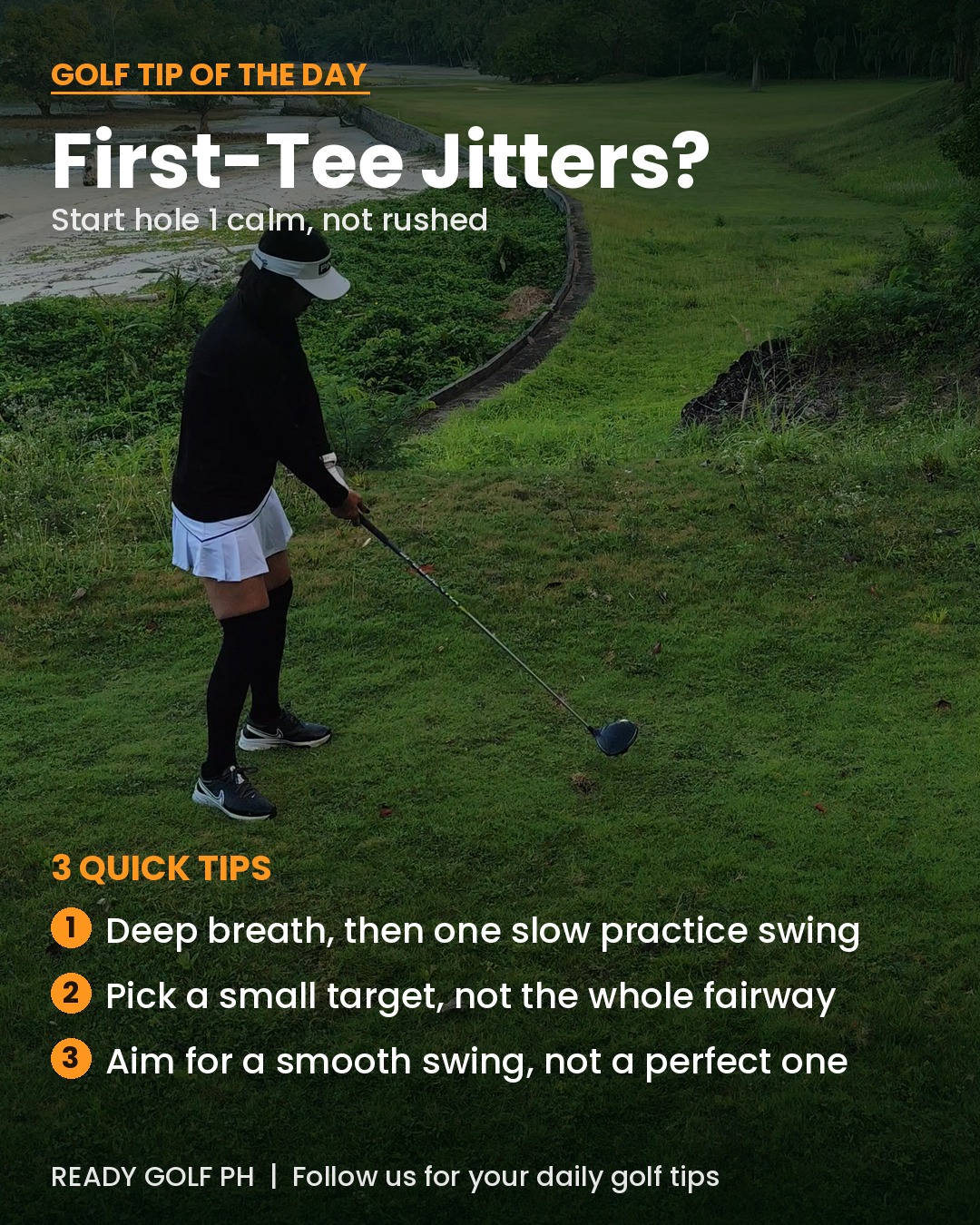
You walk up to the first tee, and suddenly the club feels heavier. Your hands are a little damp. Somebody in the group is watching, maybe a few people from the next group too, and your brain helpfully reminds you of every swing thought you’ve ever read. If this sounds familiar, you’re in very good company. Nearly every golfer, from first-timers to seasoned weekend players, feels something on hole 1.
The photo for today’s tip shows that exact moment: a player standing over the ball on the opening tee, driver soleplated behind it, the fairway bending away toward the water. It’s a beautiful setting, and it’s also where a lot of rounds quietly go wrong before they’ve begun. The good news is that first-tee nerves are very manageable, and you don’t need any fancy technique to handle them.
Why It Matters
The first tee is different from every other shot on the course. You haven’t warmed into the round yet, you often have an audience, and there’s a pull to hit a great drive to “prove” you belong. That pressure changes how you swing. Shoulders tighten, the grip gets squeezed, and the backswing gets short and rushed. The result is usually a pop-up, a slice, or a topped ball that barely leaves the tee box.
Here’s the part that matters for scoring: one poor first drive does not just cost you a stroke. It can set the mood for the next few holes. Golfers who start tense often stay tense, and they spend holes 2 and 3 trying to win back a mistake that was really about nerves.
Beginners feel this the most, but it isn’t about skill. It’s about routine. A player with a simple, repeatable plan for the first tee will almost always swing better than a stronger player who just walks up and hopes.
The Fix
Breathe before you do anything else. Take one slow breath in through your nose and let it out longer than you breathed in. It sounds small, but a long exhale settles your heart rate and loosens your grip pressure. Do this behind the ball, before you step in.
Take one slow practice swing. Not three rushed ones. One smooth swing, at about 70 percent effort, feeling the club swing rather than hit. This tells your body what tempo you want and gives your mind something simple to do.
Pick a small target. “The fairway” is a big, vague thing, and a vague target invites a tense swing. Choose something specific: a tree on the far side, a patch of darker grass, a marker in the distance. Aim at that small spot and trust that the fairway will take care of itself.
Aim for a smooth swing, not a perfect one. On the first tee, the goal is a swing you’d be comfortable repeating eighteen times. Think “smooth and balanced,” hold your finish, and let the ball go wherever it goes. A balanced finish is a good sign that your tempo was right.
Play the club you trust. If the driver feels risky today, a 3-wood or a hybrid that finds the fairway is a perfectly good way to open a hole. Nobody on the tee is keeping score of your club choice. They’re mostly thinking about their own drive.
Drill to Practice
You can rehearse the first tee on the range so it feels familiar when it counts. Next time you practice, set a “first tee” routine and use it for the very first ball you hit, before you warm up. Breathe, one practice swing, pick a small target, swing smooth. The first ball is the one that counts, so treat it that way.
Then take it a step further. Hit five balls in a row using exactly the same routine, each one at a fresh small target. After each, hold your finish for two seconds and check your balance. By the fifth ball, the routine should feel automatic, and that’s the point. When the routine is automatic, there’s less room left for nerves.
If you have a friend handy, ask them to stand a few steps behind you as you hit. Learning to swing with someone watching is half of first-tee confidence.
Common Mistakes
Rushing up to the ball. Nerves make us want to get it over with. Slow down your walk, your breath, and your setup. The group will wait.
Swinging harder to impress. Extra effort almost never turns into extra distance. It turns into a tighter grip, a faster tempo, and a wider miss.
Aiming at the whole fairway. A big target gives your mind nothing to lock onto. Pick something small and specific.
Skipping the warm-up. If you can, hit a few balls or at least do some easy stretches and practice swings before you reach the tee. Stepping up cold makes every nerve louder.
Dwelling on the audience. Most people watching are thinking about their own turn. Focus on your routine and ignore the rest.
FAQ
Why do I get so nervous on the first tee?
It’s the combination of a cold start, an audience, and the pressure to hit a good opening shot. It’s normal, and it usually fades after the first few holes.
Should I use my driver on the first tee?
Only if you trust it. If a fairway wood or hybrid gives you more confidence, use it. Starting in the fairway is worth more than a few extra yards.
How many practice swings should I take?
One or two smooth ones is plenty. More than that tends to build nerves rather than calm them.
What if my first drive goes badly?
Take a breath, laugh a little, and play the next shot. One bad drive is one stroke, not your whole round.
Can breathing really help my swing?
Yes. A slow exhale lowers tension in your shoulders and hands, which helps you swing with better tempo.
Key Takeaways
The first tee doesn’t need a perfect swing, it needs a calm routine. Breathe out slowly, take one smooth practice swing, pick a small target, and swing for balance rather than perfection. Choose the club you trust, and let the first drive be just another shot. Start the round calm, and the rest of the holes get a lot easier.
Follow us for your daily golf tips!
#ReadyGolfPH #GolfTips #FirstTee #BeginnerGolfer #GolfPhilippines #GolfForBeginners