
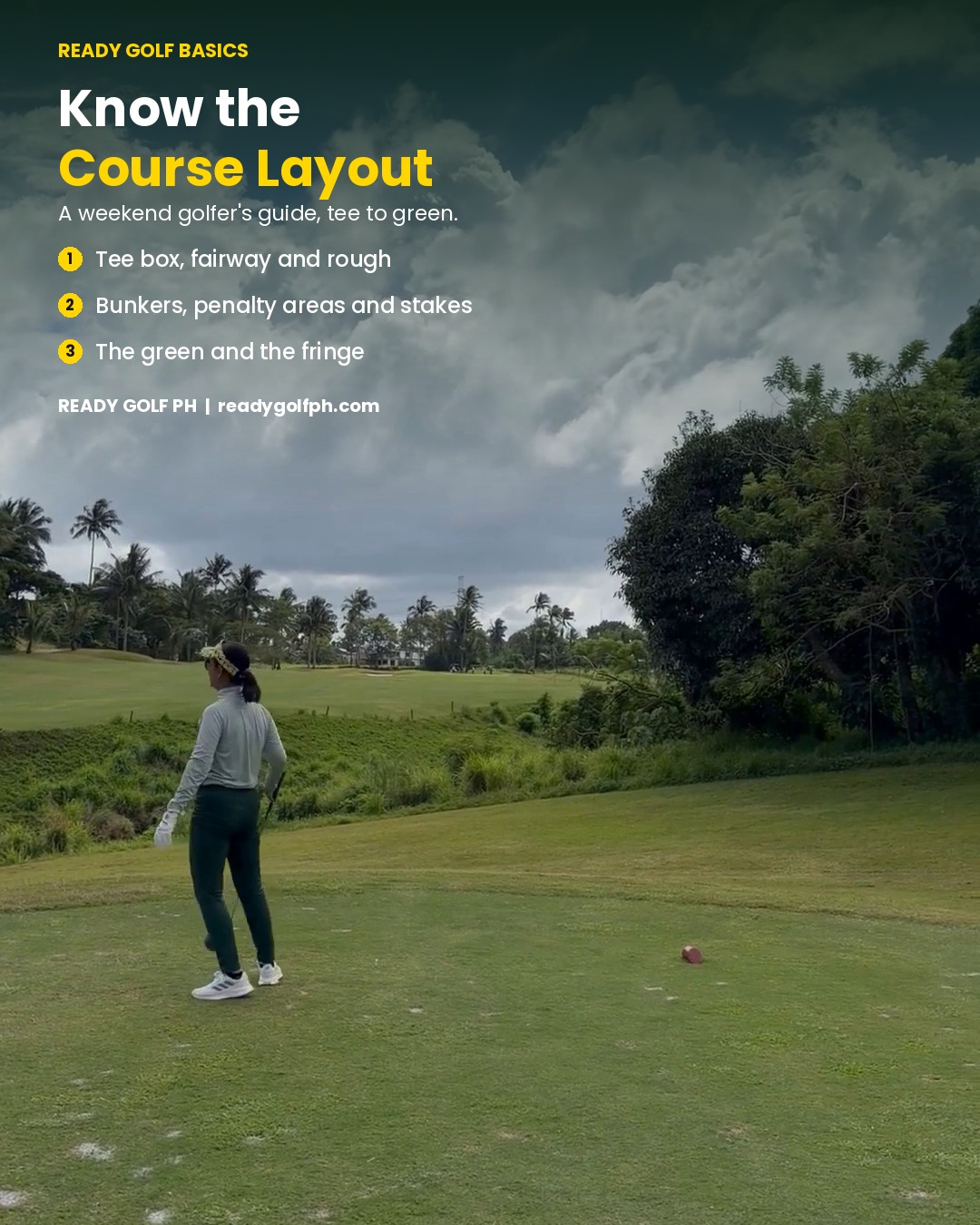
I’m not a pro or an expert. I’m a weekend golfer, and when I started playing, I didn’t really know the names of the different parts of a golf course. I’d hear “you’re on the fringe,” “that’s in the penalty area,” or “take relief from the cart path,” and I’d nod without being sure what they meant. I’ve learned that knowing the course layout makes golf easier, safer and faster. When I know where I am, I know what I’m allowed to do and which shot makes sense.
This is my guide to the layout of a golf course, from the tee box to the green, and how knowing it helps me play ready golf.
What You See in My Video
My video follows a hole from start to finish using my own shots and photos.
- The tee box: I tee up behind the markers and hit my tee shot down the hole.
- The fairway: I walk to my ball on the short grass and hit my next shot toward the green.
- The rough: I’m standing in front of the longer grass and plants beside the fairway.
- The trees: I’m near a palm tree at the edge of the fairway and play my ball back into the open.
- The bunker: I’m in the sand, getting the ball out. (The other person in the photos is blurred.)
- Hazards and stakes: A simple guide to the red, yellow and white stakes.
- The green: I’m putting toward the flag, reading my line and finishing the hole.
That’s ready golf for me: know where you are, decide quickly, play, and keep moving.
Why Knowing the Course Layout Matters
Every part of the course has its own rules and its own best shot. When I know the layout:
- I make better decisions. I know when to go for it and when to play safe.
- I follow the rules. What I can do in a bunker is different from what I can do in the fairway or on the green.
- I play faster. I don’t stop to ask what something means or where I’m allowed to drop.
- I stay safer. I know where other holes, cart paths and walkways are.
A Hole From Start to Finish
Most golf courses have 18 holes. Each hole has a par, the number of strokes a good player is expected to take:
- Par 3: short holes. I try to reach the green with my tee shot.
- Par 4: medium holes. A tee shot, a shot to the green, then putts.
- Par 5: long holes. Usually three shots to reach the green.
I wrote more about par in my post on par 72 and scoring. The hole number, par and distance are on the scorecard and often on a sign at the tee.
The Tee Box (Teeing Area)
The tee box is where every hole starts. It’s a flat, mowed area with two tee markers.
What I’ve learned:
- Tee up between the markers. The ball must be between the two markers and no more than two club lengths behind them. Never in front of the markers.
- Pick the right tees. Most courses have several sets of tees, often marked by color (for example black, blue, white, red). The front tees make the hole shorter. I play the tees that match my game, not my ego.
- I can tee up the ball only on the tee box. Once I hit, the ball is in play wherever it lands.
- Stand out of the way. While someone else is hitting, I stand to the side and behind them, quiet and still.
Ready golf on the tee: I have my club, ball and tee ready when it’s my turn. If the group agrees, whoever is ready can hit first. When I’m done, I pick up my tee and walk off. More in ready golf on the tee.
The Fairway
The fairway is the short, mowed grass between the tee and the green. It’s the target for most tee shots, and the best place to hit from because the ball sits up nicely.
What I’ve learned:
- Aim for the widest part of the fairway, not right next to the trees or the hazards. See my guide to hitting a narrow fairway.
- Fix my divots. If I take a chunk of grass, I replace it or fill it with sand or seed mix if the cart has it.
- Play it as it lies. No moving the ball to a better spot unless preferred lies are in effect. I wrote about this in play it as it lies.
Some holes have a dogleg, which means the fairway bends left or right. From the tee, I aim for the corner, not straight through the trees.
The First Cut and the Rough
Next to the fairway is the first cut, a narrow band of slightly longer grass. Beyond it is the rough, where the grass is longer and thicker.
What I’ve learned:
- The ball sits down. It’s harder to make clean contact, and the ball usually flies shorter.
- Take more loft. A lofted club helps the ball get out of the grass. I read my lie first before choosing.
- Aim for the safe target. From the rough, getting back to the fairway is often smarter than going for the green.
- Watch where it lands. Balls can disappear in long grass. I watch where the ball lands and pick a landmark.
Trees and the Edges of the Course
Many holes are lined with trees, bushes and plants. They’re part of the course, and I play them as they are.
What I’ve learned:
- Find the clearest gap, even if it means hitting sideways or backward.
- Don’t break or bend branches to make my swing easier.
- Safety first. If a shot could bounce back at me or toward people, I choose another one.
- Take my medicine. One safe shot back to the fairway is better than three shots into the trees. See take your medicine.
- If the ball goes toward another hole, I shout “fore.” More in what “fore” really means.
Bunkers (Sand Traps)
A bunker is a hollow area filled with sand. Fairway bunkers sit beside or across the fairway. Greenside bunkers guard the green.
What I’ve learned:
- Don’t touch the sand with my club before my swing, not in a practice swing and not when I set up. That’s a two-stroke penalty in stroke play.
- I can remove loose impediments like leaves and twigs, as long as my ball doesn’t move.
- Get out first. My goal is to get the ball out of the sand and onto the grass. I’m not trying to be a hero.
- Enter and leave from the low side so I don’t damage the edge.
- Rake my footprints and marks before I leave, and put the rake back where the course wants it.
Ready golf in a bunker: I bring the right club and the rake with me so I don’t walk back and forth.
Hazards, Penalty Areas and Stakes
Water and some areas of the course are marked as penalty areas. They’re shown with red or yellow stakes or lines. Out of bounds is shown with white stakes.
- Yellow stakes or lines (penalty area): I can play the ball as it lies, or take relief with one penalty stroke, either behind the penalty area on the line from the hole through where my ball crossed in, or from where I last hit.
- Red stakes or lines (penalty area): Same options as yellow, plus a lateral option: I can drop within two club lengths of where my ball last crossed into the area, no closer to the hole, with one penalty stroke.
- White stakes (out of bounds): My ball is off the course. I replay from where I last hit, with one penalty stroke. If I’m not sure my ball is in bounds, I hit a provisional ball right away.
Other markings I’ve seen:
- Ground under repair: often marked with white lines or blue stakes. Free relief.
- Cart paths and sprinkler heads: immovable obstructions, with free relief if they get in my stance or swing.
- Yardage markers: posts, plates or sprinkler heads that show the distance to the green. Colors vary by course, so I check the scorecard.
If you play in the rainy season, my guide to the rain rules covers standing water and other relief.
The Green
The green is where the hole is. It has the shortest, smoothest grass on the course.
What I’ve learned:
- The hole (cup) is marked by the flagstick. Some courses use flag colors to show where the hole is on the green, but it varies.
- I can leave the flagstick in while I putt, or have it taken out. I just decide before my turn.
- Repair my ball mark, and any others I see. I use a divot tool and gently push the grass back.
- Don’t drag my feet or lean on my putter on the green.
- Mark my ball with a coin or marker if it’s in someone’s line, and don’t step on other players’ lines.
The Fringe (Collar or Apron)
Around the green is the fringe, also called the collar or apron. The grass is a little longer than the green but shorter than the fairway.
- It’s not part of the green. I can’t mark and lift my ball there.
- I can putt from the fringe. A putt is often easier than a chip.
How Knowing the Layout Helps Me Play Ready Golf
- On the tee: I know which tees to play and where the safe landing area is.
- In the fairway: I choose my club while others are hitting.
- In the rough or trees: I know my options right away and pick the safe shot.
- At a penalty area: I know the colors and my relief options without a long discussion.
- On the green: I read my putt while others are putting, and we leave the green as soon as we’re done. Scores are written at the next tee. More in ready golf on the green.
The Mistakes I Made
- Teeing up in front of the markers without noticing.
- Grounding my club in the bunker during setup.
- Not knowing what red stakes meant, and wasting time debating where to drop.
- Walking across other players’ putting lines on the green.
- Forgetting to rake the bunker after my shot.
- Trying hero shots from the trees instead of getting back to the fairway.
Questions I Had About the Course Layout
What’s the difference between a hazard and a penalty area?
The current Rules of Golf use “penalty area” for water and similar areas marked red or yellow. Many golfers still say “hazard.” Bunkers are a separate area with their own rules.
Can I ground my club in a penalty area?
Yes. Under the current rules, I can touch the ground or water in a penalty area. In a bunker, I can’t touch the sand before my swing.
Is the fringe part of the green?
No. I can’t mark and lift my ball on the fringe, but I can putt from there.
What if my ball lands on a cart path?
I can take free relief: find the nearest point where the path doesn’t get in my way, then drop within one club length, no closer to the hole.
What do the colored tees mean?
They show different starting points. The farther back, the longer the hole. I pick the tees that match my distance.
What I’m Taking Away
- Every hole goes from the tee box, to the fairway, to the green.
- The rough, trees and bunkers are part of the course. Play them smart.
- Red and yellow mean penalty areas. White means out of bounds.
- Knowing where I am helps me choose my shot and play faster.
- Each round, I learn a little more about the course and my game.
Which part of the course do you find hardest to play? Share it with me in the comments. New to golf? Start here, and see my guide to the pitch shot.
For a new tip from me every day, follow Ready Golf PH on Facebook and visit readygolfph.com for more guides for everyday golfers.