
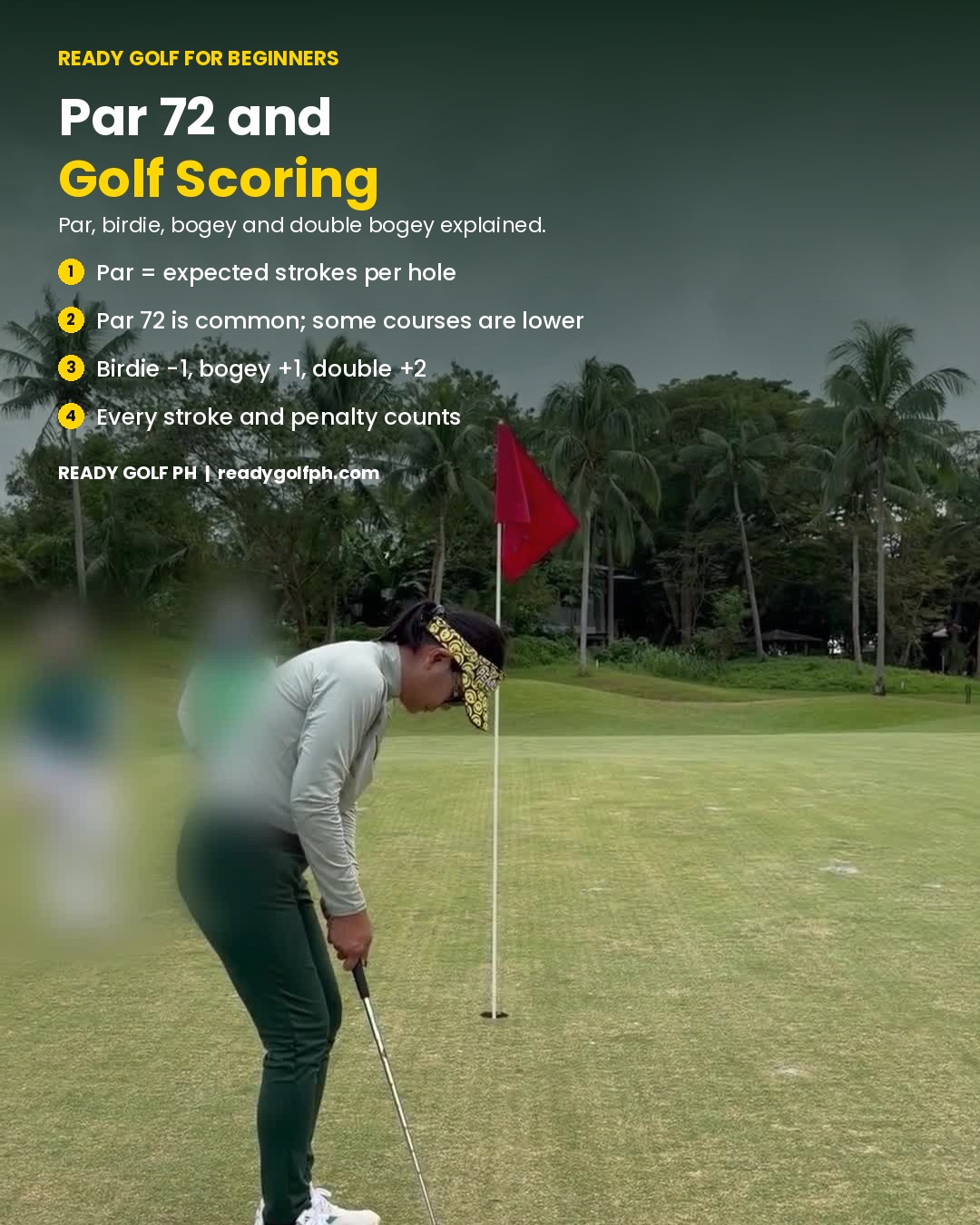
I’m not a pro or an expert, and when I started playing, golf scoring confused me. People talked about birdies and bogeys, a “par 72” course, and handicaps, and I nodded along without really understanding. If you’re new to golf, this is the simple guide I wish I had: what par means, how a par 72 course works, and what all those scoring words mean.
Knowing how scoring works also helps me play ready golf. When I understand my score, I set realistic goals, keep my card quickly, and don’t slow down my group trying to figure things out.
What You See in My Video
In my video, I’m on the green with a short putt beside the flag. I make a smooth stroke, and the ball drops in. That little putt counts as one stroke, exactly like a long drive. That was one of the first scoring lessons I had to learn.
What “Par” Means
Par is the number of strokes a skilled golfer is expected to need to finish a hole. It’s mostly based on the length of the hole:
- Par 3: a short hole. The idea is one shot to reach the green and two putts.
- Par 4: a medium hole. Two shots to reach the green and two putts.
- Par 5: a long hole. Three shots to reach the green and two putts.
Reaching the green in par minus two strokes is called hitting the green “in regulation.” For a beginner like me, that’s a nice bonus, not an expectation.
What a Par 72 Course Is
Add up the par of all 18 holes, and you get the course par. Par 72 is the most common for an 18-hole course, but it isn’t the only one. Some courses have a lower par, like 70 or 71, and shorter “executive” courses have even lower pars because they have more short holes.
The mix of par 3s, 4s and 5s also depends on the course. One common example of a par 72 layout is:
- 4 par-3 holes (4 × 3 = 12)
- 10 par-4 holes (10 × 4 = 40)
- 4 par-5 holes (4 × 5 = 20)
12 + 40 + 20 = 72. Another par 72 course might have a different mix, like more par 5s and more par 3s. The scorecard always shows the par for each hole, so I check it before I tee off. The front nine and back nine each usually have their own par too, often 36 each on a par 72 course.
A score of 72 on a par 72 course is called shooting “even par.” That’s an excellent score. Most weekend golfers, including me, score well above that, and that’s perfectly fine.
The Scoring Words, Explained
These terms describe your score on a single hole compared to par:
| Term | Strokes compared to par | On a par 4, that’s |
|---|---|---|
| Albatross (double eagle) | 3 under par | 1 |
| Eagle | 2 under par | 2 |
| Birdie | 1 under par | 3 |
| Par | Equal to par | 4 |
| Bogey | 1 over par | 5 |
| Double bogey | 2 over par | 6 |
| Triple bogey | 3 over par | 7 |
A hole-in-one (or ace) is getting the ball in the hole with your first shot, usually on a par 3. On a par 3, that’s also an eagle.
When people say they “shot 90,” they mean 90 total strokes for 18 holes. On a par 72 course, that’s 18 over par, about one bogey per hole. Golfers call a player who averages around a bogey per hole a “bogey golfer.” For many beginners, that’s a great goal to work toward.
Counting Your Strokes
Your score on a hole is every stroke you make, plus any penalty strokes. These all count:
- Every swing at the ball, including a complete miss (a “whiff”)
- Every putt, even a tiny tap-in
- Penalty strokes, such as hitting into a penalty area or losing a ball
Practice swings don’t count, as long as I’m not trying to hit the ball. I wrote more about honest scoring in count every stroke.
Reading a Scorecard
At first, the scorecard looked like a spreadsheet to me. Here’s what the main rows mean:
- Hole: 1 to 18.
- Yardage: the length of each hole, often in several rows by tee color. Beginners usually play from the forward tees.
- Par: the par for each hole.
- Handicap or Index (HCP/SI): ranks the holes from hardest (1) to easiest (18). It’s used to decide where handicap strokes are given.
- Out / In / Total: the front nine total, the back nine total and the 18-hole total.
I write my score for each hole right after I finish it, usually while walking to the next tee, so I don’t forget and I don’t hold anyone up.
Gross Score, Net Score and Handicap
- Gross score: my actual number of strokes.
- Handicap: a number that shows roughly how many strokes above par a golfer usually plays. It lets golfers of different levels play fairly against each other.
- Net score: my gross score minus my handicap strokes.
As a beginner, I didn’t need a handicap right away. I just focused on counting honestly and seeing my scores slowly come down over time.
Stroke Play and Match Play
- Stroke play: I count every stroke for the whole round. The lowest total wins.
- Match play: each hole is its own little contest. Whoever wins the most holes wins the match.
Most casual rounds and beginner events use stroke play.
The Mistakes I Made With Scoring
- Forgetting strokes. On messy holes, I’d lose count. Now I count as I go.
- Not adding penalty strokes. I didn’t always know when a penalty applied. I asked, and I learned.
- Comparing myself to par on every hole. I’d feel bad about every bogey. Now I see a bogey as a decent score for me.
- Taking forever on a hard hole. I’d keep hacking away while my group waited.
- Mixing up the terms. Birdie, bogey, eagle. I had to look them up more than once before they stuck.
What I Try to Do Now
I set my own par. On some holes, especially long ones, my goal is a bogey, not a par. That one change made my rounds much calmer, because now I play with a goal I can actually reach on each hole. Some holes are still really hard, and I go over my goal. But every round teaches me something about the course and my game.
When a hole is going badly in a casual round, I keep the pace in mind. Some groups agree on a maximum score per hole, so a player picks up after reaching it and moves on. For handicap purposes, the World Handicap System also caps each hole at a “net double bogey.” In competitions, though, every stroke must be played and counted. If I’m not sure which applies, I ask my group before we start.
I also try to aim for two putts on every green and finish every putt, because short putts are where many of my strokes used to slip away.
Questions I Had About Scoring
Is shooting over 100 okay for a beginner? Yes. Many beginners score over 100 in their first rounds. I focus on improving a little each time, not on par.
Do I count a ball that falls off the tee? If it falls off the tee before I swing, no. I just tee it up again. If I swing and make contact, or swing to hit it and miss, it counts.
What’s a good first goal? Breaking 120, then 110, then 100. Or simply counting every stroke honestly for a whole round. That’s a real achievement.
Do I need to know all the rules before I play? No. Learn the basics, ask your flightmates when unsure, and keep learning. Most golfers are happy to help a beginner. If you’re nervous about your first round, read first-tee jitters.
What I’m Taking Away
- Par is the expected number of strokes for a hole.
- Par 72 is the most common course par, but some courses have a lower par, and the mix of par 3s, 4s and 5s varies.
- Birdie is one under, bogey is one over, double bogey is two over.
- Every stroke and penalty counts.
- Setting my own par for each hole keeps me calm and keeps my group moving.
- Every round teaches me something new.
What’s your best score on a single hole so far? Share it with me in the comments. New to golf? Start here, and see my guide to starting at the driving range.
For a new tip from me every day, follow Ready Golf PH on Facebook and visit readygolfph.com for more guides for everyday golfers.