
I’m not a pro or an expert. I’m a weekend golfer who still remembers how confusing my first sessions at the driving range felt. I didn’t know where to stand, what to work on, or why the ball went everywhere except where I aimed. If you’re just starting to learn golf and spending your first hours hitting balls at the range, this is the guide I wish someone had given me.
Ready golf, for me, starts long before the first tee. It starts at the range, where I build the habits that help me play steadily and calmly later on the course.
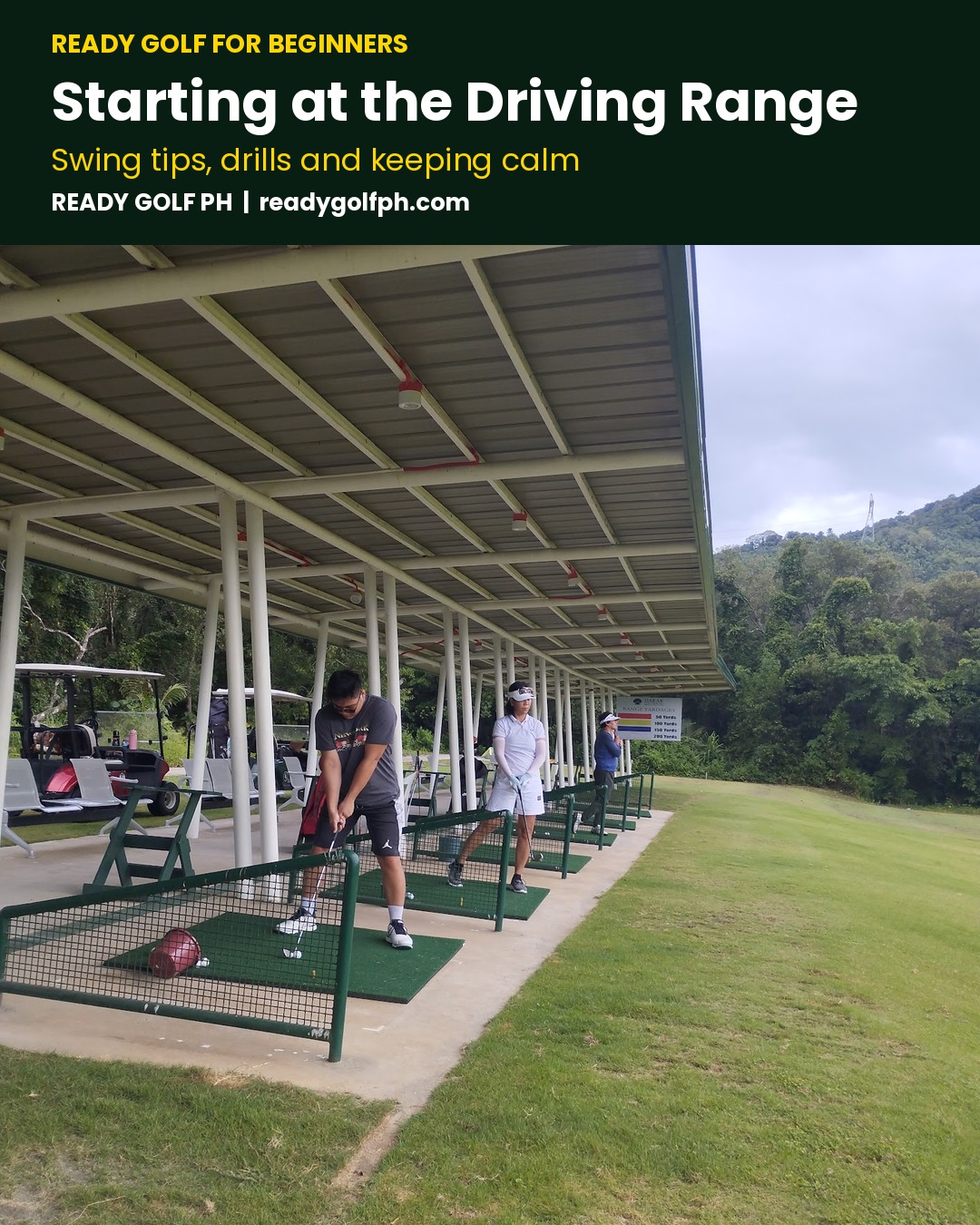
What You See in My Photo

In my photo, I’m in one of the bays at the driving range, club in hand, getting ready to hit. My son is hitting in the bay in front of me, and my partner is practicing at the far end. Going to the range together makes practice more fun, and we cheer each other on, even on the bad shots. Behind us is a sign with the range distances: 50, 100, 150 and 200 yards. Those markers are some of the best teachers at the range, and I’ll explain why below.
My Goal for Every Range Session
My goal at the range isn’t to hit every ball well. It’s to leave a little better than when I arrived, with one thing I understand more clearly. Some sessions go nicely. Others feel like I’ve forgotten everything. Both kinds teach me something, as long as I practice with a purpose and stay patient with myself.
The Mistakes I Made When I Started
- Hitting ball after ball as fast as I could. I thought more balls meant more progress. It mostly meant more tired arms and more bad habits.
- Starting with the driver. It’s the hardest club to hit, and starting with it made me frustrated within minutes.
- Swinging as hard as I could. I wanted distance. I got sore wrists and balls going left and right.
- Not aiming at anything. I just hit “out there,” so I had no idea if a shot was good or not.
- Changing something after every bad shot. One tip, then another, then another. By the end, I didn’t know what I was working on.
- Getting upset at every miss. My mood went up and down with every ball, and the tension made my swing worse.
Before You Swing: Set Up Well
Most of my early problems started before I moved the club. A good setup makes a decent swing much more likely.
Grip. Hold the club mostly in your fingers, not deep in your palms. Grip pressure should be light, firm enough to control the club but not squeezing. When I look down, I see about two knuckles on my lead hand. If your grip feels strange at first, that’s normal. A coach can check it in a few minutes, and it’s worth asking.
Stance. For a mid-iron like a 7-iron, I stand with my feet about shoulder-width apart. A little narrower for short irons and wedges, a little wider for longer clubs.
Posture. I bend forward from my hips, not my waist, with a slight flex in my knees. My arms hang down naturally. I shouldn’t feel like I’m reaching for the ball or crowding it.
Ball position. With a 7-iron, I put the ball around the middle of my stance. Wedges go slightly back of center, and the driver goes forward, near the inside of my front heel.
Alignment. I pick a target first, then aim the clubface at it, then set my feet, hips and shoulders parallel to that line. At the range, I lay a spare club on the mat or ground along my feet to check. My alignment drifts more than I expect.
I wrote more about setup in golf setup fundamentals and know your ball position.
What I Try to Do With My Swing
I’m not a swing coach, so I keep it simple. These are the ideas that helped me most as a beginner.
Start small. Before full swings, I hit small shots: hip-high back, hip-high through. It’s easier to make solid contact with a smaller swing, and solid contact builds confidence.
Smooth, not hard. I try to swing at a pace I could repeat ten times in a row. When I swing hard, my balance and contact fall apart. A smoother swing often goes just as far, because I hit the center of the club.
Turn, don’t just lift. I try to turn my shoulders and hips back, not just lift my arms. Then I turn through to face the target.
Ball first, then grass. With irons, the club should hit the ball first and then brush the grass or mat after it. I don’t try to scoop the ball into the air. The loft on the club does that job. I shared more in ball first, then grass.
Hold your finish. After every swing, I try to finish facing the target with my weight on my front foot and hold it for a few seconds. If I can’t hold it, something in my swing was off. See hold your finish.
One thing at a time. I pick one swing thought per session, like “smooth tempo” or “hold my finish,” and stick with it, even when a shot goes badly.
Drills I Do at the Range
Drills give my practice a purpose. These are simple enough for beginners and don’t need special equipment.
1. The half-swing drill. With a 7-iron or a wedge, I swing back until my lead arm is about parallel to the ground, then through to the same height on the other side. I hit 10 balls this way, focusing only on solid contact. When most of them feel clean, I go a little bigger.
2. The alignment-club drill. I lay one club on the ground pointing at my target, just outside the ball, and another along my toes. Every few shots, I step back and check that both still point where I think they do.
3. The feet-together drill. I hit a few easy shots with my feet almost touching. It forces me to swing smoothly and stay balanced. If I swing too hard, I’ll feel it right away.
4. The pause-at-the-top drill. I swing to the top, pause for one count, then swing through. It teaches me not to rush from the top. More in the pause-at-the-top drill.
5. The range-marker drill. This is where those distance signs help. I pick one marker, like the 100-yard flag, and hit five balls at it with one club. Then I note roughly where they landed. Over time, I learn how far I really hit each club, which helps me choose clubs on the course.
6. The one-ball, one-routine drill. For the last part of my session, I treat every ball like a shot on the course. I step behind the ball, pick a target, take one practice swing, set up and hit. No raking the next ball over right away. More in play a round on the range.
Managing My Emotions on the Range
This is the part nobody told me about, and it may be the most important. At the range, I see the result of every single shot. When I’m new, many of those results are not pretty. Here’s what helps me stay calm and keep learning.
Expect misses. Even good golfers miss shots on the range. As a beginner, I expected to miss a lot. When I accepted that, each miss stopped feeling like a disaster.
Notice, don’t judge. After a bad shot, I try to notice what happened, like “it went right” or “I hit behind it,” instead of calling myself names. Noticing helps me learn. Judging only makes me tense.
Use a short reset. After a frustrating shot, I take a breath, step back, and look at my target again before the next ball. It takes ten seconds and keeps me from hitting angry.
Count good contact, not perfect shots. I keep a simple count of shots that felt solid. If I get more than last time, that’s progress, even if they didn’t all go straight.
Don’t compare yourself to the next bay. There’s always someone hitting it farther. They may have played for years. I compare myself only to my own last session.
Stop before you’re tired. When I’m tired or frustrated, my swing gets worse and practice turns into bad habits. I’d rather hit 50 balls with attention than 150 without it.
End on a good one. I like to finish my session with a few easy wedge shots that I can hit well. Leaving on a good shot makes me look forward to the next session.
I wrote more about this in mistakes are part of golf and one bad shot.
Range Habits That Lead to Ready Golf
The habits I build at the range follow me onto the course.
- Stay in your own bay and never walk in front of the hitting line.
- Give the person next to you space, and don’t stand behind someone who’s swinging.
- Keep your routine short at the range, so it stays short on the course.
- Pick a target for every shot, the same way I will on the course.
- Practice your short game too. Chipping and putting save the most strokes for beginners, and they help keep my pace on the course.
That’s what ready golf means to me: being prepared, so when it’s my turn, I can take my time on the shot without anyone waiting.
A Simple First Session Plan
If you’re not sure where to start, this is roughly what I’d do with a small bucket of about 50 balls:
- Warm up (5 balls). Stretch a little, then hit easy half swings with a wedge. See warm up before you play.
- Half swings (10 balls). 7-iron or wedge, focus on solid contact.
- Full swings with a mid-iron (15 balls). One swing thought, a target for every shot, hold your finish.
- Range-marker drill (10 balls). Pick a flag and learn your distance.
- One-ball routine (5 balls). Treat each like a shot on the course.
- Finish (5 balls). Easy wedge shots, ending on a good one.
Then, if there’s a practice green, spend some time putting.
Questions I Had as a Beginner
Which club should I start with? A 7-iron or a pitching wedge. They’re easier to control than the driver or long irons.
How often should I go to the range? For me, short, regular sessions help more than one long session. Even once or twice a week, with a plan, makes a difference.
Should I take lessons? If you can, yes. Even one or two lessons early on helped me avoid habits that are hard to undo later. A second set of eyes sees things I can’t feel.
How do I know I’m improving? Not every session will feel better. I look at small things: more solid contact, a steadier finish, fewer wild misses. Those add up.
When am I ready for the course? When I can make contact most of the time and know basic etiquette. I don’t need to be good. Many beginners start with a few holes or a short course. If you’re nervous, read first-tee jitters.
What I’m Taking Away
- Set up well before worrying about the swing.
- Start small, swing smooth and hold your finish.
- Use simple drills so every ball has a purpose.
- Expect misses, notice instead of judge, and reset.
- Compare yourself only to your last session.
- Every range session teaches me something, even the frustrating ones.
Are you just starting to learn golf? Tell me what you find hardest at the range. I’d love to hear from you. New to golf? Start here.
For a new tip from me every day, follow Ready Golf PH on Facebook and visit readygolfph.com for more guides for everyday golfers.