
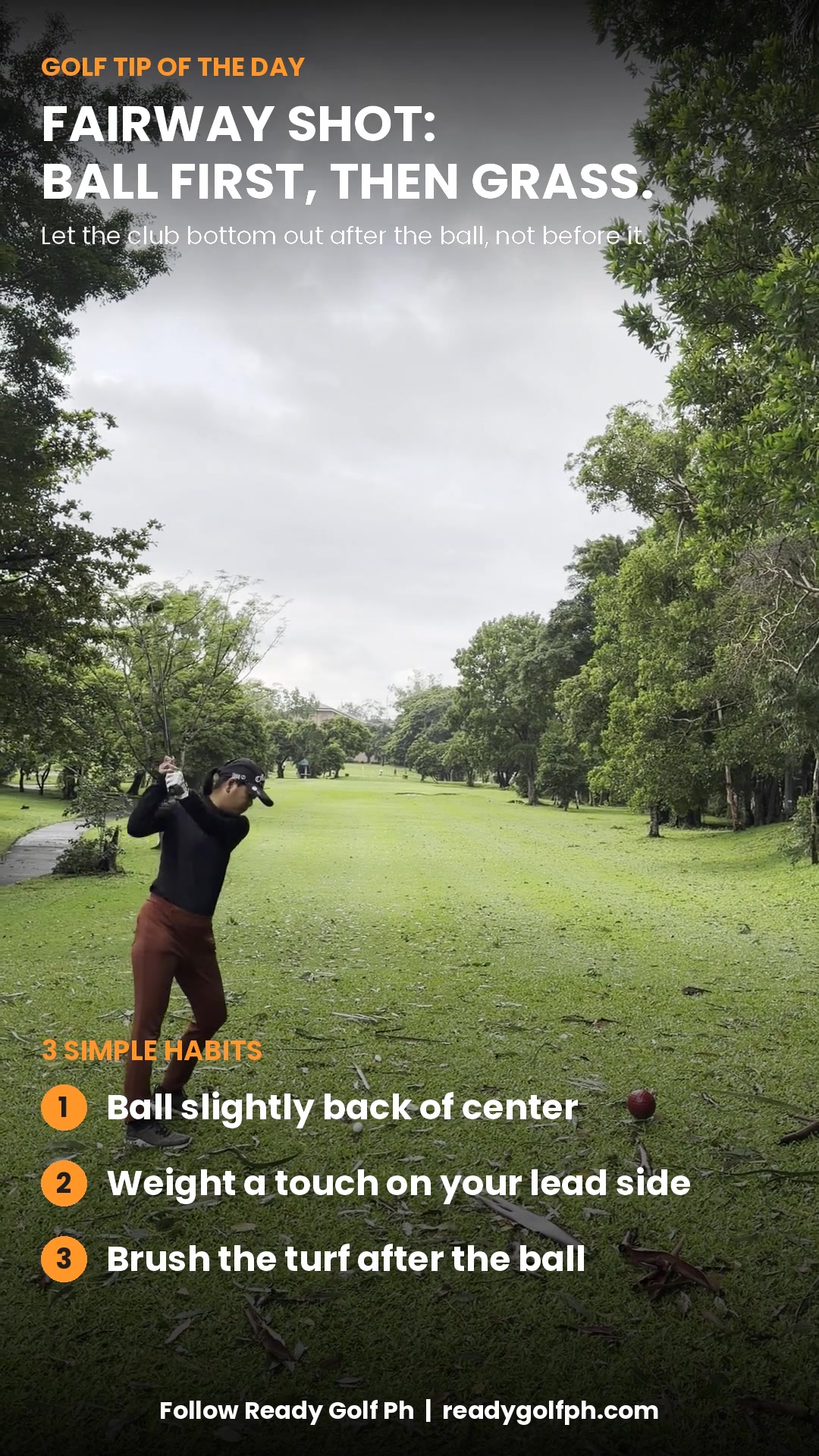
Lead image: still from the Ready Golf Ph “Fairway Shot: Ball First, Then Grass” video (ready_golf_fairway_ball_first_poster.jpg).
You walk up to your ball sitting nicely on the fairway. It’s a good lie, the hardest part of the hole is behind you, and then it happens: the club hits the ground first, the ball dribbles forward, and the divot flies farther than the ball. Golfers call it a “fat” shot or a chunk. Its cousin, the “thin” shot, skims the ball along the ground.
Both come from the same place: the club doesn’t reach the bottom of its swing at the right moment. The cure is easier than most people think. It starts before you swing, with three simple setup habits, and one clear picture: ball first, then grass.
Why Ball-First Contact Matters
On a fairway shot, the ball sits on top of short grass, not on a tee. To get it airborne with a clean, solid strike, the club has to meet the ball on the way down, and then brush the turf just after it.
If the club bottoms out before the ball, you hit the ground first. The club slows down, the ball barely moves, and your hands feel a sting. If it bottoms out too late or rises on the way in, you catch the ball’s equator and send it low and weak.
When contact is ball first, you get:
- Better distance, because the energy of the swing goes into the ball, not the ground.
- A higher, more consistent flight, because the club’s loft does its job.
- More confidence, because you know what a good strike feels like.
Habit 1: Ball Slightly Back of Center
For most fairway shots with an iron or a hybrid, position the ball about one ball-width behind the middle of your stance (a little closer to your back foot). With the driver, the ball sits forward, near your lead foot. For a fairway shot, it should be different.
Why it works: the club is still moving downward when it meets a ball that’s a touch back, so you catch the ball first and the turf afterward. Move the ball too far forward and you’re likely to hit the ground before the ball.
A quick way to check: take your stance with the club in front of you, then look at where your sternum sits. The ball should be just behind that point.
Habit 2: Weight a Touch on Your Lead Side
Many beginners hang back on their rear foot, trying to help the ball into the air. That’s the main cause of chunked shots, because the club’s lowest point shifts back behind the ball.
Instead, set up with slightly more weight, say 55 to 60 percent, on your lead foot (your left foot if you’re right-handed). Keep it there during the swing. You don’t need to lean far. A small tilt is enough to put the low point of the swing in front of the ball.
If you want a feeling to hold on to: let your chest stay over the ball as you swing through. Your finish should balance on your lead side, with the back heel lifted off the ground.
Habit 3: Brush the Turf After the Ball
This one is about where you look and what you picture. Instead of aiming at the ball, imagine a spot on the grass about an inch in front of it, and let your club brush that spot.
Here’s a simple practice trick:
- Find a patch of grass and draw a line in the dirt or place a tee a few inches in front of your ball.
- Make 10 swings, and try to leave your mark, the divot or scrape, in front of the ball and not behind it.
- Hit a few real shots with the same picture in your head.
A good divot should be shallow and start just after where the ball sat. If your marks start behind the ball, check habits 1 and 2.
A Quick Drill: The Towel Line
Place a small towel or a headcover about 4 to 6 inches behind the ball, on your target line. Your goal is to hit the ball without touching the towel.
- If you hit the towel, your swing is bottoming out too early.
- If you miss it cleanly and strike the ball, you’re on the right track.
Do this for 10 to 15 swings with a mid iron, using short, smooth swings at first.
Common Mistakes
- Trying to scoop the ball. You don’t need to lift it. The loft of the club does that for you.
- Swinging too hard. An overswing throws off balance, and balance is what controls the low point.
- Hanging back on the rear foot. This is the number one cause of chunks.
- Looking up early. Keep your eyes on the ball until the club has passed through.
- Ignoring the lie. If the ball is sitting down in thick grass or on a slope, adjust your plan. Choose a more lofted club and take a smooth swing.
FAQ
Should I take a divot on every fairway shot?
With irons, a small divot after the ball is normal and a sign of a good strike. With fairway woods and hybrids from a tight lie, you’ll just brush the grass.
What if I keep hitting the ground behind the ball?
Check your weight. Most often it’s too far back. Move it slightly forward and keep it there through the swing.
Is it okay to replace my divot?
Yes. Replace the turf, or fill the divot with sand if your course provides it, and press it down with your foot. It keeps the course in good shape for everyone.
Which club is best for practicing this?
A mid iron, such as a 7-iron, is a good start. It has enough loft to help you launch the ball and is easy to control.
Key Takeaways
- Fairway shots need a downward strike: ball first, then grass.
- Play the ball slightly back of center in your stance.
- Keep a little more weight on your lead side, and keep it there.
- Picture a spot an inch ahead of the ball and brush it.
For more practice ideas, try Know Your Ball Position and Avoid Early Extension. Follow Ready Golf Ph for your daily golf tips, and visit readygolfph.com for more guides for beginner golfers.