
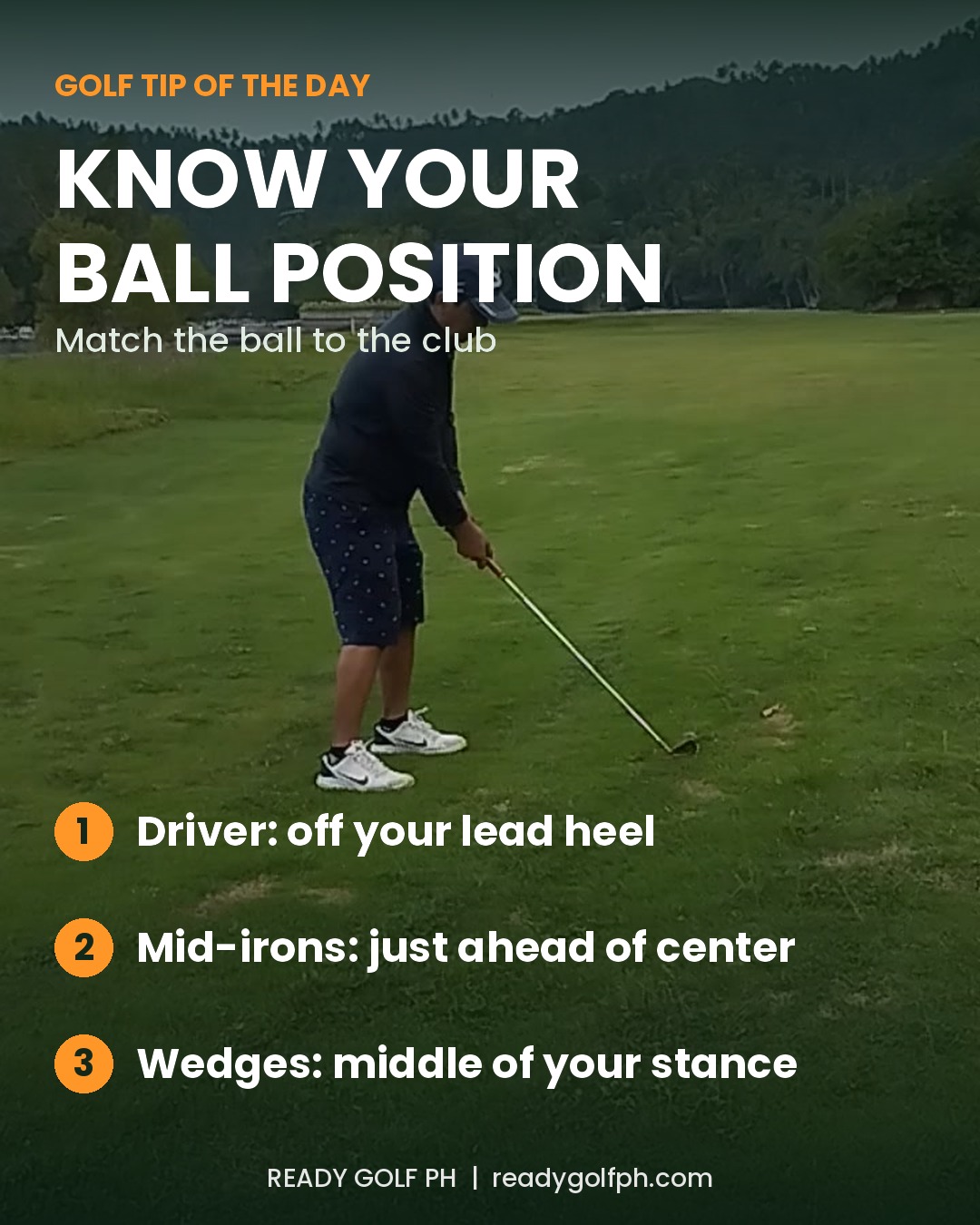
Ask a few golfers what went wrong with a bad shot and you’ll hear about the swing: too fast, too steep, head came up. But a surprising number of poor shots are decided before the club even moves. One of the biggest culprits is something that takes two seconds to fix: where the ball sits in your stance.
Ball position is one of the simplest parts of the setup, and one of the most overlooked. Get it right and solid contact becomes much easier. Get it wrong and even a good swing can produce thin shots, fat shots and strange curves. Here’s what you need to know.
Why Ball Position Matters
Your swing has a low point, the spot where the club bottoms out. For most golfers, that low point sits roughly under the middle of the chest or slightly in front of it. Where the ball sits relative to that low point decides what kind of strike you get.
- Ball too far back. The club meets the ball while it’s still on the way down. This tends to produce low shots, pulls and hooks, and a steep, digging strike.
- Ball too far forward. The club reaches its lowest point before it gets to the ball. That often means thin shots, fat shots and slices as the shoulders open up to reach it.
- Ball in the right spot. The club contacts the ball cleanly, with the loft doing its job and a flight you can predict.
The longer the club, the more the swing is traveling level or slightly upward at impact, so the ball moves forward. The shorter the club, the steeper the strike, so the ball moves back toward the middle.
The Simple Ball Position Guide
You don’t need to memorize a chart. Think of it as three zones, measured against your stance.
1. Driver: off your lead heel. With the driver, you want to catch the ball slightly on the upswing, so the ball sits well forward, about in line with the inside of your lead heel. Because the ball is on a tee, this position helps launch it higher with less spin.
2. Mid-irons: just ahead of center. With a 7-iron, 6-iron or similar club, play the ball about one ball-width or two ahead of the middle of your stance. This gives you the slight downward strike that makes the ball pop up off the turf.
3. Wedges: middle of your stance. Short clubs are hit with a steeper angle, so the ball moves back to the center. Standing it in the middle helps you strike the ball first, then the turf, for crisp contact and control.
For long irons, hybrids and fairway woods, simply slide the ball gradually forward as the club gets longer. A good habit is to keep your feet and stance in the same place and move only the ball as you change clubs.
How to Check Your Ball Position
Setting the ball by feel is hard when you’re nervous or in a hurry. Use a few quick checks instead.
- Find the middle first. Stand with your feet at your normal width and notice the center point between them. Everything is measured from there.
- Use your lead heel as a marker. For the driver, the ball lines up with the inside of the lead heel. It’s an easy reference to remember on the tee.
- Step in the same way each time. Place the clubface behind the ball first, then build your stance around it. This keeps your position consistent from shot to shot, as part of your pre-shot routine.
- Check on video or photo. Ask a playing partner to take a photo from the side, as shown in the photos for today’s tip. It’s the easiest way to see where the ball really sits.
A Quick Drill to Make It a Habit
This drill takes about ten minutes at the range.
- Lay one club on the ground pointing at your target to mark the line of the ball.
- Lay a second club across your stance, pointing out from the middle of your feet, to mark the center.
- Hit five shots with a wedge, ball in the middle. Then five with a 7-iron, ball just ahead. Then five with the driver, ball off the lead heel.
- After every shot, note where the ball finished relative to your target and whether the contact felt clean.
After a couple of sessions you won’t need the clubs on the ground. Your eyes will learn what correct looks like.
Common Mistakes
- Playing every club from the same spot. Many beginners set up the same way for every shot. Moving the ball for each club is one of the quickest ways to improve contact.
- Shifting the ball without moving your stance. If you move the ball but your shoulders and hips stay in the same place, your alignment changes. Keep your body setup steady and adjust only the ball.
- Standing too close or too far. Distance from the ball changes the whole stance. Let the arms hang naturally and keep slight knee flex before checking your ball position.
- Guessing when you’re rushed. If the group behind you is waiting, it’s tempting to skip the setup. A quick glance down at the ball position costs almost no time.
- Ignoring the lie. On uneven ground or in thick grass, you may need to adjust slightly. Start with the standard position, then adapt.
FAQ
Does ball position change for a left-handed golfer?
The same ideas apply, just mirrored. “Lead heel” means the heel closest to the target, which is the right heel for a left-handed player.
Should the ball be further back for a punch shot?
Yes. Moving the ball back a little with a slightly forward shaft lean produces a lower, more controlled flight, which is handy in the wind or under trees.
What about fairway woods and hybrids?
Place them between the mid-iron and driver positions. A good rule is a bit behind the driver position and a bit ahead of center, moving forward as the club gets longer.
How do I know if my ball position is wrong?
Look at your contact. Frequent thin or fat shots, or a flight that is always low or always high, can point to a ball position issue. Fix this first before changing your swing.
Key Takeaways
- Ball position decides how the club meets the ball, so set it before you swing.
- Driver: off your lead heel. Mid-irons: just ahead of center. Wedges: middle of your stance.
- Move the ball, not your feet, as the club changes.
- Practice with clubs on the ground until the right position looks and feels natural.
Want more simple tips to build a solid setup? Follow Ready Golf Ph for daily golf tips, and visit readygolfph.com for more guides for beginner golfers.