
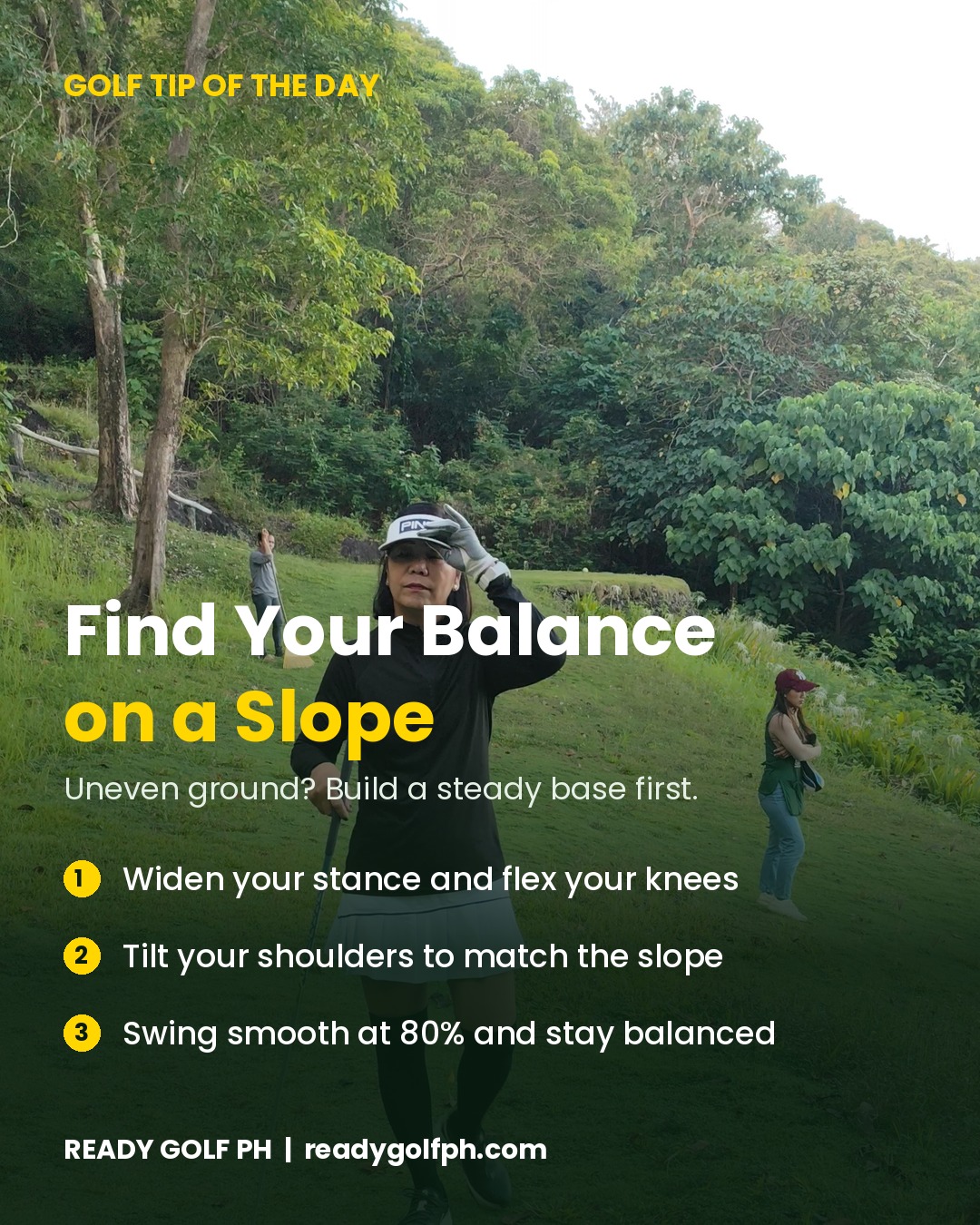
On a slope, build a steady base before you swing. Widen your stance and flex your knees, tilt your shoulders to match the ground, and swing smooth at about 80 percent. Then aim for the way the ball will curve off the slope.
Very few golf courses are pancake flat. They climb hillsides, wrap around lakes and roll along coastlines, so you’ll spend a good chunk of any round standing on ground that tilts one way or another. If you’ve ever set up to a ball and felt like you were about to slide down the hill, you know exactly what we mean.
In the photo above, the golfer is standing on a sloping fairway, taking a moment to settle in before the shot. That pause is the right instinct. On uneven ground, the most important shot you hit is the one you make before the swing: building a steady base.
Why Slopes Cause So Much Trouble
On flat ground, your body is used to a certain feeling. Your weight sits in the middle of your feet, your spine tilts a little away from the target and your club travels along a predictable path. Put the same swing on a slope and a few things shift at once.
- Your balance moves. Gravity pulls you downhill. If you don’t plan for it, you’ll lean or lunge toward the low side as you swing.
- The ball flies differently. The slope changes the angle of the club at impact, so the ball tends to start a bit left or right of where you aimed.
- Contact gets harder. The low point of your swing changes. You may hit the ground early or catch the ball thin.
- Nerves creep in. When you don’t feel stable, you tend to rush or swing harder to compensate, which makes everything worse.
The good news is that a few small adjustments take most of the sting out of it. You don’t need a new swing. You need a better setup and a calmer tempo.
The Fix: Three Simple Adjustments
1. Widen your stance and flex your knees.
A slightly wider stance gives you a bigger base, like a table with longer legs. Add a bit more knee flex than usual so you can sink into the slope instead of fighting it. Your weight should feel centered and quiet, not stuck on your toes or heels. Before you swing, give yourself a small test: if someone gave you a gentle nudge, could you hold your ground? If not, widen up.
2. Tilt your shoulders to match the slope.
This is the one most beginners miss. On a sidehill lie, you want your shoulders to run roughly parallel to the ground. If the ball is above your feet, your shoulders will tilt a little more toward the hill; if it’s below your feet, they’ll tilt downhill. Matching the slope helps the club travel along the ground instead of digging in or bouncing off it. Think of it as setting your upper body to the same angle as the ground, so the club has a natural path.
3. Swing smooth at about 80 percent.
You can’t swing as hard on a slope without losing your balance, so don’t try. Take one more club if you need the distance, shorten the swing a little and focus on a smooth tempo. A balanced swing at 80 percent will almost always beat a wild swing at 100.
Know How the Ball Will React
Once you’ve set up, a quick adjustment to your aim helps too. As a rule of thumb:
- Ball above your feet: the ball tends to curve left, so aim a touch right. Choke down on the club a little since the ball is closer to you.
- Ball below your feet: the ball tends to curve right, so aim a touch left. Bend your knees a bit more to reach it.
- Uphill lie: the ball tends to fly higher and a little left. Take extra club and swing along the slope.
- Downhill lie: the ball tends to fly lower and a little right. Use a more lofted club than you think you need.
These are tendencies, not guarantees, so use them as a starting point and adjust as you learn how your own ball behaves. Start by picking a target that gives you plenty of room for error, and aim for the fat part of the fairway or green.
A Simple Drill to Practice Balance
You don’t need a hillside to train this. Try it on any practice area, or even in your backyard.
The Hold-Your-Finish Drill. Hit five easy shots with a half-swing, and after each one, hold your finish for a full three seconds. If you can freeze in a comfortable, balanced pose, you swung within yourself. If you stumble or step forward, you swung too hard or lost your base. Our guide to holding your finish explains why this simple checkpoint works.
Once that feels easy, find a gentle slope on the range, or ask a friend which part of your course has uneven lies, and try the same drill there. Hit five shots with the ball above your feet, five with it below, and notice how you need to adjust your aim and your tempo. After a couple of sessions, those awkward lies stop feeling scary.
Common Mistakes to Avoid
- Swinging for distance. Hitting harder on a slope is the quickest way to lose balance. Take more club instead.
- Standing too tall. Locked knees make you wobble. Stay athletic and a bit lower.
- Ignoring the slope in your aim. If the ball will curve, plan for it before you swing.
- Rushing the setup. Take an extra few seconds to find solid footing. It’s worth it.
- Fighting the hill. Don’t try to stand up straight on a slope. Let your body match the ground and keep your weight centered.
Make Balance Part of Your Routine
Add one step to your pre-shot routine: before you address the ball, ask yourself, “Is my footing solid?” Feel the ground, take your practice swing from the same spot and notice how your feet respond. If anything feels shaky, adjust now rather than hoping it works out mid-swing.
Over time, you’ll start to read slopes the same way you read greens. You’ll look at the lie, see how the ground tilts and know almost automatically how to set up. That calm confidence is what separates a golfer who panics at a sidehill lie from one who just shrugs and plays the shot.
FAQ
Should I use a different club on a slope?
Often, yes. Because a slope makes a full swing harder to control, many golfers take one more club and swing a bit easier. It also gives you room for the ball to curve a little.
Where should the ball be in my stance on a sidehill lie?
Generally keep it near the middle of your stance, and let your shoulder tilt do the work. Extreme ball positions make an awkward lie even harder.
What if I can’t get a stable stance at all?
It’s fine to play safe. If the ground is too steep to stand on comfortably, chip or punch the ball back to flatter ground rather than risk a bad miss. Smart golf is often about avoiding a second mistake, the same idea behind taking your medicine when you’re in trouble.
Does this apply to the tee box too?
Yes. Some tee boxes are slightly sloped. Take a moment to find the flattest spot, and use the same setup ideas.
Key Takeaways
- Build your base first: a wider stance and soft knees.
- Match your shoulders to the slope so the club can travel along the ground.
- Swing at about 80 percent and hold your finish.
- Plan for how the ball will curve and aim accordingly.
- When the footing is bad, take the safe option.
Which gives you more trouble: the ball above your feet or below them? Try the hold-your-finish drill on a gentle slope this week and see how much steadier you feel.
For a new tip every day, follow Ready Golf PH on Facebook and visit readygolfph.com for more guides for everyday golfers.