
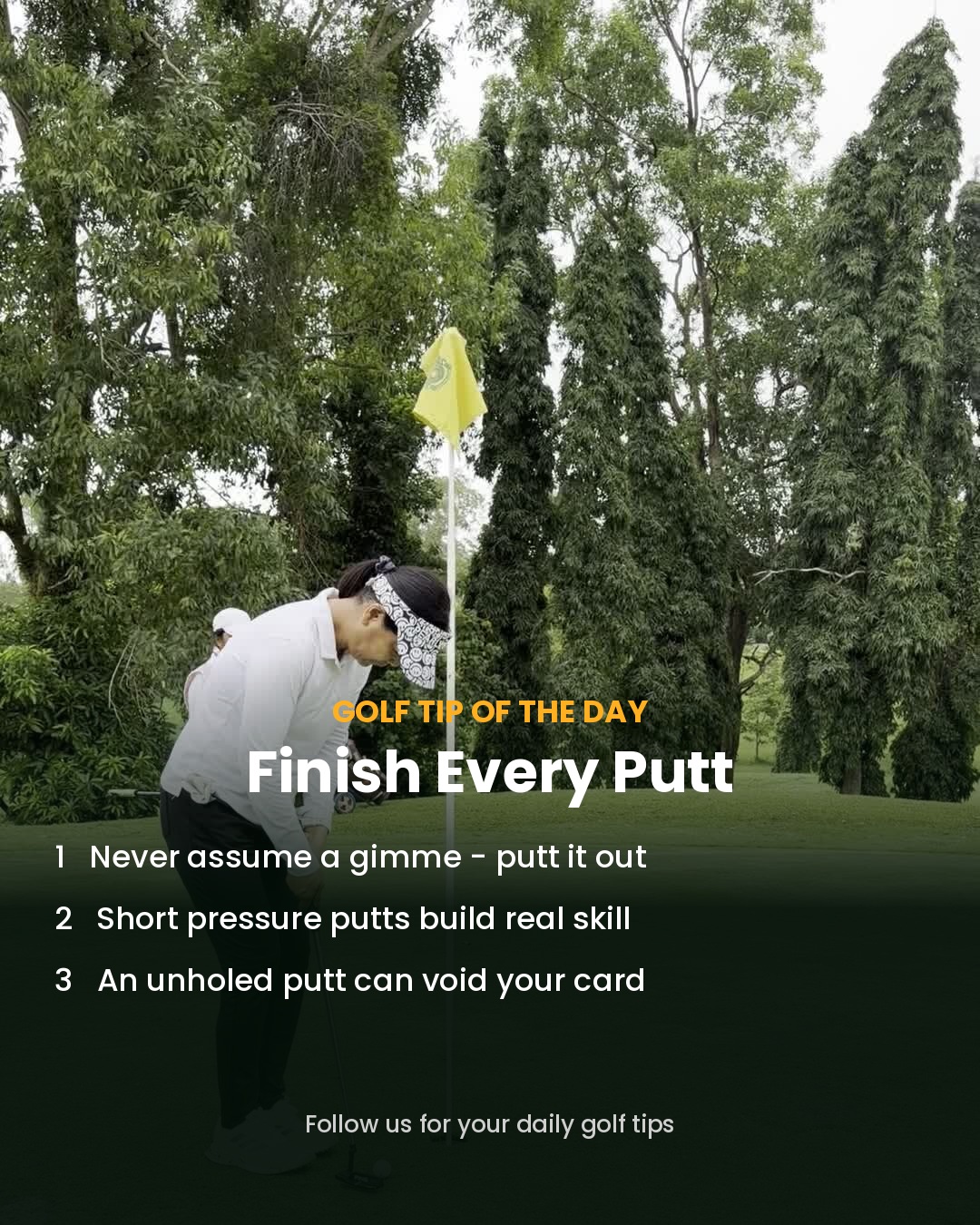
It happens on almost every green, in almost every casual round. Your ball rolls up a foot or two from the cup, someone in your group waves a hand and says “that’s good,” and you pick it up without ever taking the stroke. Nobody thinks twice about it. It feels like common courtesy, a way to keep the round moving instead of fussing over a putt that “would have gone in anyway.” Ready Golf Ph readers know pace of play matters — but this particular habit is worth a second look, because the short putt you skip today is exactly the putt that would have made you better tomorrow.
The gimme is a completely legitimate part of casual golf. Nothing about this tip says you should stop giving or accepting them with friends. The issue is when it becomes automatic — when short putts get waved off by habit rather than by actual agreement, or when they get skipped in rounds where the score is supposed to count. That’s where a friendly convenience quietly turns into a bad habit and, in some cases, an invalid scorecard.
Why It Matters
A gimme only exists because your group agrees to it, explicitly, in that moment. It is a social convention, not a rule of golf. The Rules of Golf don’t recognize conceded putts at all outside of match play, where a putt can be conceded stroke-by-stroke by an opponent. In stroke play — which covers most casual rounds, all club competitions, and anything where you’re posting a real score — every ball has to be holed. Picking up a two-footer because it “looked good” and writing down the score you assume you’d have made isn’t a minor shortcut. Technically, it means you didn’t complete the hole, and depending on the format, that can void your score for that hole entirely.
Beyond the rules question, there’s a skill-building reason to putt everything out, and it matters even more for golfers who are still building their game. Short putts under a bit of pressure are one of the few shots in golf you get dozens of reps at during a single round. Every time you skip one because it’s “basically in,” you’re skipping a rep that would have sharpened your stroke, your read, and your ability to stay calm over a putt that matters. Tour players hole out short putts constantly in practice for exactly this reason — the two-footer with something riding on it feels different from the two-footer that doesn’t count, and the only way to get comfortable with that feeling is to face it, over and over, until it stops rattling you.
There’s also a simple confidence argument. Golfers who are used to finishing every putt carry a calmer, more settled feeling over any putt, long or short, because the short ones have never been a source of anxiety — they’ve just been routine. Golfers who are used to picking up short putts often discover, the first time it actually matters, that a “gimme length” putt feels a lot longer and a lot more nerve-wracking than they remembered.
The Fix
The simplest version of this habit is also the most effective: unless your group has clearly and verbally agreed it’s a gimme, putt it out. That’s the whole rule. It doesn’t require a rules official or a rulebook in your bag — it just requires treating “that’s good” as something that has to actually be said and agreed to, not assumed because the ball happens to be close.
If you’re playing a casual round with friends and gimmes are part of how your group plays, that’s fine — just be consistent and explicit about it, and understand it’s a social agreement, not an official score. If you’re posting a score for handicap purposes or playing any kind of competition, hole out everything, every time, regardless of distance or how the group around you is playing. This one habit alone keeps your scorecard legitimate and keeps your handicap honest.
On practice greens, make finishing putts a deliberate part of your routine rather than something you only do when you remember. Instead of hitting ten putts and picking them all up as soon as they get close, putt every single one into the hole, including the tap-ins. It feels repetitive, but that repetition is the entire point — it’s building the exact motion and mindset you need on the course when a short putt actually has weight behind it.
Drill to Practice
Try the “21 drill,” a simple pressure-putting exercise built around exactly this habit. Set three balls at 3 feet, three at 5 feet, and three at 7 feet from the hole, all around the cup. Putt each one out — no picking up, no assuming. Made putts score based on distance (1 point for 3 feet, 2 for 5 feet, 3 for 7 feet), and you’re trying to reach 21 points before you run out of a set number of attempts. The format forces you to hole out every single putt, including the short ones you’d normally give yourself, and it builds the same finishing habit you want on the course.
A simpler version: the next time you’re on a practice green, commit to holing out every putt for the entire session, no exceptions, no matter how short. It sounds almost too basic to be a real drill, but most golfers don’t actually do this consistently, and the ones who do notice their short putting getting measurably steadier within a few sessions.
Common Mistakes
The most common mistake is treating “that’s good” as something the other player has to actively object to, rather than something that has to be actively granted. If nobody says anything and you just pick up your ball, that’s not a gimme — that’s an assumption, and it’s the exact habit that erodes both your putting and the integrity of your score.
A second mistake is inconsistency — giving yourself gimmes on some holes and not others based on mood or how the round is going, rather than by a clear standard the group has agreed on. This makes it hard to know, at the end of the round, whether the score you’re writing down actually reflects what happened.
A third mistake is assuming gimme etiquette from casual weekend rounds carries over into any round where the score counts. Club competitions, handicap-posting rounds, and anything resembling tournament play all require holing out, full stop — the habits from a relaxed round with friends don’t transfer, and golfers who haven’t built the finishing habit often get caught off guard by how unfamiliar a “must-hole-it” short putt feels.
Finally, some golfers only putt out when they’re nervous about a bad read, and pick up automatically when the putt looks straightforward. Ironically, this means they’re getting the least practice on exactly the putts that should be the most automatic — the short, straightforward ones that a smooth pre-shot routine and finishing habit would otherwise handle without a second thought.
FAQ
Is it against the rules to accept a gimme?
In match play, conceding a putt is a legitimate part of the rules — your opponent can concede your next stroke at any point. In stroke play, conceded putts aren’t recognized at all; every ball has to be holed for the score to count.
What counts as a “gimme” length?
There’s no official distance. It’s entirely up to what your group agrees on for that round, and it can vary from a few inches to a couple of feet depending on how the group plays. The important part isn’t the distance — it’s that it’s actually agreed on, not assumed.
Does finishing every putt really make a difference to my score?
Yes, in two ways. It keeps any card you’re posting accurate and valid, and over time it builds the pressure-putting skill that shows up in the putts that matter most — the ones late in a close match or a good round, when a short putt suddenly doesn’t feel routine anymore.
Will my rounds take longer if I putt everything out?
Barely, if at all. Holing a 2-foot putt takes a few seconds. The bigger pace-of-play wins come from things like being ready to play when it’s your turn and not lingering over decisions, not from skipping short putts.
Key Takeaways
A gimme is a social agreement, not a rule of golf — and outside of match play, every putt technically has to be holed for your score to count. Beyond the rules, finishing every putt is one of the simplest ways to build real pressure-putting skill, since short putts under a bit of stakes are exactly the reps that make the short game reliable when it matters. The habit costs you almost no time and pays off every time a short putt actually counts.
#ReadyGolfPH #GolfTips #PuttingTips #GolfRules #BeginnerGolfer #GolfPhilippines