
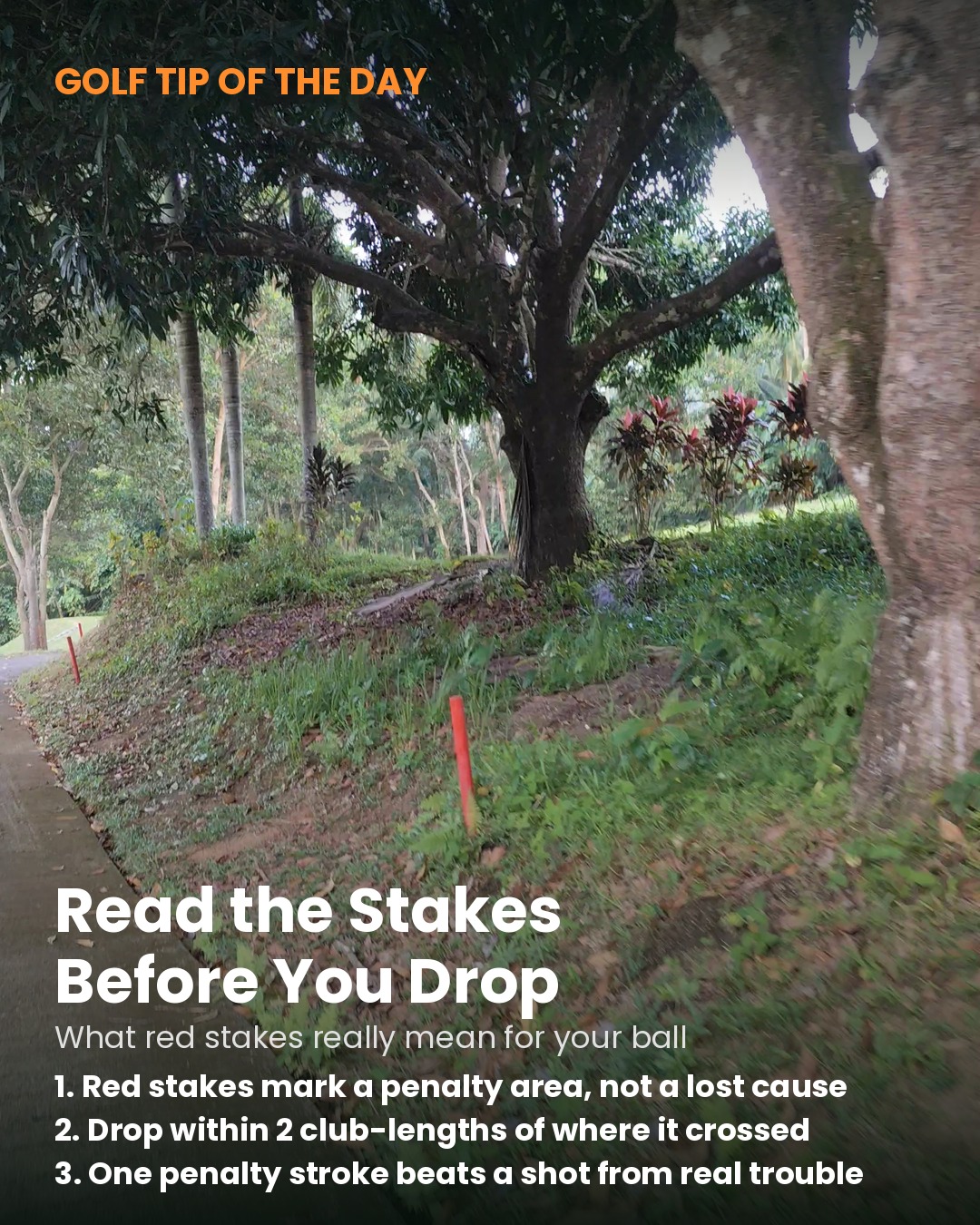
Every course has them: thin stakes poking out of the rough, usually painted red or yellow, easy to walk right past without a second thought. Then one day your ball ends up near one, and suddenly you’re standing there unsure whether you’re allowed to play it, required to take a penalty, or supposed to just pick up and walk to the next tee. It’s one of those moments that makes new golfers freeze, not because the shot is hard, but because the rules feel like a mystery.
The good news is that red stakes are actually one of the more beginner-friendly parts of the rulebook once you understand what they’re telling you. They’re not a punishment sign, they’re an information sign, and they hand you more options than most new golfers realize. Once you know what they mean, that walk over to check the stake color becomes second nature instead of a moment of panic.
Why It Matters
Red and yellow stakes mark what the Rules of Golf call a penalty area, the modern name for what used to be called a water hazard. The color isn’t decorative. It tells you exactly which relief options are available to you before you take your next swing, and getting it wrong can mean either an unnecessary penalty stroke or, just as often, an unnecessary attempt at a shot you never needed to hit.
A lot of beginners either freeze near a penalty area or guess at what they’re allowed to do, and both reactions cost strokes. Some players assume any ball near a stake is automatically lost and pick up, taking a bigger penalty than the rules actually require. Others do the opposite: they see the ball is technically playable and try to muscle a low-percentage shot out of thick rough or standing water rather than taking the simple, cheap drop that was available the whole time.
Understanding the stakes also matters because it speeds up play. Nothing slows down a group more than a player unsure of their options standing over a ball near a hazard line, debating with a playing partner about what’s legal. Knowing the rule cold means you can make a confident decision and keep the round moving, which is exactly the kind of ready-golf habit that makes you a welcome playing partner.
The Fix
Learn to read the stake color before you do anything else. Yellow marks a standard penalty area, front a water hazard directly in front of you, usually crossing the hole. Red marks a lateral penalty area, one that runs alongside the hole rather than directly across it. The color tells you which set of relief options you get, so this is always the first thing to check, before you even think about the shot.
Know that a red stake gives you more ways out than a yellow one. For both colors, you can always play the ball as it lies if it’s sitting in a playable spot, or go back to where you last played from for a one-stroke penalty. Red penalty areas add two extra lateral options on top of that: you can drop within two club-lengths of the point where your ball last crossed the edge, no nearer the hole, or drop at the equivalent point on the opposite side of the penalty area, the same distance from the hole. All of these lateral options cost one penalty stroke, the same as the standard back-on-the-line relief.
Default to taking the drop instead of forcing a shot. If your ball is in the penalty area itself, sitting in mud, thick grass, or standing water, the smart play is almost always the one-stroke drop rather than trying to hit a hero shot from a bad lie. A clean shot from a normal lie plus one penalty stroke will beat a low-percentage swing from real trouble far more often than not, even if it feels like giving up a stroke you didn’t have to.
Put those three habits together, check the color, know your lateral options on red, and take the drop when the lie is bad, and a red stake stops being a source of confusion and starts being one of the more useful markers on the course.
Drill to Practice
You can’t practice this one on the range, but you can practice it the next time you play. Before your round, take thirty seconds to notice where the penalty areas are on the scorecard or course map, and whether they’re marked yellow or red where you can see them from the tee. Knowing the layout ahead of time means you’re not scrambling to figure out the rule under pressure when your ball actually ends up near one.
The next time you do end up near a stake, make it a habit to walk to the point where your ball crossed the line before deciding anything. Standing at that exact spot makes the two club-length lateral drop easy to measure and helps you actually see your options instead of guessing from a distance.
Finally, practice the conversation, not just the rule. If you’re playing with newer golfers, get comfortable explaining the color difference out loud. Teaching it back to someone else is one of the fastest ways to make sure it’s actually stuck for you too, and it keeps everyone in the group moving instead of waiting on a rules debate.
Common Mistakes
The most common mistake is treating every hazard the same regardless of color, which usually means missing out on the extra lateral relief that red stakes provide. Players who only know the yellow-stake rule end up walking all the way back to their previous shot for a red-stake ball, when a much closer lateral drop was available the whole time.
A close second is assuming a ball near a penalty area is automatically unplayable and picking up without checking. Plenty of balls that finish near the edge of a penalty area are sitting in perfectly playable rough just outside the line, no penalty required at all. Always check exactly where the ball is before assuming you need to take relief.
Many golfers also misjudge where the ball “crossed the line” for the purposes of a lateral drop, measuring from where the ball came to rest instead of where it last crossed the edge of the penalty area. Those can be very different spots, especially on a sloped bank, and it affects where you’re legally allowed to drop.
Finally, some players try to play a shot from inside the penalty area purely out of stubbornness, even when the lie is genuinely bad. Taking the one-stroke drop isn’t a failure, it’s the smart, ready-golf choice that keeps your score and your pace of play in better shape than a low-percentage recovery attempt.
FAQ
What’s the difference between a penalty area and what used to be called a water hazard?
They’re the same thing under a new name. The 2019 Rules of Golf update replaced “water hazard” and “lateral water hazard” with the simpler term “penalty area,” and also removed some of the older restrictions, like being allowed to ground your club in one.
Can I ground my club or take a practice swing inside a penalty area?
Yes. Under the current rules, you’re allowed to touch the ground or water with your club in a penalty area, which wasn’t always the case under older rules. Just remember that other rules about improving your lie still apply.
What if I can’t tell whether the stake is red or yellow?
When in doubt, ask a playing partner or check the course’s scorecard or hole map, which usually shows penalty areas and their colors. If you genuinely can’t determine the color and it affects your options, play it as the more restrictive yellow penalty area to stay safe.
Do I always have to take a penalty stroke near a red stake?
No. If your ball is outside the penalty area margin, even if it’s close to a stake, you can play it as it lies with no penalty at all. The stroke only applies if your ball is actually inside the penalty area, or if you choose to take relief instead of playing a difficult lie.
Key Takeaways
Red and yellow stakes aren’t there to punish you, they’re there to tell you exactly what your options are. Check the color first, remember that red penalty areas give you extra lateral drop choices that yellow ones don’t, and default to the one-stroke drop over a low-percentage shot when your ball ends up in real trouble. Knowing this cold turns a confusing rules moment into a quick, confident decision that keeps your score and your group’s pace of play in good shape.
#ReadyGolfPH #GolfTips #GolfRules #PenaltyArea #BeginnerGolfer #GolfPhilippines