
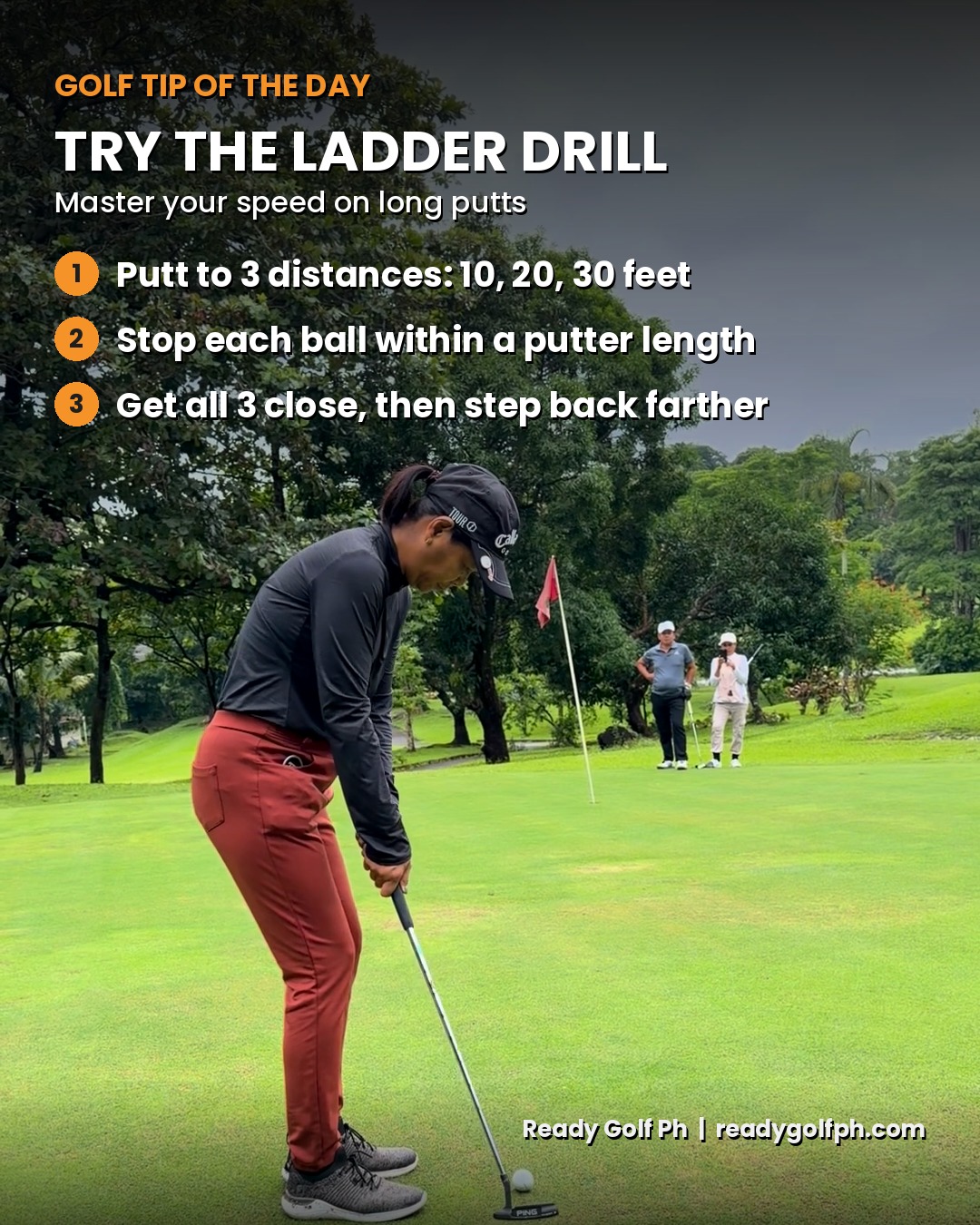
Long putts are where a lot of three-putts are born. You hit a good approach onto the green, but you’re 30 or 40 feet away. The first putt races six feet past, or dies halfway there, and suddenly you’re facing a nervy second putt you never wanted.
The fix isn’t a better read. On long putts, speed matters far more than line. A putt that’s a little off line but the right speed usually finishes close. A putt on the perfect line with the wrong speed almost never does.
The video behind today’s tip shows a long putt from well off the hole: a steady setup, a smooth stroke, and a calm walk after the ball. That’s the kind of putt the ladder drill is built for.
Why It Matters
Most golfers practice putting by hitting the same short putt again and again. That builds confidence, but it doesn’t teach your hands and eyes how hard to hit the ball from different distances. On the course, you rarely face the same putt twice.
The ladder drill trains distance control. By putting to several distances in a row, you teach yourself how a 10-foot stroke feels compared to a 20-foot or 30-foot stroke. Over time, you stop guessing and start feeling it.
Better speed means more tap-ins after your first putt, fewer three-putts, and lower scores, without changing anything about your swing.
How to Do the Ladder Drill
1. Putt to 3 distances: 10, 20, 30 feet. Find an open area on the practice green. Place a tee or coin at about 10 feet, 20 feet, and 30 feet from where you’re standing. If you don’t want to measure, use big steps: roughly 3, 7, and 10 steps. You don’t need a hole for this drill. The tees are your targets.
2. Stop each ball within a putter length. Putt one ball to each target, starting with the closest. The goal is to have every ball finish within a putter length of its tee, short or long. Lay your putter down next to the target to check.
3. Get all 3 close, then step back farther. If all three balls finish inside a putter length, move your starting point back a few steps and do it again. If any ball misses the zone, repeat the same set until you get all three. Mixing the order (30, then 10, then 20) makes it even harder and closer to real golf.
Tips for Better Speed Control
- Make your stroke longer, not harder. For a longer putt, take the putter back farther and keep the same smooth rhythm. Avoid hitting harder with your hands.
- Look at the target during practice strokes. Make one or two practice strokes while looking at the target, not the ball. Your eyes help your body judge the distance.
- Finish the stroke. Let the putter swing through to a finish about as long as your backstroke. A stroke that stops at the ball often leaves putts short.
- Watch how the green rolls. Uphill putts need more speed, downhill putts much less. Try the ladder both ways on a sloped part of the practice green.
Common Mistakes
- Only practicing short putts. Short-putt practice is great, but it won’t help you with the 30-footers that lead to three-putts.
- Focusing on making it. On long putts, aim to leave yourself an easy second putt, not to hole it. That mindset takes the pressure off.
- Changing your tempo. Rushing the stroke on long putts or slowing down on short ones makes speed hard to control. Keep the same rhythm every time.
- Skipping the check. Lay the putter down. Guessing how close you finished makes the drill much less useful.
FAQ
How long should I spend on this drill?
Ten to fifteen minutes before a round is plenty. It’s a great way to learn how fast the greens are that day.
Do I need a hole?
No. Tees, coins, or even ball markers work as targets. Many golfers find it easier to focus on speed without a hole.
What if the practice green is crowded?
Use shorter distances, like 6, 12, and 18 feet. What matters is practicing a few different lengths in a row.
Key Takeaways
- Putt to three distances: about 10, 20, and 30 feet.
- Try to stop every ball within a putter length of the target.
- When you get all three close, step back and try again.
- On long putts, speed matters more than line.
Want more simple drills to make your practice count? Follow Ready Golf Ph for daily golf tips, and visit readygolfph.com for more guides for beginner golfers.
#ReadyGolfPH #GolfTips #GolfDrills #PuttingTips #BeginnerGolfer #GolfPractice #GolfForBeginners