
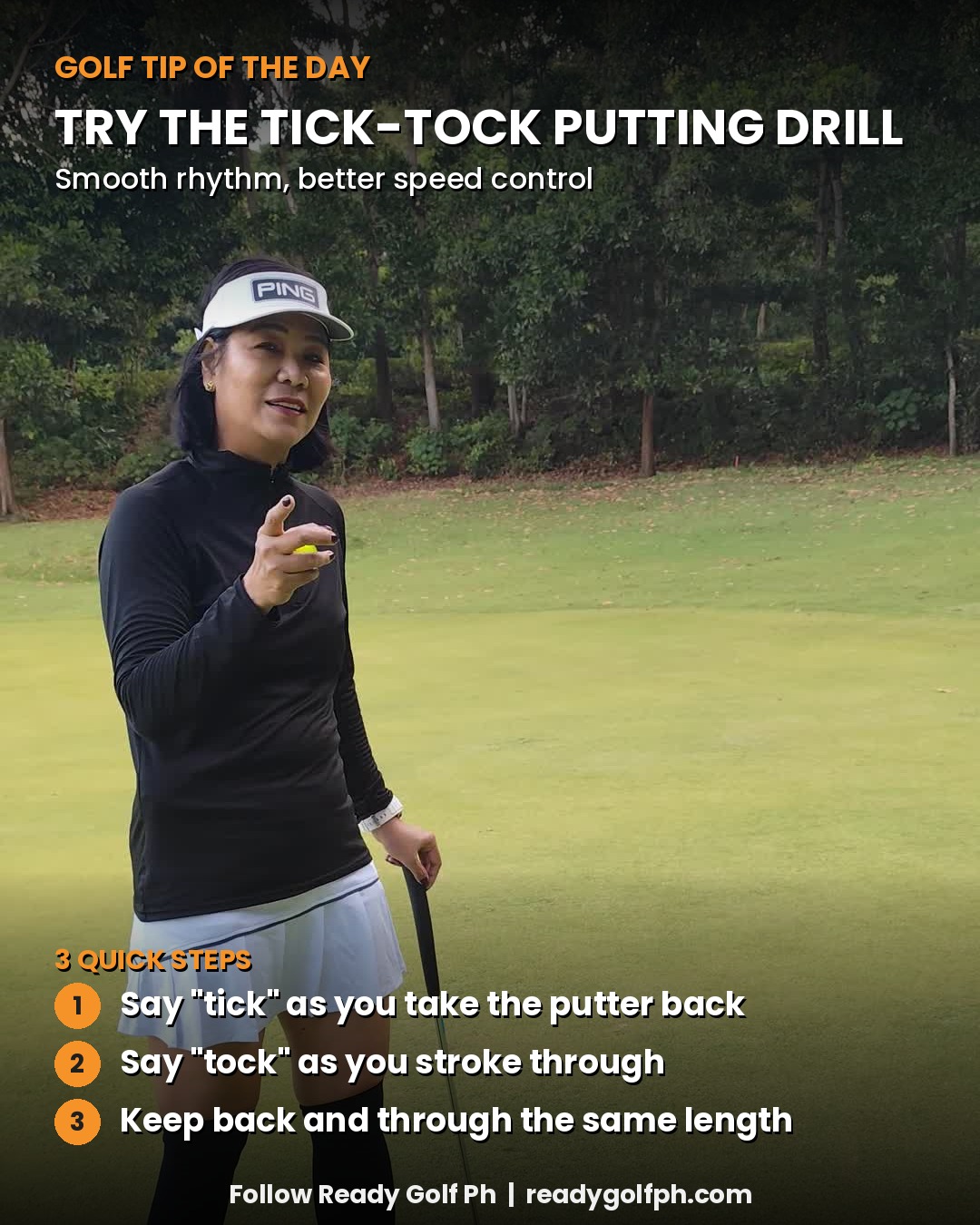
Most three-putts don’t come from a bad read. They come from bad speed. And bad speed usually starts with bad rhythm: a short, quick backstroke followed by a jab, or a long, slow backstroke that slows down at the ball.
The tick-tock putting drill fixes that with one simple idea: give your stroke a beat. When the back and through take the same amount of time, the putter swings like a pendulum, and the ball rolls out at a speed you can repeat.
Why Rhythm Matters in Putting
Good putters have very different styles, but almost all of them share one thing: a steady, even tempo. Their stroke takes about the same time whether the putt is 5 feet or 30 feet. Only the length of the stroke changes.
When rhythm breaks down, speed breaks down with it:
- A quick, short backstroke forces you to hit at the ball to make up for it. The ball jumps off the face and races past the hole.
- A long backstroke that slows down at impact (deceleration) leaves putts short and pushes them off line.
- Rushing under pressure makes your stroke shorter and faster, which is why nervous putts so often miss on speed.
A simple count takes your mind off the hole and puts it on your rhythm.
How to Do the Tick-Tock Putting Drill
1. Say “tick” as you take the putter back. Set up to a putt of about 10 to 15 feet on a flat part of the practice green. As you start the backstroke, say “tick,” out loud or in your head. Let your shoulders rock the putter back smoothly, with your hands and wrists quiet.
2. Say “tock” as you stroke through. At the end of the backstroke, let the putter swing forward and say “tock” as it strikes the ball. Don’t add a burst of speed at the bottom. The putter should feel like it’s swinging on its own.
3. Keep back and through the same length. Your follow-through should be about as long as your backstroke. If the putter stops short after impact, you probably decelerated. If it flies far past, you probably hit at the ball.
Hit 10 putts with the count. Then change distances: try 5 feet, 20 feet and 30 feet. Keep the same “tick-tock” timing every time and let only the length of your stroke change. That’s how you build real distance control.
Tips for the Drill
- Find your own beat. Some golfers like a slow “tiiick, tooock.” Others like it quicker. Pick the pace that feels natural and keep it the same for every putt.
- Hold your finish. Freeze for a second after each putt, with the putter pointing down your line. It shows you whether the stroke was balanced.
- Watch the ball, not the hole. Keep your eyes down through impact. Looking up early often pulls the putter off line.
- Grip lightly. A soft grip lets the putter swing freely. A tight grip adds tension and kills your rhythm.
- Take it to the course. Before every putt in a round, say “tick-tock” once in your head during the practice stroke, then use the same count for the real one.
Common Mistakes
- Speeding up the “tock.” The forward stroke shouldn’t be faster than the backstroke. Let it swing, don’t hit.
- Changing the beat with distance. Longer putts need a longer stroke, not a faster one. Keep the count the same.
- A short backstroke and a long follow-through. This usually means you’re pushing the ball. Match the two sides.
- Judging the drill by makes. The goal is a smooth, repeatable stroke. Holed putts will come once your speed becomes consistent.
FAQ
Should I say “tick-tock” out loud? At first, yes. Saying it out loud makes the rhythm easier to feel. Later, a silent count in your head works just as well.
How long should I practice this drill? Ten to fifteen minutes before a round, or as part of any practice session, is enough to lock in your tempo.
Can I use this drill at home? Yes. A putting mat or a straight stretch of carpet is perfect. Rhythm doesn’t need a real green.
Key Takeaways
- Most putting speed problems come from uneven rhythm, not a bad read.
- Say “tick” on the backstroke and “tock” through the ball.
- Keep the backstroke and follow-through the same length.
- Change the length of the stroke for distance, never the beat.
Want more putting drills? Try The One-Hand Putting Drill and The Ladder Drill. Follow Ready Golf Ph for daily golf tips, and visit readygolfph.com for more guides for beginner golfers.
#ReadyGolfPH #GolfTips #GolfDrills #PuttingTips #PuttingDrill #BeginnerGolfer #GolfForBeginners