
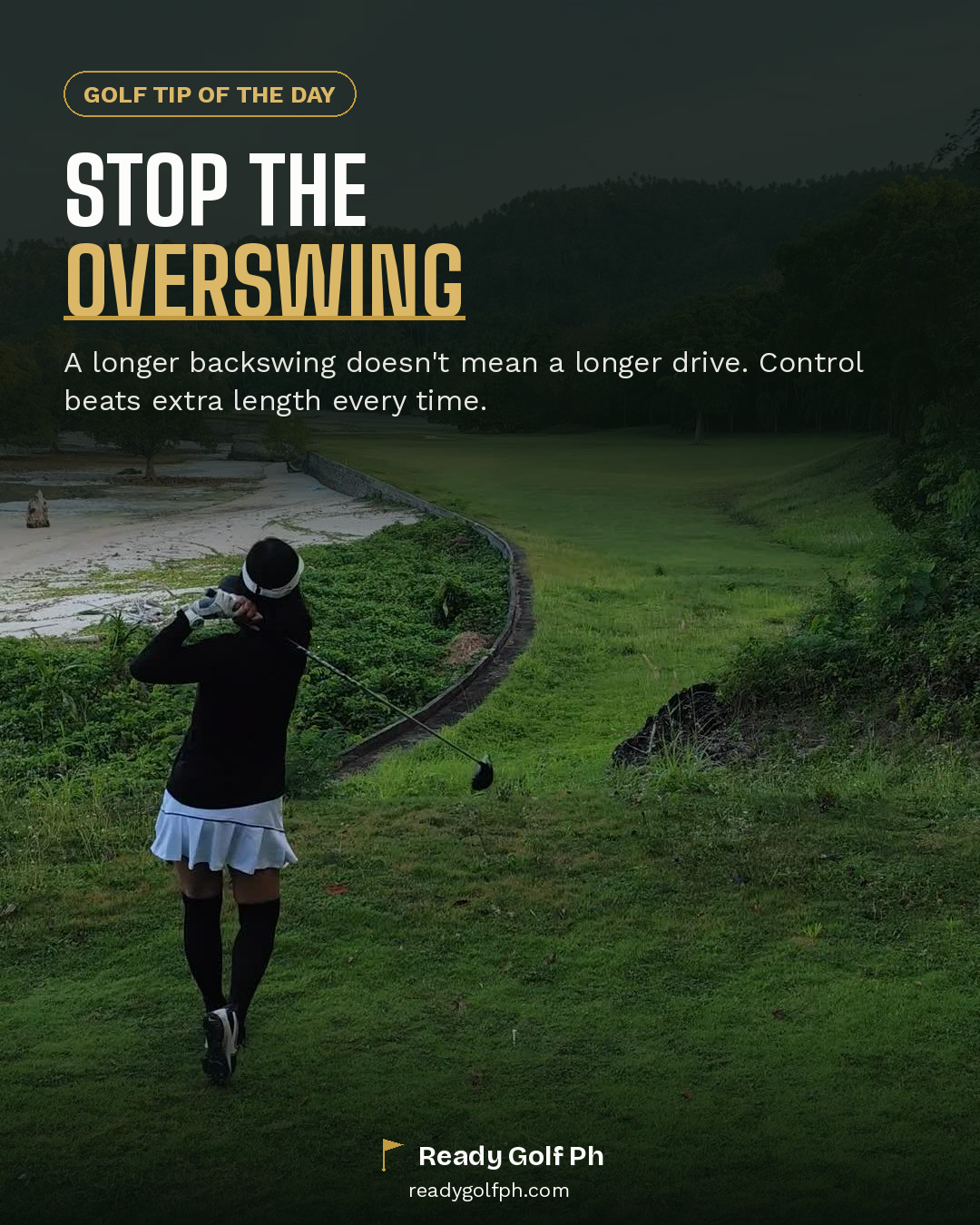
Watch enough golf swings and you’ll notice a pattern: the players struggling most with consistency are often the ones with the biggest backswings. The club collapses well past parallel, the lead arm folds, and by the time everything has to reroute back down to the ball, timing has already broken down. It looks powerful. It usually isn’t.
An overswing is one of the most common power leaks in golf, and one of the easiest to misdiagnose. It feels like more turn should mean more distance, so when contact is inconsistent or shots come up short, the instinct is to turn even more. That almost always makes the problem worse, not better.
Here are 3 keys to a controlled backswing that actually holds up under pressure.
1. Stop the Club at or Before Parallel
For the vast majority of golfers, the club shaft should be roughly parallel to the ground at the top of the backswing, pointing somewhere close to the target line. When the club collapses well past that point, it’s usually not extra flexibility working in your favor, it’s the wrists breaking down and the structure of the swing coming apart.
A backswing that goes past parallel has to travel further to get back to the ball, which means more room for timing errors and more speed lost to compensations along the way. Stopping the club at or before parallel gives you a shorter, more repeatable path back down, which is exactly what consistent ball striking depends on.
2. Keep Your Lead Arm Firm, Not Floppy
The lead arm is the structural backbone of the backswing. When it stays reasonably firm and connected through the takeaway and into the top of the swing, it controls the width and the shape of the swing arc. When it collapses or bends excessively, the arc gets narrow and inconsistent, and that’s usually when the club starts diving past parallel.
You don’t need a completely straight, locked lead arm to swing well, plenty of great ball strikers have some natural flex in it. What matters is that the arm stays connected to the turn of your body rather than disconnecting and swinging on its own. A simple check: if your lead arm feels like it’s doing something completely different from your shoulders at the top, that disconnect is very likely feeding your overswing.
3. Let Tempo, Not Length, Power the Swing
The biggest myth behind overswinging is that a longer backswing automatically produces more clubhead speed. In reality, speed comes from sequencing, from the lower body leading the downswing while the upper body and arms release through impact in the right order, not from how far back you can wind the club.
A shorter backswing paired with good tempo and proper sequencing will consistently outproduce a long, loose backswing with poor timing. Instead of chasing extra length at the top, focus on a smooth transition and accelerating through the ball. The speed you’re looking for comes from how you use the swing you have, not from adding more distance to travel before you even start down.
Why Overswinging Costs You More Than It Gives
The appeal of a big backswing is obvious: it feels athletic, and it feels like it should translate into more power. But the physics don’t cooperate the way it feels like they should. Once the backswing goes past the point where your body can control it, you lose the structure needed to deliver the clubface consistently at impact, and that costs you far more in accuracy and solid contact than the extra length ever gives back in distance.
Golfers who shorten an overswing almost always report the same thing: better contact, more consistent ball flight, and often more distance, not less, because the club is arriving at the ball on plane and at full speed instead of scrambling to recover from an oversized position at the top.
How to Build This Into Your Practice
Start on the range with slow-motion swings, focusing only on where the club stops at the top. Have someone film you from behind, or set up your phone, so you can actually see whether the shaft is past parallel. Seeing it on video is far more reliable than trying to feel it in the moment, since an overswing usually feels normal to the person doing it.
Once you have a visual sense of where parallel is, practice making three-quarter swings that stop short of your natural top position. It will feel restricted at first. Trust it anyway, and pay attention to contact quality and ball flight rather than how far back the club goes. Most golfers are surprised at how much speed they retain, and often gain, once the swing is shortened and connected.
FAQ
Does a shorter backswing mean I’ll lose distance?
Usually not. Most golfers gain distance with a shorter, more connected backswing because the club arrives at impact on time and at full speed, instead of losing energy to compensations on the way down.
How do I know if I’m actually overswinging?
The most reliable way is video. Film your swing from behind and check where the club points at the top. If it’s noticeably past parallel and your lead arm has broken down, that’s an overswing.
Is some flex in the lead arm at the top normal?
Yes. A small amount of natural flex is common even among strong ball strikers. The issue is a lead arm that disconnects entirely from the body turn, not a slight bend.
Key Takeaways
- Stop the club at or before parallel instead of letting it collapse past your shoulder
- Keep your lead arm connected to your body turn instead of letting it fold on its own
- Let tempo and sequencing generate speed, not extra length at the top
- A shorter, connected backswing usually improves both contact and distance
- Use video, not feel, to check where your club actually stops at the top
- Practice three-quarter swings on the range to retrain a shorter, more controlled top position
Ready Golf Ph — daily tips to help you play smarter and score better, one round at a time.