
Ask a room of beginner golfers how to hit the ball farther and most will say the same thing: swing harder. It makes sense on paper. More effort should mean more speed, and more speed should mean more distance. On the course, though, the opposite often happens. The harder we swing, the more the ball wanders.
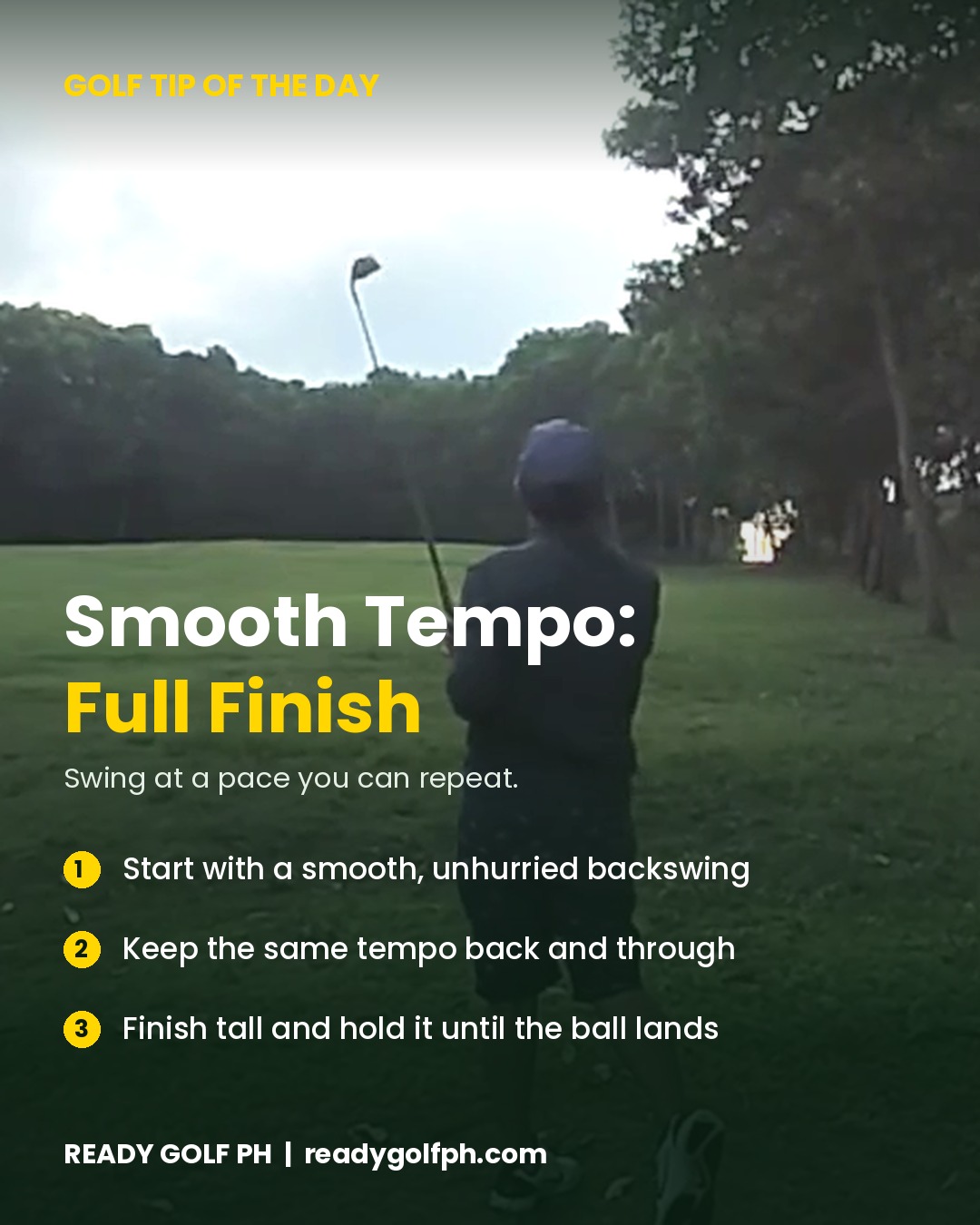
Look at the swing in the clip: nothing rushed, nothing violent. The golfer goes back at an easy pace, comes through at the same pace, and finishes tall and still, club up, weight on the front foot, simply watching the ball fly. That calm rhythm is what we mean by tempo, and it’s one of the most useful habits you can build.
What Tempo Actually Means
Tempo is the speed and rhythm of your swing from start to finish. It isn’t about swinging slowly. It’s about swinging at a pace that stays the same from one swing to the next, so your body can predict what’s coming and your club arrives at the ball in the same way every time.
Most inconsistent swings have a tempo problem hiding inside them:
- A rushed transition. The club starts down before the backswing is finished, so the body and arms get out of sync.
- A jerky start. Yanking the club away from the ball makes the whole swing choppy.
- A late slowdown. Easing off right before impact because you’re afraid of hitting it badly.
Smooth tempo helps with all three. It gives every part of the swing time to do its job.
Why Smooth Beats Hard
When you swing at 100 percent effort, your muscles tighten, your balance suffers and your clubface becomes harder to control. When you swing at roughly 75 to 80 percent, you give up a little speed but gain a lot of accuracy. Over a round, that usually means more fairways and greens, and fewer lost balls.
There’s also a bonus. A smooth swing tends to produce better contact in the center of the clubface, and center contact is where distance really comes from. Plenty of golfers gain yards by swinging easier.
The Three Keys
1. Start with a smooth, unhurried backswing.
Take the club away low and slow, as if you were pouring something out of a pitcher. There’s no need to hurry to the top. Let your shoulders turn and your arms follow along. A good test is to count “one” on the way back and “two” on the way down, with a steady beat between them.
2. Keep the same tempo back and through.
This is the heart of it. Don’t speed up halfway down or try to hit the ball with a burst of effort. The club should keep accelerating naturally on the way through. If your downswing feels like a different swing from your backswing, you’re probably forcing it. Smooth and steady is the goal.
3. Finish tall and hold it until the ball lands.
A full finish is proof of a good swing. Your chest faces the target, most of your weight sits on your front foot, and your back foot is up on its toes. Hold the pose and watch the ball. If you can freeze there comfortably, you stayed in balance. If you stumble forward or fall backward, the swing was too fast or too wild.
A Simple Drill to Build Tempo
The 3-Count Drill. Pick a mid-iron and hit ten balls using this rhythm: count “one-two-three” in your head, with “one” as the start of the backswing, “two” as the top of the swing and “three” at impact. Keep each count the same length. It might feel slow at first, but you’ll find the club still travels with plenty of speed.
Then try the feet-together drill: put your feet close together and make easy half-swings. It’s almost impossible to swing hard and stay balanced this way, so you’ll naturally find a smoother rhythm. Return to your normal stance and keep that feeling.
Common Mistakes to Avoid
- Swinging for the fence. Trying to crush the ball ruins rhythm and balance. Pick an easy target and an easy swing.
- Rushing from the top. Give the backswing time to finish before you start down.
- Cutting the finish short. Stopping the club at impact makes you decelerate. Swing all the way through.
- Stepping or stumbling at the end. That’s a sign the tempo was too fast. Slow down and hold your finish.
- Changing tempo with every club. Your driver swing and wedge swing can be different lengths, but the rhythm should feel the same.
Make It Part of Your Routine
Before each shot, take a slow practice swing and feel the rhythm you want. Then step up, take a breath and repeat it. On the first tee, when nerves are loudest, tempo is your anchor. If you can hold on to a smooth beat, the rest tends to take care of itself.
FAQ
Is a slow swing the same as good tempo?
Not exactly. Good tempo means a steady, repeatable rhythm. It can be quite fast, as long as it’s smooth and doesn’t change from swing to swing.
Will I lose distance with a smoother swing?
Probably not. Most beginners gain consistency, and many gain distance because they hit the ball more solidly.
How do I know my tempo is good?
If you can hold your finish comfortably until the ball lands, you were balanced and your tempo was likely in a good place.
Can I practice this at home?
Yes. Make slow practice swings with a short club in a safe space, counting your rhythm and holding the finish.
Key Takeaways
- A smooth, steady swing beats a hard, rushed one.
- Keep the same rhythm going back and coming through.
- Swing at about 75 to 80 percent effort.
- Finish tall and hold it until the ball lands.
- Practice with the 3-count drill.
Follow us for your daily golf tips.
#beginnergolfer #readygolf #readygolfph #golfforbeginners #golfer #golfswing #golftips #swingtempo