
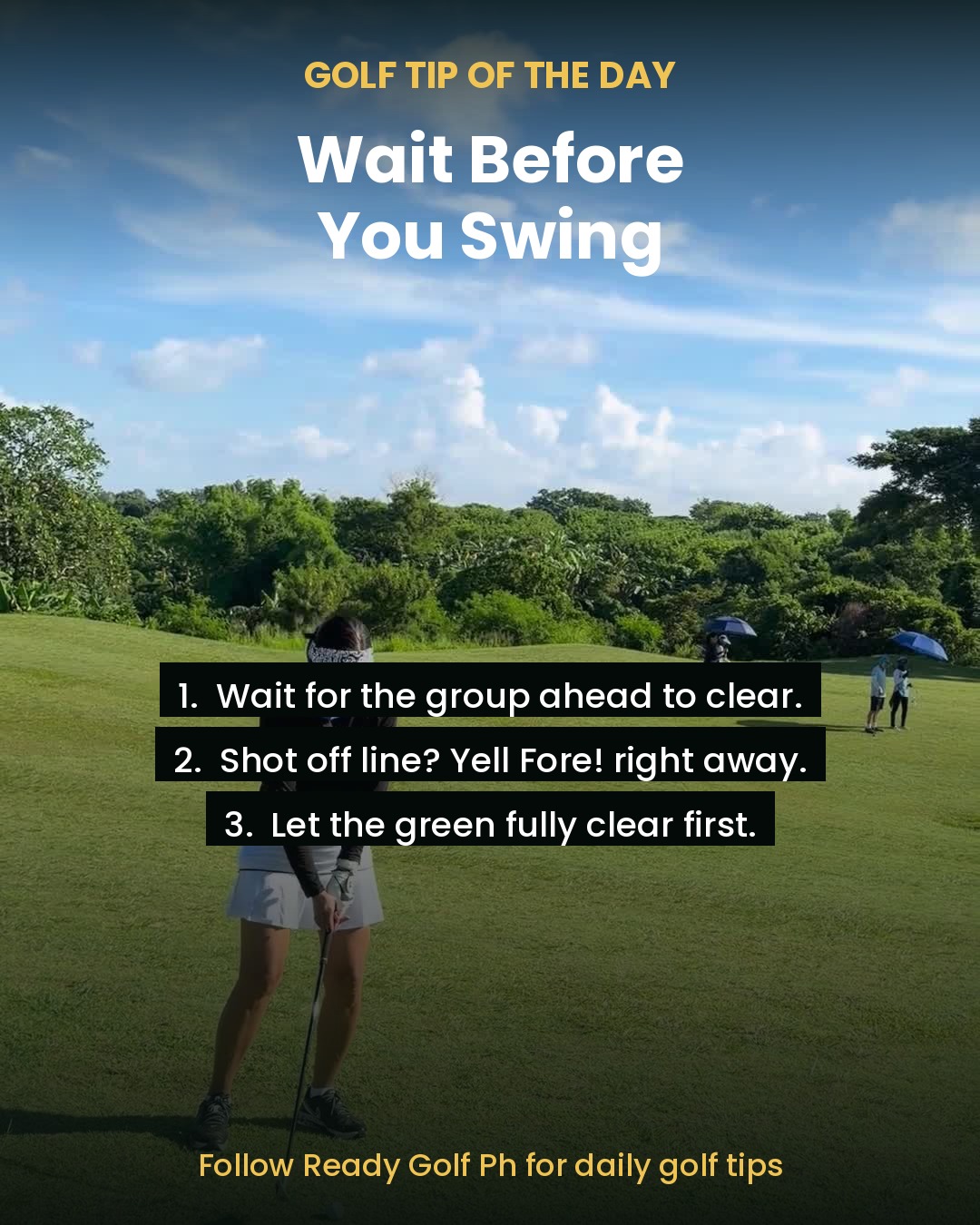
You’re standing over your ball on the fairway, itching to hit your approach shot. The green looks open. Your playing partners are ready to move. But if you look up and there’s still a group walking toward the putting surface, or standing anywhere near where your ball could land, the shot has to wait. This is one of the simplest rules in golf, and also one of the most important, because unlike almost everything else in the game, getting it wrong can genuinely hurt somebody.
Golf balls travel fast, they travel far, and they don’t always go where you intend. A well-struck shot can cover well over a hundred yards in a couple of seconds, and a mishit can squirt sideways into a completely different part of the course than you planned. That combination is exactly why golf has such a strong, unwritten rule about range and timing: you don’t hit until the space in front of you, and anyone in it, is genuinely clear.
Why It Matters
Every other rule in this series is about improving your score or protecting the course. This one is about protecting people, and that makes it non-negotiable in a way nothing else in golf really is. A golf ball hit from a mid-iron or driver carries enough force to cause a serious injury, and it happens because someone assumed the group ahead was “probably” far enough away, or didn’t bother to check at all before pulling the trigger.
The instinct to hurry is understandable. Nobody wants to be the slow group, and standing around waiting can feel like it’s working against the pace of play habits most golfers are trying to build. But there’s an important distinction here: playing efficiently and playing safely are not in conflict. Being ready to hit the moment it’s actually safe to do so is good pace of play. Hitting before it’s safe just because you don’t want to wait is not efficiency, it’s a risk you’re putting on someone else without their consent.
There’s also a course-management angle. Golfers under pressure to keep moving sometimes convince themselves a shot will fall short of the group ahead, when in reality a topped shot, a shot hit further than expected with the wind, or a mishit that goes further left or right than planned can easily change that calculation. You can’t fully control where your ball ends up, which is exactly why the standard has to be full clearance, not a guess about probability.
The Fix
Before every shot where a group is anywhere in view ahead of you, take a real look, not a glance. Confirm they’re out of your range for the club you’re about to hit, meaning well beyond where even a longer-than-expected shot could reach them, and clearly off to the side or off the green rather than lingering near a spot your ball could roll or bounce into. If there’s any doubt, the answer is simple: wait. A few extra seconds standing on the fairway costs you almost nothing. A ball hit into someone costs a lot more.
If you do hit a shot that’s heading toward anyone, on the course or even near it, yell “Fore!” immediately and as loudly as you can. Don’t wait to see if it’s actually going to reach them, and don’t feel embarrassed about it. A loud, early warning gives people time to react, duck, or turn away, and it’s always better to shout an unnecessary warning than to stay quiet on a shot that turns out to be dangerous. This applies even if you’re not fully sure the ball is heading toward a person. When in doubt, shout.
The same patience applies once you reach the green. Don’t walk up to put your bag down or start reading your putt while the group ahead is still finishing their hole, marking scores, or lingering near the cup. Give them the same space and time you’d want extended to you, and treat “the green is clear” as the actual green being empty, not just the players having technically holed out while they’re still standing there chatting.
Communication helps too. If you’re playing with a group ahead that you can see clearly, and it’s appropriate to do so, a quick wave or shout to confirm you’re about to hit can remove any ambiguity. Most golfers appreciate the heads-up, and it removes any guesswork about whether it’s actually safe to play.
Drill to Practice
This isn’t a swing mechanic, so there’s no range drill for it, but there is a habit you can build deliberately. Before every single shot for your next few rounds, make a conscious habit of doing a “clear check” as part of your pre-shot routine, the same way you’d check your grip or your target. Look up, scan the area ahead of you, and mentally confirm out loud or in your head that the space is clear before you address the ball. Doing this consistently, even on shots where the answer is obviously yes, builds the habit so it’s automatic on the shots where the answer might actually be no.
A useful add-on: the next time you’re waiting for a green to clear, use the pause productively instead of impatiently. Take the opportunity to finalize your club selection, visualize the shot, or just relax your grip and breathe, so the waiting doesn’t feel like wasted time working against your rhythm.
Common Mistakes
The most common mistake is treating distance as a guess rather than a genuine check. Golfers often estimate that a group is “far enough” based on a quick look, without accounting for the club they’re about to hit or the possibility of a longer-than-normal shot. Always check against the club in your hand, not against a general sense of distance.
A second mistake is hesitating to yell “Fore!” out of embarrassment, worrying it will look like an overreaction or draw attention to a bad shot. This hesitation defeats the entire purpose of the warning. The point of a warning shout is to give people time to react, and that only works if it comes immediately, loudly, and without self-consciousness.
A third mistake is rushing because of pace-of-play pressure, treating a clear-ahead check as an optional step you can skip when you’re trying to keep the group moving. Genuine pace of play comes from being ready and efficient during the parts of the round that don’t involve anyone’s safety, not from cutting corners on this one.
Finally, some golfers only apply this caution to full shots with a driver or long iron, assuming a wedge or a putt is too weak to be a real risk. Any struck ball can travel further and faster than expected, and the same clear-and-confirm habit should apply regardless of the club in your hand.
FAQ
What should I do if I accidentally hit toward someone?
Yell “Fore!” immediately and as loudly as possible, even if you’re not certain the ball will reach them. It’s always better to give an unnecessary warning than to stay silent on a shot that turns out to be dangerous.
How far away is “safe” for the group ahead?
There’s no single fixed number, since it depends on the club and shot you’re about to hit. The standard is genuine, comfortable clearance for a shot that goes further or more off-line than expected, not the minimum distance for an average shot.
Does this slow down my round?
Barely, if at all. Waiting a few extra seconds for a clear fairway or green costs you almost nothing over the course of a round, especially compared to the time lost dealing with an actual incident.
Is this really that big a deal for casual, beginner-friendly rounds?
Yes, if anything it matters more. Beginners are still building consistency, which means shots are more likely to go further off-line than planned. That makes checking the space ahead even more important, not less.
Key Takeaways
Never hit a shot until the group ahead is genuinely clear of your range, accounting for the club in your hand and the possibility of a longer or more off-line shot than usual. If a shot does head toward anyone, yell “Fore!” immediately and without hesitation. This is the one rule in golf that exists purely for safety rather than score or etiquette, and it costs almost nothing to follow well.
#ReadyGolfPH #GolfTips #GolfSafety #GolfEtiquette #BeginnerGolfer #GolfPhilippines