
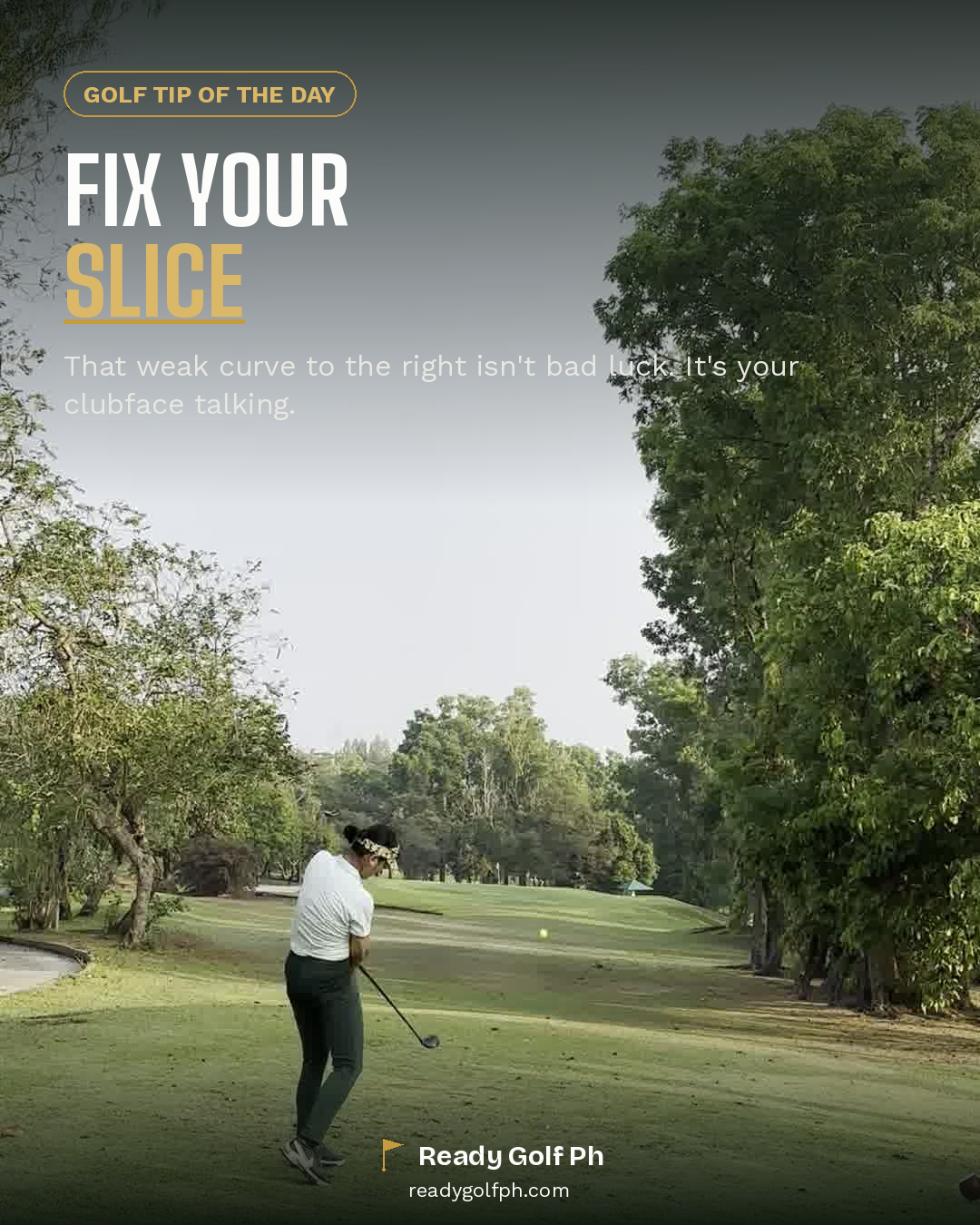
Almost every golfer has hit it: a shot that starts out promising, then peels weakly off to the right and lands well short of where it should. It is one of the most common misses in the game, and also one of the most misunderstood. Most golfers blame the slice on swinging too hard, or bad luck, or the wrong club. The truth is simpler and much more fixable than that. A slice has a specific, mechanical cause, and once you understand it, the fix stops being a mystery.
What a Slice Actually Is
A slice happens when the ball spins from left to right in the air, curving away from a right-handed golfer’s target. It is not randomness. It comes from two things happening at once: the clubface is open relative to your swing path at impact, and that swing path is usually cutting across the ball from outside to inside. The combination puts sidespin on the ball, and the more open the face is relative to the path, the more dramatic the curve. Understanding that a slice is a face-and-path problem, not a strength or effort problem, is the first step to actually fixing it.
Why Swinging Harder Makes It Worse
A natural instinct when a shot goes badly is to swing harder next time, as if more effort will force the ball to behave. With a slice, this backfires. Increasing swing speed while keeping the same open face and out-to-in path just adds more spin, which makes the curve more severe, not less. That is why a slicer’s worst shots often happen right when they try hardest to power through the ball. The fix isn’t more effort. It’s a different clubface and a different path.
The Fix: Three Reasons Your Slice Happens
Check your grip first. A weak grip, where your hands are rotated too far toward the target on the club, makes it very hard to square the clubface by impact. At address, you should be able to see roughly two knuckles on your lead hand when you look down. If you see none, your grip is likely contributing to that open face. This is the cheapest, fastest fix available, and it costs you nothing but a few practice swings to feel the difference.
Retrain your swing path. Most slicers swing across the ball from outside the target line to inside it, which is what puts the cutting sidespin on the shot. A simple mental image helps: imagine you’re trying to swing the club out toward right field, like a baseball player driving a ball to the opposite side. That feeling of swinging “out” rather than “across” moves your path in the right direction, even before your face angle catches up.
Square the clubface before you ever start your swing. A slice is often decided before the club ever moves. If the face is already open at address, relative to your target line, you are fighting an uphill battle from the very first inch of the swing. Take a moment before every shot to consciously check that the face looks square to where you’re aiming, not just close to it.
Why the Fix Works Together, Not Alone
These three pieces work as a system. A stronger grip helps you square the face more naturally. A better swing path stops you from cutting across the ball. A square setup gives both of those things a fair starting point. Golfers who fix only one piece, like the grip, and ignore the others often see a smaller, more manageable slice instead of a cured one. Working on all three together is what actually straightens the shot out.
Common Mistakes Golfers Make Fixing a Slice
A common mistake is aiming further left to “allow” for the slice instead of fixing the cause, which only works until the curve gets worse and the miss gets worse with it. Another mistake is over-focusing on the grip alone and assuming that will fix everything, when the swing path still needs separate attention. A third mistake is trying to fix a slice only on the course, under score pressure, instead of doing the repetitions on the range first where there’s no penalty for a bad rep.
Building a Straighter Ball Flight Over Time
Fixing a slice is rarely a one-swing fix. It’s a habit you build over a series of range sessions, checking your grip at address, feeling that out-to-right-field swing path, and confirming your face is square before you commit to the shot. Small, repeated corrections compound. Golfers who stick with this process for a few weeks typically see the big banana slice shrink into a small, playable fade, and eventually into a shot they can actually predict and trust.
FAQ
Is a slice caused by swinging too hard?
Not directly. Swinging harder amplifies whatever face angle and path you already have. If your face is open and your path cuts across the ball, more speed just makes the slice worse, not better.
Will a stronger grip completely fix my slice on its own?
It helps significantly, but usually not completely. A stronger grip makes it easier to square the face, but if your swing path is still cutting across the ball, you’ll likely still see some curve, just less severe.
How long does it usually take to fix a slice?
It varies by golfer, but most people who focus on grip, path, and setup consistently see real improvement within a few range sessions, with the shot continuing to straighten out over a few weeks of practice.
Key Takeaways
- A slice comes from an open clubface combined with an out-to-in swing path, not from lack of effort.
- Swinging harder makes a slice worse, since it adds spin to the same faulty face angle and path.
- Check your grip first: you should see roughly two knuckles on your lead hand at address.
- Feel like you’re swinging out toward right field to correct an out-to-in path.
- Square your clubface at setup, before the swing ever starts, to give yourself a fair chance at impact.
Ready Golf Ph – daily tips to help you play smarter and score better, one round at a time.