
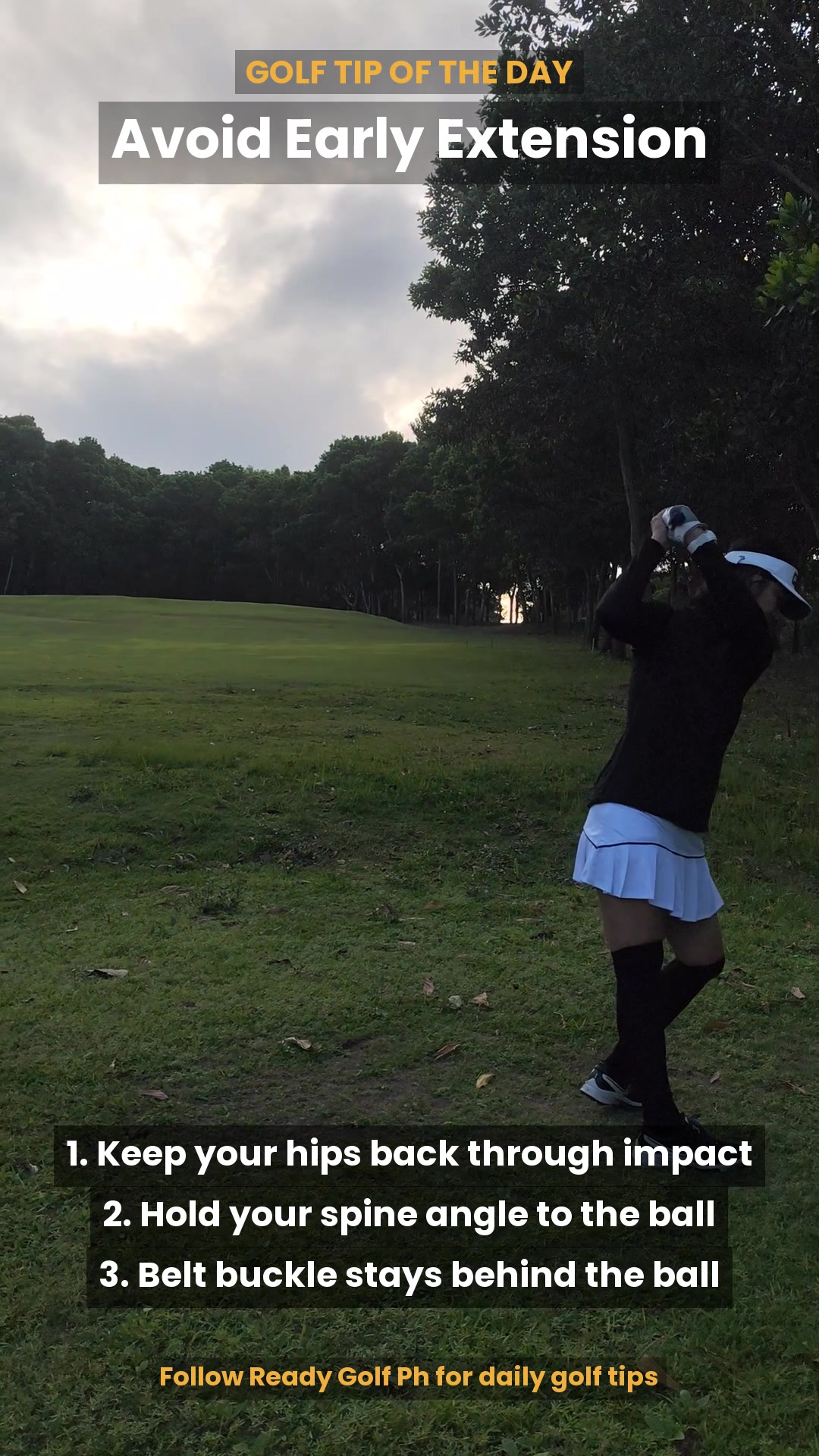
Ever catch a shot thin, or feel like you’re fighting your own body just to make contact? There’s a good chance the real problem isn’t your hands or your grip. It’s happening earlier in the swing, when your hips thrust toward the ball and your whole body stands up out of its posture. That move has a name: early extension, and it’s one of the most common power leaks in golf, at every skill level.
The frustrating part is that early extension often feels like it’s helping. Standing up gives you a sense of extra effort, like you’re throwing everything into the shot. In reality, it’s doing the opposite. It shortens the space your arms and the club have to work with, forces awkward compensations just to reach the ball, and turns what should be a simple, repeatable motion into a timing gamble every single swing.
Why It Matters
Early extension happens when, somewhere between the top of the backswing and impact, your hips and pelvis move forward toward the ball while your upper body simultaneously stands up taller. Instead of rotating around a stable spine angle, your whole posture rises and shifts forward at the exact moment you need the most stability.
The immediate effect is a loss of space. Golf instructors sometimes call this “losing your posture” or “standing up on it,” and the description is accurate. When your body moves toward the ball, there’s less room for your arms to swing freely through impact, so your body compensates by pulling the arms up and away, or by flipping the hands to try to save the shot. Neither compensation is consistent, which is why early extension shows up as a mix of misses: thin shots, fat shots, shanks, and shots that start well right of target before curving further off line.
There’s also a power cost. A stable spine angle lets your body rotate efficiently, transferring energy from your bigger muscles (hips, core, shoulders) down through your arms and into the clubhead. When you stand up early, you interrupt that chain. Some of the energy that should be accelerating the club gets redirected into that upward, forward movement instead, which is why golfers who fix early extension often report more distance without swinging any harder.
Beyond ball-striking, early extension is also a common source of lower back strain, since it asks your spine to do work it wasn’t built to do efficiently under load, repeated swing after swing, round after round.
The Fix
The good news is that early extension is very learnable to feel and correct, because the fix comes down to one core idea: keep your hips back and your spine angle intact from address all the way through impact.
Start at setup. Get into your normal posture, bent from the hips with a slight flex in your knees, and pay attention to where your rear end sits relative to your heels. A good checkpoint is feeling like your glutes are gently pushed back, almost like you’re about to sit on a tall stool behind you. This is the posture you want to maintain, not just hold at address and then abandon on the way down.
During the backswing and especially the transition into the downswing, the goal is to rotate your hips rather than let them slide or thrust toward the ball. Feel like your trail hip is working around and behind you, not forward. A useful mental cue many instructors use is “keep your belt buckle behind the ball” through impact, rather than letting it race ahead and point at the target too early.
A simple way to build the feeling: at address, get into your posture, and have a training partner (or simply notice on your own) hold light pressure against your hips from behind. Practice making slow backswings and downswings while keeping constant, gentle contact with that pressure. If you stand up or thrust forward, you’ll immediately lose that contact, which gives you real-time feedback that’s hard to get any other way.
Video is also incredibly useful here. Because early extension happens fast and can feel subtle in the moment, filming your swing from a face-on angle (the same angle used in the tip photo above) often reveals it clearly, especially when you compare your posture at address to your posture at impact.
Drill to Practice
The “wall drill” is one of the simplest, most effective ways to feel and correct early extension without needing a full range session.
Stand in your golf posture with your rear end lightly touching a wall, a golf bag, or any similarly-placed object positioned just behind you. Take slow, controlled half-swings, focusing only on maintaining that light contact with the wall throughout the entire motion, from address through impact and into the follow-through.
At first, go slowly enough that you can actually feel the moment your hips want to drift away from the wall. That moment is exactly where early extension would happen in a full-speed swing. Repeat the slow-motion swing until you can complete it smoothly without losing contact, then gradually build up speed while keeping the same feeling.
Once the half-speed version feels natural, try it with a few full swings, ideally still checking on video, to confirm the improved posture is holding up when you swing at a more realistic speed. This drill translates well to the course too: before addressing a shot, a quick reminder to “keep contact with the wall” (even without an actual wall present) can cue the right feeling.
Common Mistakes
The most common mistake is trying to fix early extension by consciously “staying down” with the upper body alone, without addressing the hip movement that’s actually driving the fault. This often creates a new problem: golfers hunch or crouch artificially instead of rotating properly, which limits power just as much as the original issue.
Another mistake is only practicing the fix at slow speed and never testing it at full swing speed. Early extension tends to sneak back in under speed and pressure, so it’s important to gradually build the corrected feeling into faster swings rather than assuming a slow-motion fix will automatically transfer.
Some golfers also overcorrect into the opposite fault, sitting down too much or staying so far back on their heels that they lose balance in the other direction. The goal is a stable, athletic posture maintained throughout the swing, not an exaggerated crouch.
Finally, skipping the video check is a missed opportunity. Early extension can be genuinely hard to feel from the inside, since the movement often happens in a fraction of a second and the golfer’s own sense of “staying down” doesn’t always match what’s actually happening. A short video clip, even from a phone propped against a bag, removes the guesswork.
FAQ
How do I know if I have early extension?
Common signs include thin or fat contact, shots that start right of target (for a right-handed golfer) before curving further offline, and a general feeling of running out of room on the downswing. Filming your swing from face-on and comparing your hip position at address to impact is the most reliable way to confirm it.
Is early extension only a problem for beginners?
No. It shows up at every level of the game, including tour professionals, though better players often manage smaller amounts of it more consistently. For most recreational golfers, though, reducing early extension leads to noticeably more consistent contact.
Will fixing early extension really add distance?
Often yes, because a stable spine angle allows more efficient energy transfer through the swing. Many golfers find they can generate more clubhead speed with less effort once the fault is corrected, simply because less energy is being lost to the upward, forward movement.
Do I need a coach to fix this?
A coach can speed up the process and give real-time feedback, but the wall drill and video comparison described above are genuinely effective on their own for golfers who want to work on it independently first.
Key Takeaways
Early extension, standing up and thrusting your hips toward the ball during the downswing, is one of the most common and most costly swing faults in golf. It steals the space your arms need to deliver the club, forces inconsistent compensations, and quietly drains power that could otherwise go into your shots. The fix starts with awareness: keep your hips rotating back and around rather than sliding forward, hold your spine angle from address through impact, and use a simple checkpoint like “belt buckle behind the ball” to keep yourself honest. The wall drill, paired with an occasional video check, is enough to build a noticeably more stable, more powerful swing over time.
#ReadyGolfPH #GolfTips #GolfSwing #SwingMechanics #BeginnerGolfer #GolfPhilippines