
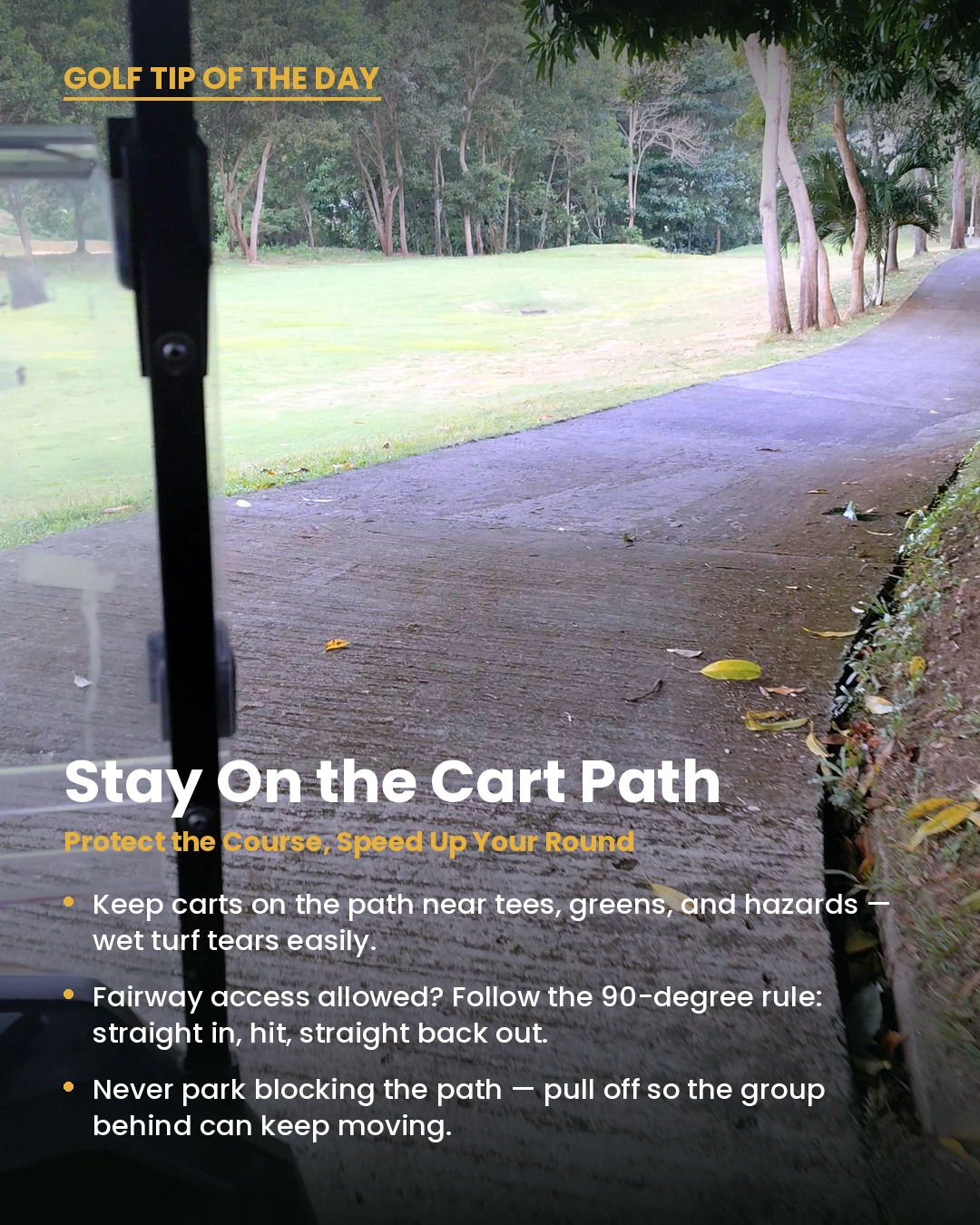
It’s easy to think of a golf cart as harmless. It doesn’t leave the deep divots a mishit iron shot does, it doesn’t ball-mark the green, and nobody’s ever been penalized two strokes for driving one badly. But over the course of a single busy weekend, the wheels of forty or fifty carts rolling across the same strip of turf can do more lasting damage to a course than every spike mark and divot from that day combined. Ready Golf Ph readers already think about pace of play and course courtesy — cart path etiquette belongs right alongside those habits, and it’s one of the easiest to get right once you know the actual rules.
Most golfers were never formally taught cart etiquette. You get handed the keys, or you hop in as a passenger, and you pick up the “rules” by watching whatever the group ahead of you happens to do. Sometimes that’s fine. Often it means bad habits — cutting corners near the green, parking wherever’s convenient, treating the fairway as open territory — get passed down from one round to the next.
Why It Matters
Grass under repeated cart traffic compacts the soil, and compacted soil struggles to grow healthy turf. That’s true anywhere on the course, but it’s especially true in three zones: right around tees, right around greens, and anywhere near a hazard or a slope where water tends to collect. These are exactly the spots where the temptation to cut close with a cart is strongest, because they’re also exactly where you’re getting in and out to hit your shot. A course that gets driven across in the same spots day after day starts to show it — thinning turf, ruts, bare patches that take weeks of careful grounds work to recover from, if they recover at all before the next round of cart traffic undoes the repair.
Rain makes this dramatically worse. Wet turf is soft, and soft turf under the weight of a loaded golf cart tears and ruts far more easily than dry turf does. A path that would tolerate a cart crossing it on a dry afternoon can get chewed up by the same cart after a morning downpour. This is exactly why most courses post “cart path only” signage after rain, or restrict fairway access entirely for a day or two until things firm back up. It’s not the course being precious — it’s basic turf management, and ignoring it costs everyone who plays there for weeks afterward.
There’s a pace-of-play angle too, which is where this stops being purely about course care and starts being about your own round. Carts that wander, stop in odd places, or have to backtrack because someone drove somewhere they shouldn’t have slow everyone down, not just the driver. A group that handles its cart cleanly and efficiently — path when required, straight lines when fairway access is open, sensible parking — plays faster almost without trying.
The Fix
The core habit is simple: default to the cart path near tees, greens, and hazards, every time, regardless of whether signage is posted that day. These are the zones most vulnerable to compaction and the ones grounds crews care about most. If the course allows fairway access elsewhere, that’s fine to use, but treat tees, greens, and hazard margins as path-only as a personal rule, not just when you’re told to.
When fairway access is allowed, use the 90-degree rule. This is the standard most courses actually operate on, whether or not they spell it out: from the cart path, turn 90 degrees onto the fairway, drive straight to your ball, hit your shot, then drive straight back out to the path the same way you came in rather than continuing on across the turf. This keeps cart traffic concentrated in short, predictable lines instead of spread across the whole fairway in wandering paths that compound over a full day of groups doing the same thing slightly differently.
Parking is the other half of good cart etiquette, and it’s the part golfers think about least. Never leave a cart sitting where it blocks the path for the group behind you, even for what feels like “just a minute” while you finish a shot. Pull off to the side, ideally on the side closest to your ball or your next tee, so play behind you isn’t held up and so you’re not creating a bottleneck at a blind corner or a narrow stretch of path. On tee boxes especially, park well clear of the teeing area itself so the group isn’t dodging a parked cart mid-swing.
One more habit worth building: read the course’s signage and flags for the day. Many courses use directional arrows, roped-off sections, or “cart path only” flags that change based on recent weather or maintenance work. These aren’t permanent fixtures you can learn once and ignore — they shift day to day, and a quick glance at the pro shop or starter’s instructions before you tee off tells you what’s actually in effect that day.
Drill to Practice
This isn’t a swing drill, but it’s worth treating as deliberately as one. On your next few rounds, make a point of narrating the 90-degree rule out loud to yourself or your cart partner every time you pull off the path: “straight in, hit, straight out.” It sounds unnecessary, but turning it into a spoken habit is exactly how it becomes automatic instead of something you only remember when a marshal is watching.
If you’re playing with newer golfers or introducing someone to the course for the first time, use your own cart habits as the teaching moment. Point out the cart path zones near tees and greens, explain why they matter, and let them see the 90-degree rule in action rather than just telling them about it. Etiquette spreads fastest when it’s demonstrated, not lectured.
Common Mistakes
The most common mistake is treating cart rules as optional suggestions rather than course care. Golfers who’d never dream of taking a divot on the green somehow don’t extend the same instinct to driving a cart across it — but the damage, while less dramatic in the moment, adds up the same way.
A second mistake is ignoring “cart path only” days because the fairway “looks fine.” Turf can look dry on the surface while staying soft and vulnerable a few inches down, especially the morning after rain. If the course has posted path-only restrictions, that’s a grounds-crew call based on conditions you can’t fully judge by eye — respect it rather than second-guessing it.
A third mistake is casual parking — leaving the cart at an angle that blocks sightlines or the path itself, or parking on the apron of a green rather than well back from it. It feels minor in the moment but creates real slowdowns and, near greens specifically, risks compacting some of the most sensitive turf on the entire course.
Finally, some golfers only apply cart etiquette when a marshal or other golfers are visibly nearby, and relax it on quieter days or later rounds. The course doesn’t distinguish between a busy Saturday morning and a quiet Tuesday afternoon when it comes to compaction damage — the habit needs to hold regardless of who’s watching.
FAQ
Why can’t I just drive close to my ball if no one’s around?
Turf damage from cart traffic doesn’t depend on whether anyone sees it happen. A quiet round is still adding wear to the same ground every other round that day is adding wear to, and the cumulative effect is what causes lasting damage.
What does the 90-degree rule actually mean?
It means you exit the cart path at a right angle, drive the shortest reasonable line straight to your ball, and return to the path the same way — rather than driving parallel to the path for a stretch before cutting in, which multiplies the amount of fairway getting driven over.
Is it ever okay to drive a cart near the green?
Generally no. Most courses want carts parked well back from the green and its surrounding apron, with players walking in the rest of the way. This is one of the most protected zones on the course because the turf there is maintained to a much finer standard than the fairway.
What should I do if I’m not sure whether cart path only is in effect?
Ask at the pro shop or check with the starter before you head out. Conditions can change overnight after rain, and a thirty-second question up front avoids guessing wrong on the course.
Key Takeaways
Golf carts feel low-impact compared to a mishit shot, but repeated cart traffic in the same zones — tees, greens, hazard margins — compacts turf and does real, lasting damage, especially after rain. The fix is simple and doesn’t cost you anything in your round: default to the cart path in sensitive zones, use the 90-degree rule when fairway access is open, and park considerately so you’re never blocking the group behind you. It’s a small set of habits that protects the course you keep coming back to and, as a bonus, keeps everyone’s round moving at a better pace.
#ReadyGolfPH #GolfTips #GolfEtiquette #CourseCare #BeginnerGolfer #GolfPhilippines