
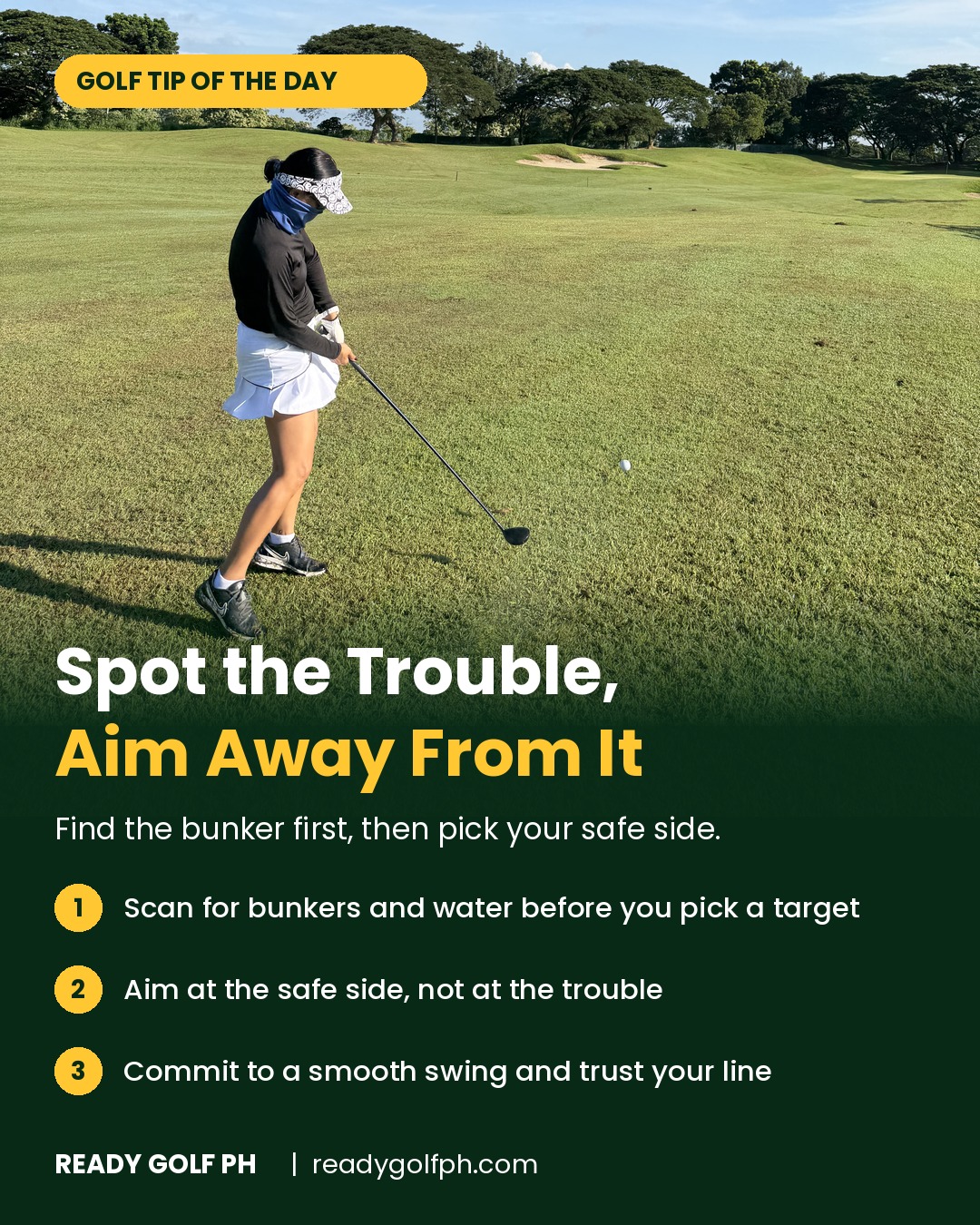
Take a look at the photo above. A golfer stands over her ball on a wide, open fairway on a clear morning. Far down the hole, tucked beside the green, sits a small patch of pale sand. It is a bunker, and from where she stands it looks tiny. Beautiful course, big sky, lots of room. And yet that little patch of sand is exactly the kind of thing that quietly ruins scorecards.
Most beginners never plan for hazards. They look at the flag, point themselves at it, and swing. If the ball finds the sand, the water or the trees, it feels like bad luck. Often it isn’t. It is simply what happens when the plan was “hit it at the target” and the target was right next to trouble. The fix costs nothing and takes about ten seconds: spot the trouble first, then aim away from it.
Why Hazards Catch So Many Golfers
Golf courses are designed to tempt you. The flag is placed near the bunker. The prettiest line runs beside the water. Your eyes want to go there, and where your eyes go, your body follows.
There is also a mental trap. When you stare at a hazard and think “don’t hit it in the bunker,” your brain mostly hears “bunker.” Your swing tightens, your target gets fuzzy, and the ball drifts toward the very place you wanted to avoid. Good players don’t fight this with willpower. They change the picture. They stop looking at the trouble and choose a target on the safe side instead.
Here is the other thing beginners miss: you do not need to be fancy. A shot that finishes twenty feet from the pin on the safe side beats a shot aimed at the flag that finishes in the sand. A bunker shot is one of the harder things in golf to do well. Avoiding it entirely is much easier.
The Three-Step Routine
1. Scan for trouble before you pick a target
Before you decide anything, look at the whole hole. Check the sides of the fairway, the front, back and sides of the green, and anything in between. Bunkers, water, out-of-bounds stakes, thick rough, trees. You are not judging the shot yet. You are just taking inventory.
Do this as you walk up to your ball, not while standing over it. The walk is free planning time, and you will see far more from a few steps back than you will from address, where everything looks flat.
Ask yourself two questions. Where is the trouble? And which side of the target is the safe side?
2. Aim at the safe side, not at the trouble
Once you know where the trouble sits, build your plan around it. If the bunker guards the right side of the green, your target is the left-center. If water runs down the left of the fairway, you aim at the right half of the fairway and let the shot have room.
A good rule of thumb is to give a hazard a generous margin. If you aim at the edge of a bunker, even a slightly imperfect shot ends up in it. If you aim at the middle of the safe area, a slightly imperfect shot still ends up on the grass.
In the photo, the bunker is a long way ahead and off to one side. That is a perfect example of why this habit matters. The golfer has a huge amount of fairway to work with. Choosing a target well away from the sand turns a risky shot into an easy one.
Don’t forget your own miss. If you tend to slice right, a right-hand bunker is more dangerous for you than for someone who hooks. Aim to the side where your usual miss does the least damage.
3. Commit to a smooth swing and trust your line
This is the step that makes the first two work. After you have chosen a safe target, pick a small spot to aim at, such as a patch of different-colored grass, a distant tree top or a mark on the fairway. Look at that, not at the hazard.
Then take your practice swing, step in and go. Do not add extra speed because you are nervous. Do not steer the ball. A tight, hurried swing is the fastest way to send the ball somewhere you didn’t plan. Smooth tempo and a clear picture will do far more for you than power.
A Simple Example
Say you are 140 yards from the green with a pin on the right side and a bunker just short and right of it. You could fire at the flag. If you hit it perfectly, great. If you leave it a few yards short or right, you are in the sand with a tricky shot and likely a bogey or worse.
Or you can aim at the center of the green. A good shot leaves a manageable putt. A slightly weak shot still finishes on the grass. A slightly pulled shot is still safe. Over a full round, that second choice saves you several strokes without asking you to hit a single extra-good shot.
A Quick Drill to Build the Habit
Try this over your next two or three rounds.
- On every full shot, say the trouble out loud before you pick your club. For example, “bunker front right” or “water on the left.”
- Name your safe side, and name a specific target on that side.
- Take one calm practice swing while looking at that target, then hit.
By the second round you will start doing this without thinking. By the third, you will probably notice that you are making fewer big numbers, which is where most beginners lose their scores.
Common Mistakes
- Aiming at the flag by default. The flag is not always your friend. When trouble is close to it, aim for the middle of the green.
- Staring at the hazard. Looking at the bunker tells your body to go there. Look at your target instead.
- Ignoring your own miss. Know which way your ball usually goes under pressure and choose the safe side accordingly.
- Swinging harder to “clear” trouble. Extra effort usually means worse contact. Take one more club if you need the carry and swing smoothly.
- Planning over the ball. Scout on your walk, decide early and arrive ready to hit. That also keeps the pace of play moving, which is the heart of ready golf.
Frequently Asked Questions
How do I stop hitting my ball into bunkers?
Start by choosing a target away from them. Most bunker shots come from aiming too close to the sand, not from a bad swing. Give hazards a wide margin and aim at the center of the safe area.
Should I always avoid bunkers completely?
Not always, but as a beginner it is a smart default. Sand shots are harder than most players expect, so staying out of them saves strokes and frustration. Once your game grows, you can start taking on more risk.
What if I’m nervous about a hazard even after I pick a safe target?
Shift your focus. Pick a tiny, specific spot on your safe line and look only at that. Take a slow breath, make a smooth practice swing and let your routine do the work.
Does this apply to water and out-of-bounds too?
Yes. The same three steps work for any hazard: scan, aim at the safe side, commit. The bigger the penalty, the more margin you should give yourself.
Is aiming away from trouble the same as playing scared?
No. It is playing smart. Experienced golfers do this on every hole. They simply make the safe choice automatically and save the bold shots for when the odds are in their favor.
Key Takeaways
- Look for bunkers, water and other trouble before you choose a target.
- Aim at the safe side, with a generous margin, and account for your usual miss.
- Pick a small target, stay smooth and commit to the shot.
- A shot on the safe side of the green beats a perfect-or-penalty shot at the flag.
- Scout while you walk up, so you are ready to play when it is your turn.
Follow Ready Golf Ph for your daily golf tips.
#beginnergolfer #readygolf #readygolfph #golfforbeginners #golfer #golftips #coursemanagement