
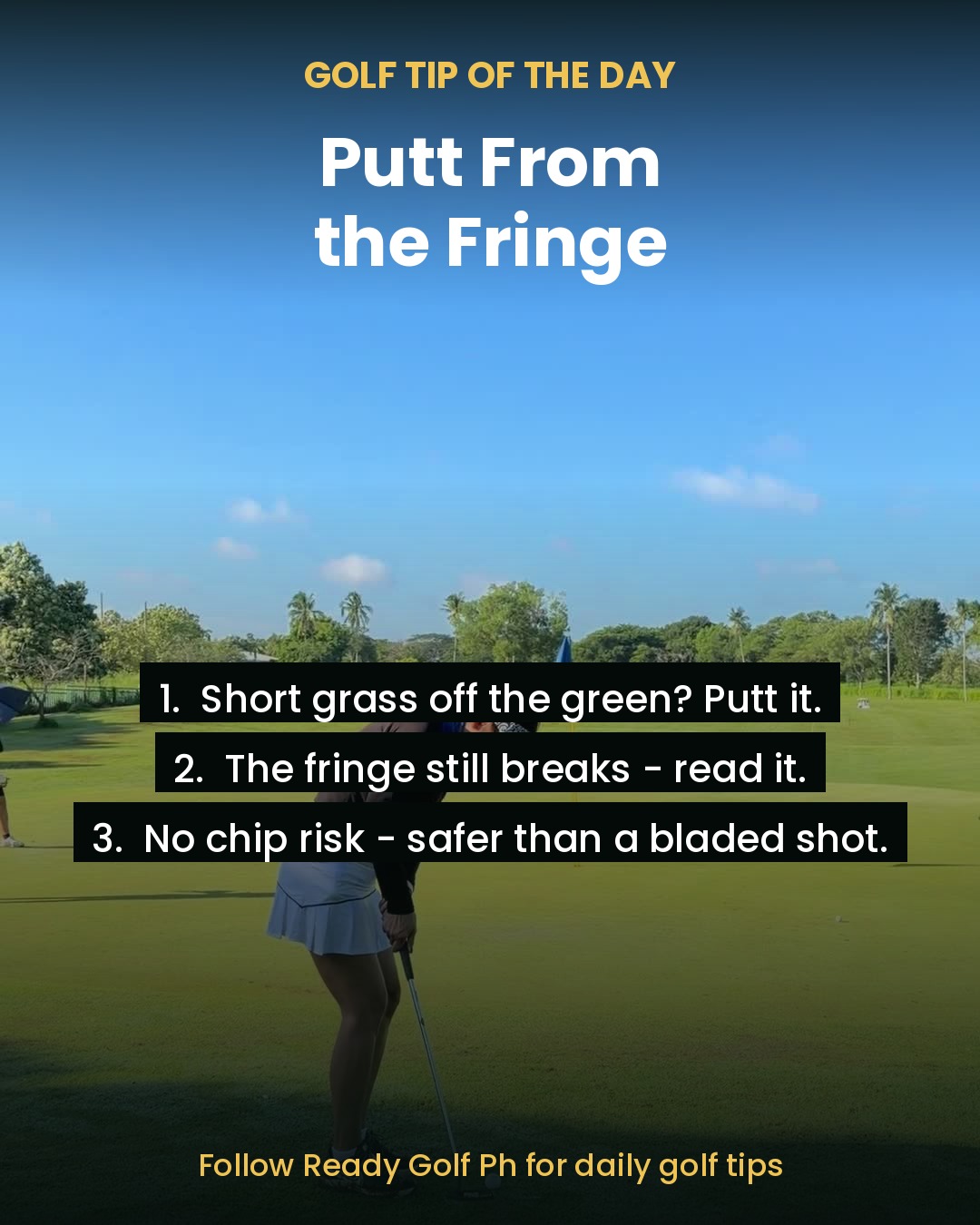
Your ball comes up just short of the green. It’s sitting in the fringe — that narrow band of slightly longer grass between the fairway and the putting surface — a foot or two off the actual green. Most golfers reach for a wedge without a second thought, because that’s what you do around the green, right? Not always. If the grass in front of you is short, even, and sitting the ball up cleanly, putting it is often the smarter play, and it’s one of the most underused shots in casual golf.
This shot has a nickname for a reason: golfers call it the “Texas wedge,” a putter used from off the green as if it were a bump-and-run club. It isn’t a trick or a shortcut. It’s a legitimate, high-percentage option that tour players use constantly, and it deserves a real spot in your own decision-making the next time your ball finishes just short of the putting surface.
Why It Matters
Chipping and putting solve the same basic problem — getting the ball from just off the green to the hole — but they carry very different risk profiles. A chip requires you to strike the ball cleanly with the leading edge of a lofted club, on a small margin of turf, often under a bit of adrenaline because you can see the flag and want to get it close. Miss that strike by a few millimeters and you can blade it across the green or chunk it a few feet in front of you. A putter removes almost all of that risk. There’s no loft to control, no bounce to manage, and no strike location that will send the ball flying off target. You’re using the same stroke you already trust on the green, just started a little earlier.
The math backs this up. Statistically, even skilled amateurs get the ball closer to the hole more consistently with a putter from the fringe than with a chip, simply because putting removes an entire category of mishit. A mediocre putt from the fringe usually still finishes within a few feet of the hole. A mediocre chip can finish anywhere from stone dead to twenty feet away, or worse. When the outcome of a bad putt is “a bit long or short” and the outcome of a bad chip is “completely off line,” the putter is doing you a favor.
There’s a mental side to this too. Standing over a chip near the green, especially with a bit of pressure or an audience, is one of the moments where tension creeps into a golfer’s hands the fastest. A putting stroke is calmer by nature — it’s shorter, slower, and more repetitive, which means there’s less room for nerves to sabotage the motion. Choosing to putt from the fringe, when the lie allows it, is as much about protecting your composure as it is about protecting your score.
None of this means chipping is a bad shot or that you should never use it. When the grass is long, wet, uneven, or sitting the ball down, or when you have to carry a bunker, fringe, or slope to reach the putting surface, a chip is still the right tool. The point isn’t to abandon the chip shot — it’s to stop reaching for it automatically when a simpler, lower-risk option is sitting right in front of you.
The Fix
Before you pull a club, take a few seconds to actually assess the grass between your ball and the green. Ask yourself three quick questions. Is the grass short and even, similar in length to the fringe or first cut rather than thick rough? Is the ball sitting up cleanly, not nestled down or sitting in a divot? And is the path to the hole relatively flat, without a ridge, bunker, or steep slope in the way? If the answer to all three is yes, the putter is almost always your best option.
Once you’ve decided to putt it, treat the shot with the same routine you’d use on the green. Walk up and check the line the way you would for any putt, because the fringe still has grain and slope just like the putting surface does — it just might be running slightly slower due to the longer grass. Read it as an extension of the green, not as a separate shot with different rules. A putt from the fringe that breaks two feet on the actual green will usually still break, just a bit less exaggerated, while it’s rolling through the fringe itself.
Adjust your speed expectations slightly. Longer grass creates more friction, so a putt struck with your normal green-side pace will often come up short once it crosses from the fringe onto the green. The fix isn’t a different stroke — it’s a firmer, more committed stroke than you’d use for the same length putt entirely on the green, so the ball has enough pace to keep rolling once it reaches the faster surface.
Finally, trust the read and commit. One of the biggest reasons golfers abandon a good decision mid-shot is second-guessing the putter choice right before impact, which leads to a tentative, decelerating stroke. If you’ve checked the lie and the grass and decided to putt it, commit to the same confident stroke you’d trust anywhere else on the green.
Drill to Practice
Find a spot on the practice green where you can drop a few balls just off the putting surface, in the fringe or first cut, at varying distances from three to fifteen feet. Putt each one, focusing specifically on pace rather than line, since pace is the part that changes most when you’re rolling the ball through longer grass before it reaches the green. Pay attention to how much firmer you need to hit it compared to the same length putt struck entirely from the green, and adjust until your speed feels natural again.
A useful variation: alternate between a chip and a putt from the exact same spot and distance, and track which one finishes closer to the hole over ten to fifteen attempts. Most golfers are surprised at how often the “boring” putt outperforms the chip, and seeing the results for yourself builds the confidence to actually choose the putter on the course instead of defaulting to a wedge out of habit.
Common Mistakes
The most common mistake is treating the decision as automatic in either direction — always chipping because that’s the reflex around the green, or always putting because it worked once. Every fringe lie is different, and the decision should come from a quick, honest look at the grass and the ball’s lie, not from habit.
A second mistake is putting from the fringe with the same speed you’d use on the green itself, without accounting for the extra friction of the longer grass. This is the single biggest reason fringe putts come up short, and it has nothing to do with the read — it’s purely a pace miscalculation that a little practice fixes quickly.
A third mistake is trying to putt from a lie that doesn’t actually support it — ball sitting down in thicker grass, or a bump or ridge between the ball and the green that a rolling putt won’t handle cleanly. The Texas wedge is a great option on the right lie and a poor one on the wrong lie, and knowing the difference is the whole skill.
Finally, some golfers get self-conscious about putting from off the green, worried it looks unconventional in front of playing partners. It isn’t. It’s a shot with a long history in the game, used by professionals on the biggest stages, and choosing the shot that gives you the best real chance of getting close is always the right call, regardless of how it looks.
FAQ
Is putting from off the green actually allowed?
Yes. There’s no rule requiring you to use a lofted club near the green. Any club, including the putter, can be used from anywhere on the course, including the fairway, fringe, or rough.
How do I know if the grass is short enough to putt through?
As a rough guide, if the grass looks and feels similar in length to the fringe itself rather than the rough, and the ball is sitting cleanly on top of it rather than nestled down, it’s usually short enough to putt through cleanly.
Should beginners use this shot more often?
Yes, especially beginners. Chipping consistently well takes time and repetition to build reliable contact. Putting is a skill most beginners already have some comfort with, and leaning on it around the green while the chipping technique develops is a smart way to protect your score in the meantime.
Does the fringe really break like the green?
Yes, generally in the same direction, though often a little less dramatically due to the longer grass. Read it the same way you’d read a putt on the green, and adjust slightly for the softer break and slower speed.
Key Takeaways
When your ball sits just off the green in short, even grass with a clear path to the hole, putting it is often a smarter and lower-risk choice than chipping. The fringe still breaks like the green, so read it the same way, but expect to hit it firmer to account for the extra friction of longer grass. This shot, sometimes called the Texas wedge, isn’t a shortcut — it’s a legitimate tool that removes an entire category of mishit and keeps your short game simple under pressure.
#ReadyGolfPH #GolfTips #ShortGame #PuttingTips #GolfPhilippines #BeginnerGolfer