
Most golfers spend their practice time working on the stroke itself, the takeaway, the tempo, the follow-through, and almost none of it on what happens before the putter ever moves. That is a mistake, because a stroke built on top of poor posture is fighting an uphill battle before it starts. If your setup puts your spine, arms, and eyes in the wrong place, even a technically sound stroke will struggle to deliver the putter face square and on line, putt after putt.
Putting posture rarely gets the same attention as full-swing fundamentals, but it deserves it. A stable, repeatable setup is what lets your stroke work the same way every time, which is the entire foundation of consistent putting. Get the posture right and a simple pendulum stroke becomes remarkably reliable. Get it wrong and you will spend your whole round compensating for a setup that was never built to repeat.
Why It Matters
Putting is a game of precision measured in inches, and small setup errors get magnified over the length of the stroke. Stand with your spine rounded instead of hinged from the hips, and your arms lose the freedom to swing naturally, forcing your hands and wrists to take over work they were never meant to do. Let your arms hang stiff or reach too far from your body, and the putter’s natural swing path gets distorted before you even start the stroke. Set your eyes outside the target line instead of directly over the ball, and your read of the line becomes unreliable no matter how well you studied the putt beforehand.
These are not minor style preferences. Tour-level putting instruction consistently comes back to the same three fundamentals: hinge from the hips rather than rounding the back, let the arms hang relaxed and connected to the body, and position the eyes directly over the ball. Together, they create a setup that supports a simple, repeatable pendulum motion, arms and shoulders moving as one unit, with minimal independent hand action to go wrong.
The posture also affects how well you can actually see the line. Eyes positioned over the ball give you the truest look down the target line. Move your eye line inside or outside that position, even slightly, and the putt will visually appear to break differently than it actually does, which means you can execute a perfect stroke on a line that was never correct to begin with.
The Fix
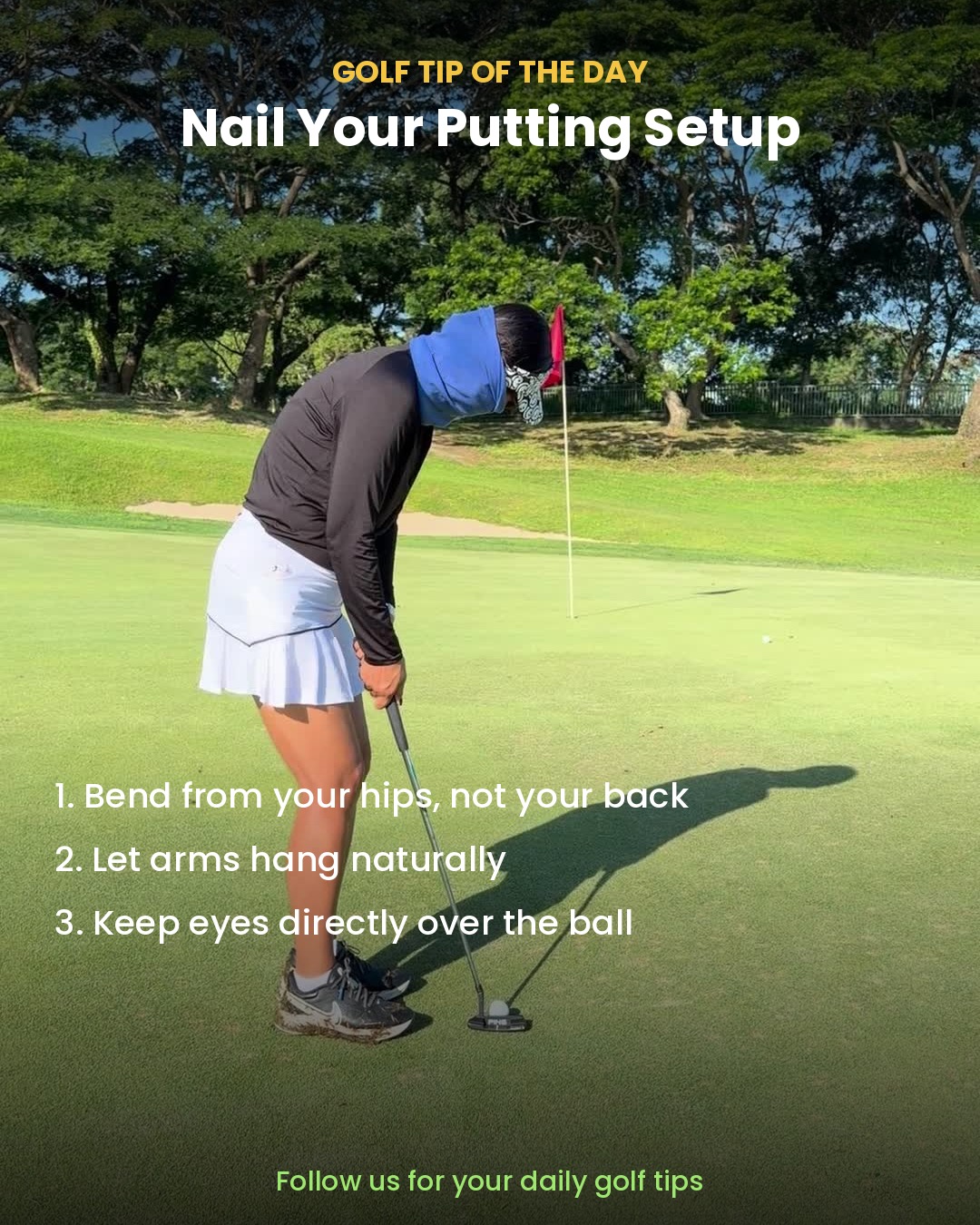
Start by bending forward from your hip joints, not by rounding your upper back. A helpful check: if you can feel tension in your lower back or your shoulders are hunching forward, you are likely bending from the wrong place. Hinging from the hips keeps your spine relatively straight and your chest facing more toward the ground than toward the hole, which is exactly the position that supports a clean pendulum stroke.
Once you are hinged forward, let your arms hang down naturally from your shoulders. Do not reach out toward the ball or pull your elbows in tight to your ribs. There should be a small, comfortable gap between your arms and your body, roughly the width of a fist, that lets your arms swing freely without your elbows getting trapped against your torso mid-stroke.
Finally, check your eye position. With the putter soled behind the ball, your eyes should sit directly above it, or very close to it. A simple way to check this on your own is to hold a second ball up to the bridge of your nose and let it drop; if you are positioned correctly, it should land on or very near the ball on the ground. Too far over the ball and you will tend to pull putts left; stand too far behind it and you will tend to push them right.
Run through all three checkpoints, hip hinge, relaxed arm hang, eyes over the ball, every single time you set up to putt, even on the shortest tap-ins. Consistency in your posture is what eventually makes the stroke itself feel automatic.
Drill to Practice
Set up over a ball on the practice green and freeze in your address position before making any stroke. Ask a practice partner to check, or use your phone propped up to film yourself from directly behind the ball, looking straight down the target line. Check that your spine is hinged from the hips rather than rounded, that your arms are hanging with a natural, relaxed gap from your body, and that your eyes appear to be directly over the ball in the video.
Make small adjustments and repeat the check until the position feels natural and looks correct on camera. Then hit a series of putts from that exact posture, paying attention to how much more connected and repeatable the stroke feels compared to your usual setup. Over several sessions, rehearsing this same posture check before every putt will start to build the habit automatically, without needing the camera to confirm it.
A useful variation once the posture feels solid: close your eyes at address and see if you can still sense that your weight, arms, and eye line feel balanced and centered. Being able to feel correct posture without needing a visual check is a sign the fundamentals are starting to become second nature.
Common Mistakes
The most common mistake is rounding the back instead of hinging from the hips. It often happens because rounding feels more natural or comfortable in the moment, but it restricts the shoulders and forces the hands and wrists to do work that should belong to the bigger muscles, which is exactly where putting strokes start to break down under pressure.
A second mistake is standing too far from the ball, which forces the arms to reach and creates tension through the shoulders, or standing too close, which cramps the arms against the body and restricts the stroke’s natural path. Both extremes fight against the relaxed arm hang that a good putting setup depends on.
A third mistake is checking eye position once during a practice session and then assuming it will hold up on the course without any further attention. Posture habits drift over the course of a round, especially when fatigue sets in on the back nine, so it is worth doing a quick mental check of all three fundamentals periodically, not just when practicing.
Finally, some golfers treat setup as something to rush through so they can get to the “real” part of putting, the stroke itself. In reality, the setup is not a formality before the putt begins, it is the foundation the entire stroke is built on, and it deserves the same unhurried attention as reading the green.
FAQ
Does putting posture matter as much on short putts as long ones?
Yes, arguably more. Short putts have less margin for error, and a setup flaw that only slightly affects a long lag putt can be the difference between made and missed on a three-footer.
Should everyone use the exact same posture?
The three principles, hip hinge, relaxed arms, eyes over the ball, apply broadly, but small details like stance width and ball position can vary based on your height and build. The core fundamentals stay the same even as the exact look adapts to you.
How do I know if my eyes are actually over the ball without a camera?
The ball-drop test described above works well without any equipment: hold a ball to the bridge of your nose at address and let it fall, then check where it lands relative to the ball on the ground.
Can bad putting posture cause problems beyond missed putts?
Yes. Consistently rounding your back during putting, especially over a full round, can also contribute to lower back fatigue or discomfort, which is one more reason to hinge from the hips instead.
Key Takeaways
A repeatable putting stroke starts with a repeatable setup. Hinge forward from your hips rather than rounding your back, let your arms hang naturally with a small gap from your body, and position your eyes directly over the ball before every putt. These three checkpoints take only a few seconds to run through, but they build the stable foundation that makes a simple, consistent stroke possible.
#ReadyGolfPH #GolfTips #Putting #GolfPosture #BeginnerGolfer #GolfPhilippines