
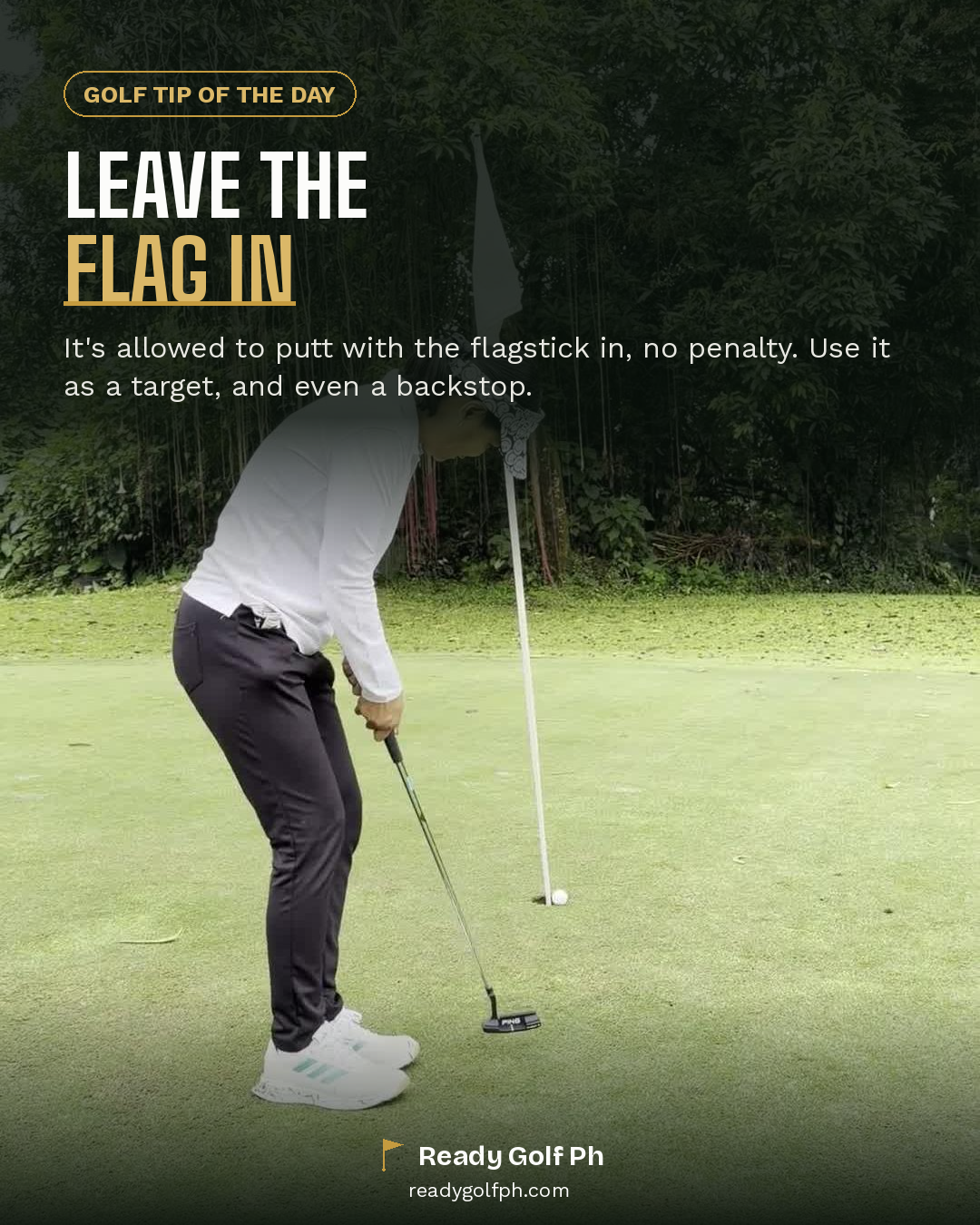
Walk onto any green on a weekend and you’ll still see it: one player jogging ahead to pull the flag before their groupmates putt, then jogging back to drop it again for the next hole. It’s a habit left over from the old rules, and for a lot of golfers it never got updated. Since 2019, the Rules of Golf have allowed you to putt with the flagstick left in the hole, with zero penalty if your ball hits it. Most recreational golfers either don’t know this or know it but never actually use it. Both are costing time and, in some cases, strokes.
This isn’t a loophole or a gray area. It’s Rule 13.2a, official and unambiguous: you can leave the flagstick in the hole for any stroke, from anywhere on the course, including on the putting green, and if your moving ball hits it, you simply play the ball as it lies. No penalty, no re-do, no drama.
Why It Matters
Pace of play is the obvious win. Sending someone to pull and re-set the flag on every single hole adds up over eighteen holes, and it’s one of the easiest habits to drop if your group agrees to leave it in. Ready Golf Ph readers already know pace of play matters, this is one more small piece of it.
But there’s a scoring angle too, and it’s the part most golfers overlook. On longer putts, especially on faster greens, an unattended flagstick sitting dead center in the hole can act as a backstop. A putt that’s tracking well but running a little hot can catch the stick and drop, where it might have lipped out or rolled several feet past on a truly bare hole. Tour pros have caught onto this, and you’ll increasingly see it used deliberately on lag putts from well off the green. For everyday golfers still building lag-putting feel, that backstop effect is a small but real edge.
The flip side matters too: the rule doesn’t force you to leave it in. On short putts, especially ones where the ball is tracking dead center and moving slowly, some golfers find the flag visually distracting or worry (usually without much basis) about a bad bounce off the stick. You’re free to pull it for those putts and leave it in for others. The rule gives you the choice on every single putt, it doesn’t hand you a fixed policy.
The Fix
Start treating the flagstick as optional equipment you control, not a fixture someone has to manage. On approach putts of any real length, especially anything over 15-20 feet or on a green you don’t have a great read on, leave the stick in. It gives you a cleaner visual target to putt at and the chance at a helpful bounce if your speed runs long.
For shorter, more straightforward putts where you’re already comfortable with your read and speed, it’s fine to have it pulled, this is really personal preference at that range, and either choice is allowed.
The one rule mechanic worth remembering: you have to decide before you strike the putt. You can’t leave the flag in, watch the ball start tracking toward the edge, and then reach out to move the stick to help or hurt your own ball’s path, that’s a rule violation and draws the general penalty. Decide, commit, then putt.
Also worth internalizing for group play: if you’re not the one putting, don’t stand near the hole “tending” the flag unless someone’s asked you to and it’s actually still in. An attended flagstick that gets pulled improperly at the wrong moment can create rules confusion nobody needs mid-round.
Drill to Practice
Next time you’re on the practice green, run a simple comparison. Pick a spot roughly 25-30 feet from the hole and putt ten balls with the flagstick in, then ten more from the same spot with it pulled. Track how many of each group finish within a two-foot circle of the hole, and pay attention to how many “long ones” get rescued by the stick versus how many roll well past on the pulled-flag set. Most golfers are surprised by how often the flagstick saves a hot putt from a much longer comebacker.
On the course, make it a standing rule with your regular playing partners: flagstick stays in unless someone specifically wants it pulled for a shorter putt. It removes the constant walk-up-and-pull routine and gets your group used to reading putts with the stick as part of the picture.
Common Mistakes
The most common mistake is simply not knowing the rule exists or still operating like it’s pre-2019, sending a player to pull the flag out of habit on every single hole. It’s harmless, just slower than it needs to be.
A second mistake is assuming the flagstick must stay in or must come out, golfers sometimes think this became a fixed rule change in one direction. It didn’t. The rule is about giving you the choice per stroke, not mandating either option.
A third mistake, and the one with actual penalty consequences, is adjusting or moving the flagstick’s position after it’s clear the ball is tracking toward it, hoping to influence the outcome. That crosses from “leaving it in” into deliberately altering conditions to gain an advantage, and it’s penalized under the rule.
Finally, some golfers leave the flagstick in but don’t actually use it as a target, they still aim at a vague area of the hole rather than the base of the stick itself. If you’re leaving it in, use it. Aim at it directly on longer putts to get the full benefit of a clean visual reference.
FAQ
Is there really no penalty if my ball hits the flagstick while putting?
Correct, as long as you didn’t deliberately move it to gain an advantage. If it’s standing normally and your moving ball strikes it, you play the ball as it lies with no penalty.
Can I decide mid-putt whether to leave the flag in?
No. The decision has to be made before you make the stroke. Once you’ve started your putt, the flagstick’s position can’t be changed to influence the ball.
Does this rule apply everywhere on the course, or just on the green?
It applies everywhere, including chips and approach shots from off the green, not just putts. You can leave the flagstick in for any stroke played from anywhere on the course.
Should beginners leave the flag in or take it out?
There’s no wrong answer, but for beginners still developing lag-putting distance control, leaving it in on longer putts is a reasonable default, it can only help, and it removes one more thing to manage before your stroke.
Key Takeaways
Since 2019, leaving the flagstick in while you putt has been fully allowed, penalty-free, and available on every stroke you take, not just some. It speeds up play, gives longer putts a visual target and a potential backstop, and puts the choice entirely in your hands rather than tradition or habit. The only real rule to respect is timing: decide before you strike, and don’t touch the stick once the ball is moving. Everything else is preference, so stop sending someone to jog out and pull the pin on every hole, and start using the flagstick as the tool the rules already let you use.