
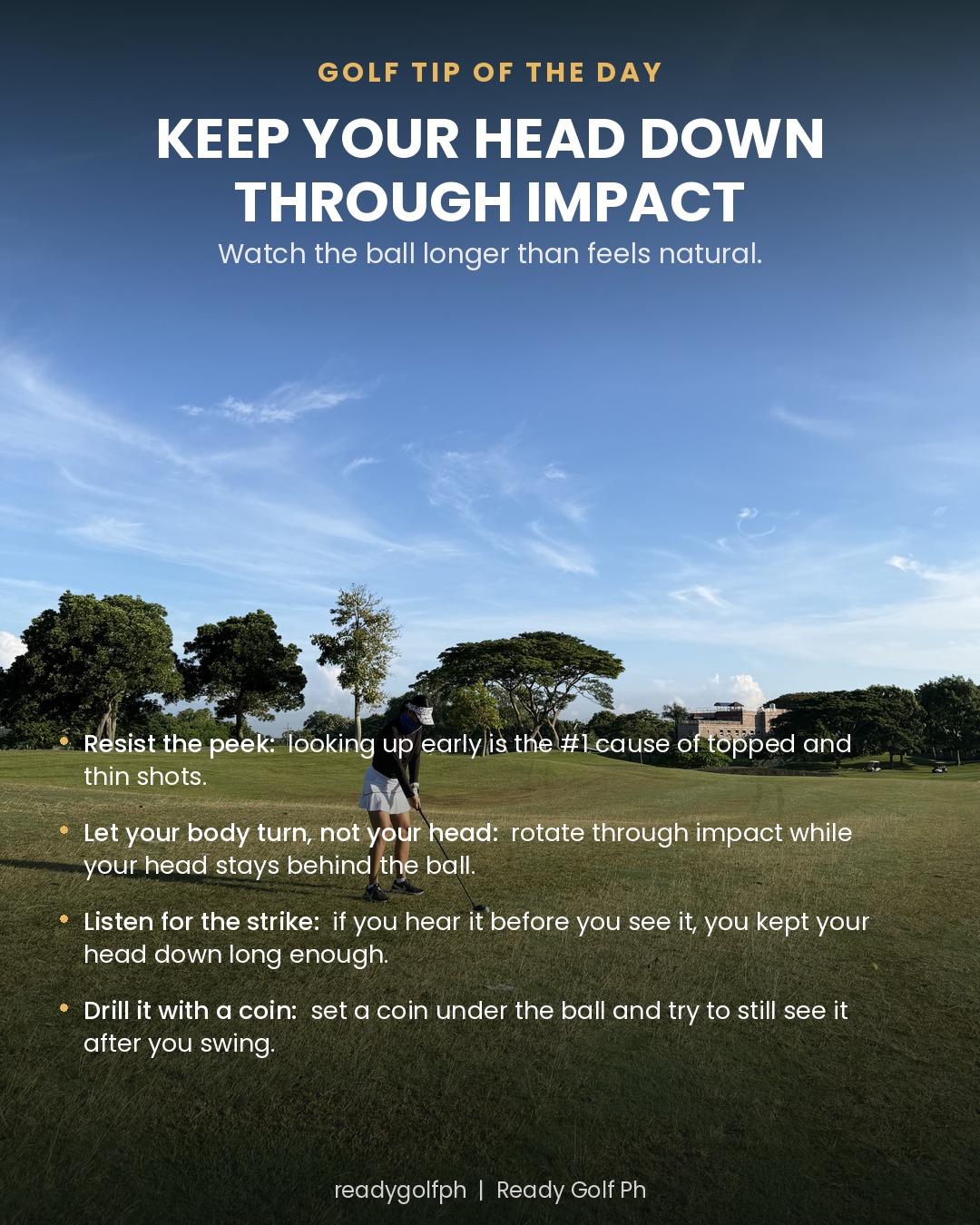
“Keep your head down” is probably the first piece of golf advice most of us ever heard, usually shouted good-naturedly by whoever was standing closest after we topped one thirty yards down the fairway. It’s also one of those tips that gets a bad reputation over time, mostly because people take it too literally and end up with a stiff, buried chin that causes its own problems. But strip away the exaggeration and the core idea is still one of the most useful things a golfer can hear: don’t let your head come up before the club gets to the ball.
What’s Actually Happening When You “Look Up”
Nobody consciously decides to lift their head mid-swing. It happens because the body wants to see the result of the shot immediately, especially when there’s water, a bunker, or an audience involved. The eyes want to check where the ball is going before the club has even finished doing its job.
The problem is timing. The moment your head starts to rise, your spine angle rises with it. Golf is a game of angles held in sequence, and the spine angle you set at address is the angle your swing is built around. Lift it early and the low point of your swing moves backward, away from the ball. That’s how you get the classic mis-hits: a top, where the club catches the top half of the ball because the whole swing bottomed out too soon; a thin shot, where the leading edge catches the ball before the club has descended enough; or a fat shot’s cousin, the “chunk and run,” where the body backs away from the ball just enough to throw off contact without fully bottoming out behind it.
None of these misses are really about the hands or the clubface. They’re about the head leaving its post a fraction of a second early.
Why “Head Down” Still Beats the Alternatives
Modern instruction has moved away from some of the old-school absolutes, and rightly so in a lot of cases. But “keep your head down” survives because it’s really shorthand for something more precise: keep your head behind the ball until impact, and let your body, not your head, supply the power.
Think about what a proper downswing sequence looks like. The lower body starts the transition, the torso follows, the arms and hands come last, and the head is the anchor that everything else rotates around. If the head jumps up and out early, it’s usually a sign the sequence broke down somewhere before it. In that sense, “keep your head down” isn’t really a standalone fix. It’s a symptom check. If your head is staying quiet through impact, there’s a good chance the rest of your sequence is working the way it should.
That’s why this tip has outlasted decades of swing theory changes. It’s not a mechanical instruction so much as a report card.
The Feel You’re Actually Chasing
Here’s where a lot of golfers overcorrect. “Keep your head down” does not mean freeze your neck and stare a hole into the grass after you’ve already hit the ball. Watch any tour player’s swing in slow motion and their head does rotate and rise, just not until well after the ball is gone. The finish position for most good ball-strikers has the head up, chin pointed at the target, eyes following the flight. The discipline isn’t in refusing to look. It’s in delaying the look.
A useful way to think about it: you’re not trying to keep your head still forever. You’re trying to keep it still long enough. The exact moment matters more than the total duration.
A simple internal cue that works for a lot of players is to try to hear the strike before you see it. If your ears register contact, that distinct sound of ball meeting face, before your eyes have registered the ball’s flight, your timing is in the right neighborhood. It’s a strange cue on paper, but it sidesteps the tendency to overthink head position and instead lets the sequence happen naturally.
A Drill Worth Actually Doing
Range sessions are full of tips that sound good and get forgotten by the third bucket. This one is worth keeping because it gives you instant, honest feedback.
Set a coin, a tee, or any small marker directly under or just behind the ball before you swing. Take your normal swing at full speed, don’t slow down artificially, since that changes the sequence you’re trying to train. After the swing, without moving your feet, check whether you can still see the marker.
If you can, your head stayed in place long enough for your eyes to track the spot through impact. If the marker’s out of your field of vision, your head came up or turned earlier than it should have. This drill is popular because it removes the guesswork. You don’t have to ask a friend or squint at a video. The marker either is or isn’t visible, and that’s the whole test.
Do this in short sets of five to ten swings, checking after each one. Most players notice a pattern quickly: maybe it’s the driver where the head jumps early because of the urge to watch a long shot, or maybe it’s under pressure shots where anxiety pulls the eyes up prematurely. Once you know when it happens, you can start managing it instead of guessing at it.
Where This Tip Tends to Break Down
There are two situations where “keep your head down” gets misapplied, and it’s worth naming them so you don’t fall into the trap.
The first is around the greens. On short chips and pitches, some players take the instruction so literally that they decelerate through impact just to make sure they don’t look up, which causes its own kind of mishit, usually a chunked chip where the club stops moving through the ball. The fix here isn’t to abandon the tip; it’s to trust that a full, accelerating stroke and a quiet head can coexist. You don’t need to slow down to stay still.
The second is with the driver. Because the goal with a tee shot is often distance, players are tempted to help the ball into the air by lifting early, almost trying to scoop it up. This is the single most common cause of a topped drive off the tee. The ball’s height comes from the loft on the clubface and the angle of attack, not from your head or shoulders trying to lift it. Trust the club to do the lifting. Your job is to stay down and let the loft work.
Why This Belongs in Your Pre-Shot Checklist
Most golfers have a handful of swing thoughts they rotate through depending on the day, and it’s easy to overload yourself with too many at once. “Keep your head down” earns a permanent spot on that short list because it’s one of the rare cues that’s both simple to remember and diagnostic of bigger issues. If your ball-striking has gone sideways and you can’t figure out why, checking your head position through impact is one of the fastest ways to find the leak.
It’s not flashy advice. It won’t show up in a highlight reel of swing thoughts from a tour coach’s Instagram. But it’s the kind of fundamental that keeps working long after trendier tips have come and gone, because it’s less about a specific technique and more about giving your swing the time it needs to do what you already trained it to do on the range.
Next time you’re standing over a shot, resist the urge to peek. Let the club finish its work first. Your eyes will get their turn.
Common Mistakes Golfers Make With This
The most common mistake is treating “keep your head down” as a literal, permanent instruction rather than a timing cue, which leads to a stiff, buried chin that restricts the shoulder turn and creates its own swing faults. A second mistake is trying to fix a topped or thin shot by working on hand and clubface adjustments first, when the real leak is often the head rising a beat too early in the sequence. A third mistake is applying the same rigid discipline to chips and pitches as to full swings, which causes deceleration and chunked contact around the greens instead of the crisp, committed strike the tip is actually meant to protect.
FAQ
Does “keep your head down” mean I should never look up during my swing?
No. Good ball-strikers do rotate and lift their head, just not until well after impact. The goal is delaying the movement, not eliminating it.
Why do I still top the ball even though I feel like I kept my head still?
The feeling of stillness and the actual timing can be slightly out of sync, especially under pressure. The coin drill gives you honest, physical feedback instead of relying on feel alone.
Should I use this cue on putts and chips too?
The underlying idea, letting the strike finish before you look, still applies, but don’t let it turn into deceleration. A full, accelerating stroke with a quiet head beats a slow, tentative one every time.
Key Takeaways
- A head that rises early changes your spine angle and moves the swing’s low point away from the ball, causing tops, thin shots, and chunked contact.
- “Keep your head down” is really about delaying the look, not freezing your neck for the whole swing.
- Use the coin drill for honest feedback: if you can still see the marker after your swing, your timing was right.
- Watch for this fault especially with the driver, where the urge to help the ball into the air causes an early lift.
- A quiet head through impact is often a sign that the rest of your swing sequence is working the way it should.
Ready Golf Ph, daily tips to help you play smarter and score better, one round at a time.