
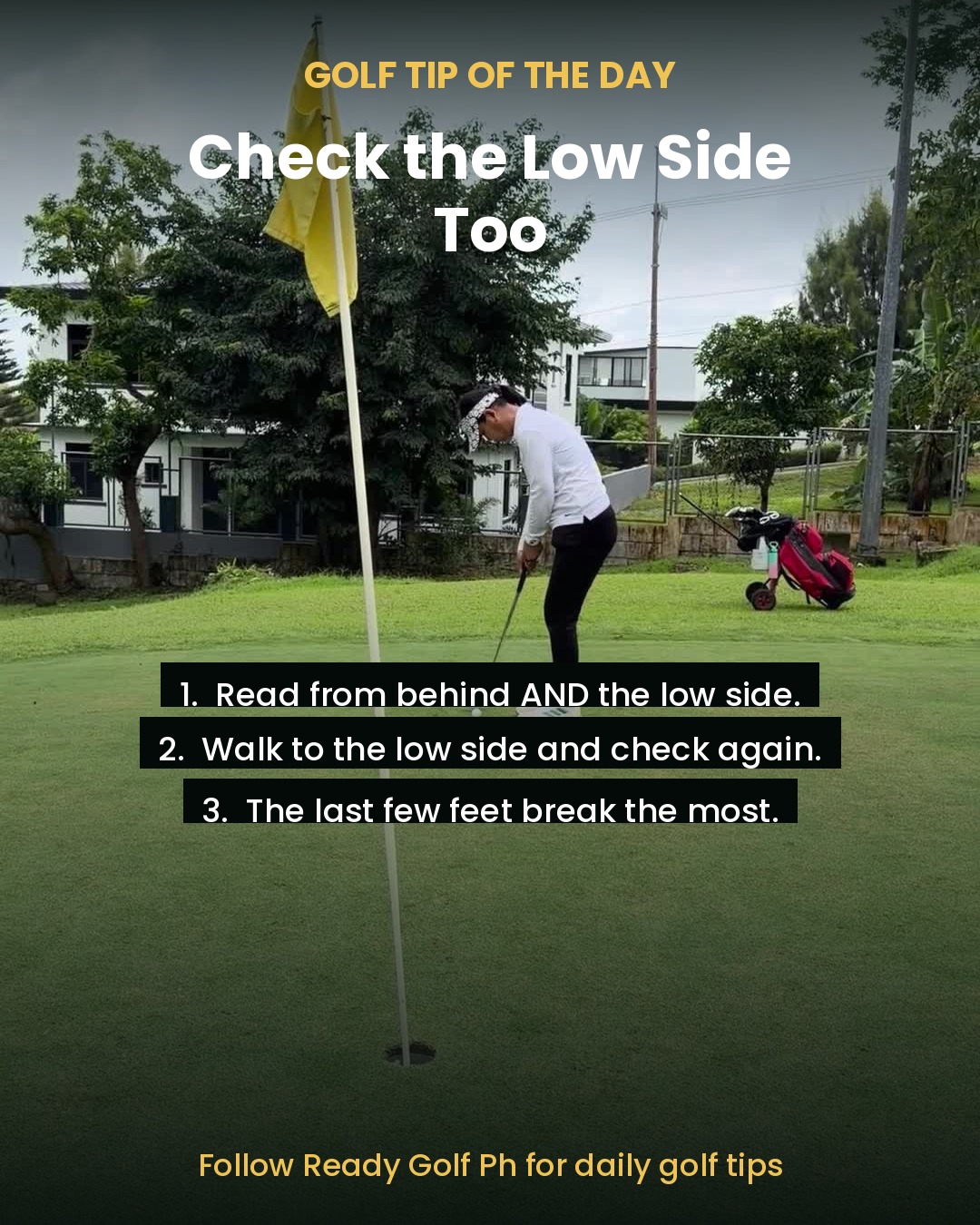
You crouch behind your ball, picture the line, and step up to putt with total confidence, only to watch the ball curve late and miss on the low side, well after you thought it had already found its line. If that’s happened to you more than once, the problem probably isn’t your stroke. It’s that reading a putt from behind the ball only tells you part of the story, and the part it leaves out tends to show up right when the ball is losing speed and most likely to break.
Most golfers learn to crouch behind the ball, sight the line to the hole, and go. It’s a good habit, but it’s an incomplete one. Green reading is a three-dimensional problem, and a single viewing angle can hide slope that becomes obvious the moment you look at the same putt from a different spot, particularly the low side.
Why It Matters
Greens are rarely flat, and the slope on a green usually isn’t uniform from every angle. Standing behind the ball shows you the general direction of the break, but it doesn’t always reveal how much the ground falls away toward the low side, especially in the last few feet before the cup, where the ball has lost most of its speed and is at its most sensitive to even subtle slope.
This is exactly why putts that look “basically straight” from behind the ball so often bend late and miss low. A ball rolling fast in the first two-thirds of a putt can power through minor slope that would clearly turn a slower-moving ball. As the putt loses speed near the hole, gravity gets more time to act on it, which means the last few feet are often where the real break shows up, whether or not you saw it in your initial read.
Checking the low side gives you a second data point. Standing at or near the low side of the hole and looking back up the line lets you see the slope from a completely different perspective, one that often makes hidden tilt obvious in a way the behind-the-ball view never will. Combining both views gives you a far more complete picture than either one alone.
The Fix
Start your read the way you normally would, crouched behind the ball, getting a general sense of direction and overall slope. Then, before you commit to a line, walk around to the low side of the hole, the side the green appears to fall toward, and look back at your ball from there. Pay close attention to how the ground behaves in the final few feet around the cup specifically, since that’s the section of the putt most likely to show break you couldn’t see from behind.
If the two views agree, you can commit to your line with real confidence. If the low-side view reveals more break than you expected, adjust your read and aim point accordingly, favoring the high side a little more than your first instinct suggested. It’s far better to catch this discrepancy before you putt than to watch the ball miss low and wonder what happened.
This habit matters most on putts inside fifteen feet, where the ball spends a larger proportion of its roll at low speed, and matters even more the closer you get to the hole. A long lag putt from forty feet has more margin for a slightly imperfect read, since the exact line matters less than getting the speed and general direction right. A five-footer for par does not have that margin, and that’s exactly the range where a missed low-side read costs you strokes.
Don’t skip this step just because a putt looks obviously straight. Some of the most deceptive putts are the ones that appear flat from behind the ball but reveal a subtle low-side pull once you check from the other angle. Treat the low-side look as a standard part of your routine, not a step reserved for putts that already look tricky.
Drill to Practice
On the practice green, pick a hole and roll putts from four or five different spots around it, all roughly the same distance out. Before each putt, do both reads: behind the ball, then from the low side looking back. Note where your two reads agreed and where they didn’t, and pay attention to which putts actually broke the way the low-side view predicted rather than the behind-the-ball view. Over a few sessions, you’ll start to develop a feel for which types of greens or slopes are more likely to hide break from the standard angle.
A useful variation: once you’ve made the read from both angles, try predicting the exact spot where the ball will start noticeably curving before you putt. Comparing your prediction to what actually happens sharpens your sense of where, not just whether, a putt breaks.
Common Mistakes
The most common mistake is reading a putt only from behind the ball and treating that single view as complete, especially on putts that look straightforward. A read from one angle is a good starting point, not a finished decision.
A second mistake is checking the low side but not paying close enough attention to the last few feet around the hole specifically. The overall slope matters, but the section closest to the cup is where a slowing ball is most affected by even minor tilt, so that’s the area deserving the closest look.
A third mistake is doing the low-side check but then ignoring what it reveals, sticking with the original read out of habit or a reluctance to second-guess the first look. If the two reads genuinely disagree, trust the additional information rather than defaulting to whichever read came first.
Finally, some golfers only bother with a multi-angle read on putts that already look obviously breaking, skipping the step entirely on putts that appear flat. Those “flat-looking” putts are often exactly the ones hiding a subtle low-side pull, which makes them the putts that benefit most from the extra look, not the ones that need it least.
FAQ
Do I need to check the low side on every putt?
It helps most on putts inside fifteen feet, where late break near the hole has the biggest impact on the outcome. On longer lag putts, a general read is usually sufficient since precise line matters less than speed and direction.
What if I can’t tell which side is actually the low side?
Look at how water would drain across the green, or notice which direction nearby putts tend to curve. With practice, identifying the low side becomes quicker and more intuitive.
Does this slow down my pace of play?
Not meaningfully. A quick look from the low side takes only a few extra seconds, and it’s easy to do while your playing partners are also reading their putts.
Is this only useful for advanced players?
No, it’s arguably more useful for beginners, since they’re less likely to have developed an instinct for hidden slope yet. Building this habit early creates better green-reading fundamentals overall.
Key Takeaways
A single read from behind the ball often misses subtle slope that becomes obvious from the low side, especially in the final few feet before the hole where a slowing ball is most affected by break. Make checking the low side a standard part of your putting routine, particularly on putts inside fifteen feet, and trust what that second look tells you when it disagrees with your first read.
#ReadyGolfPH #GolfTips #Putting #GreenReading #BeginnerGolfer #GolfPhilippines