Watch a group of weekend golfers from a distance and you can usually tell who is about to hit well before the club ever moves. Some players walk up, glance at the general area they’re aiming for, and swing. Others pause, even if only for two or three seconds, and you can almost see them picture something before they settle in. That pause is not superstition and it is not a stalling tactic. It is one of the simplest, most repeatable habits in golf, and it costs nothing except a few seconds of attention you were probably not using well anyway.
Visualizing your shot means forming a clear, specific picture of what you want to happen before you ever take the club back: the exact target, the shape of the flight, and where the ball comes to rest. It sounds almost too simple to matter. In practice, it is one of the few mental habits that measurably tightens a golfer’s misses, because a vague intention produces a vague swing, and a specific picture gives your body something precise to organize itself around.
Why a Vague Target Produces a Vague Shot
Most amateur golfers aim at things that are far too big. “That side of the fairway.” “Somewhere near the green.” “Away from the water.” These are not targets, they are zones, and a zone gives your swing nothing specific to commit to. When your mind is holding a fuzzy intention, your body tends to make a fuzzy motion to match it, and the miss that results is often bigger and less predictable than it needs to be.
Compare that to a golfer who picks a single point, a particular leaf on a tree at the edge of the fairway, the left edge of a bunker, a specific spot on the green ten feet past the flag, and holds that one point in mind through the whole shot. Even when that shot misses, it tends to miss by less, because there was something precise to miss from. The target does not guarantee a good result, but it consistently narrows the range of bad ones, which over eighteen holes adds up to noticeably fewer big numbers on the card.
The Fix: See It, Then Trust It
The process is short enough that it will never slow down your pace of play, which matters if you’re also trying to play ready golf and keep your group moving. It breaks down into four small steps that take a matter of seconds once they become habit.
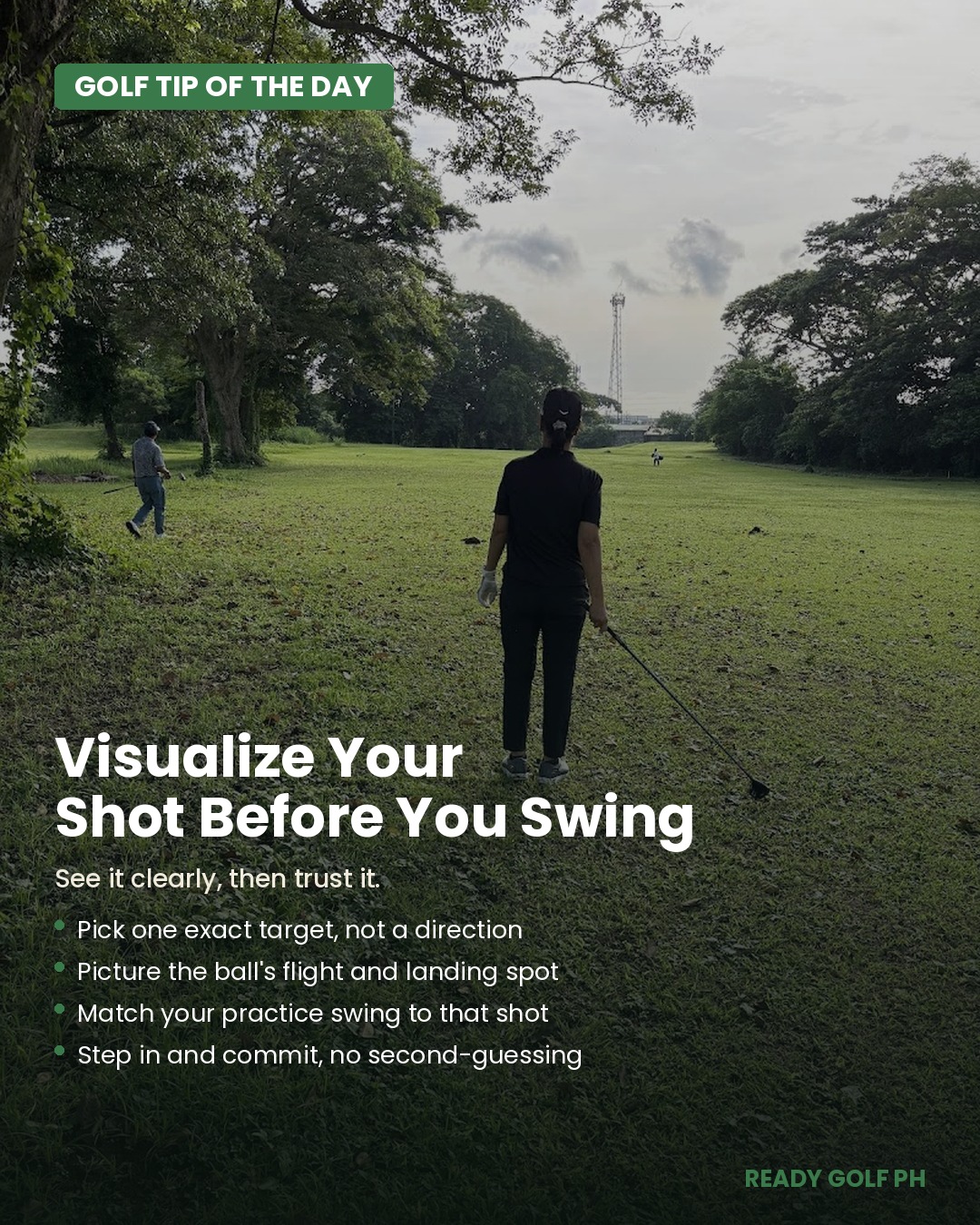
Pick one exact target, not a direction. Before you do anything else, choose a single specific point, not a side of the fairway or a general area of the green. The more specific, the better your mind has something concrete to lock onto.
Picture the ball’s flight and landing spot. See the shot happen before you hit it: the trajectory it takes off the club, whether it draws or fades slightly, and where exactly it lands and rolls out to. This does not need to be a vivid, cinematic mental movie. Even a rough, quick image is far more useful than no image at all.
Match your practice swing to that shot. Your practice swing should feel like a rehearsal of the specific shot you just pictured, not a generic loosen-up motion. If you saw a smooth, controlled swing in your head, your practice swing should feel smooth and controlled too, not rushed or tentative.
Step in and commit, no second-guessing. Once you’ve seen the shot and rehearsed it, step up to the ball and go. This is the step golfers skip most often. They visualize a shot, then stand over the ball and start negotiating with themselves about club choice or swing thoughts, which erases most of the benefit of the visualization in the first place. Once you’ve pictured it, the job left is simply to let that picture happen.
A Simple Drill to Build the Habit
Visualization is easy to understand and surprisingly easy to forget under pressure, so it helps to build it deliberately rather than hoping it shows up on its own. On the driving range, before every third or fourth ball, stop and actually name your target out loud or in your head, something specific like “the yellow flag, twenty yards left of it.” Picture the flight for a second or two, then hit. Compare how that shot feels and where it goes against the balls you hit without doing this. Most golfers notice the difference within a single bucket.
On the course, a low-pressure way to build the habit is to apply it only on tee shots at first, since there is more time and less immediate pressure than on approach shots or shots around the green. Once picking a precise target and picturing the shot becomes automatic off the tee, it naturally starts showing up on approach shots, chips, and even putts, where “seeing the line” is really the same skill applied to a shorter, slower shot.
Why It Matters Beyond Just Aim
The value of visualization goes a little deeper than simply picking a better target. It also quiets the parts of your mind that tend to interfere with a good swing. When you are actively picturing a specific, positive outcome, there is less mental room left over for the doubts and mechanical thoughts that tend to creep in over the ball, the ones about keeping your head down, not looking up early, or remembering five different swing thoughts at once. A clear picture of the shot you want tends to crowd out the noise about the shot you’re afraid of.
This is part of why golf gets described as a game played twice, once in the mind and once for real. The swing itself happens in a second or two and is largely reactive by that point; most of the actual decision-making and shot-shaping happens in the moments right before it, whether a golfer realizes that or not. Golfers who are deliberate about that mental rehearsal tend to give their body clearer instructions, and a body with clear instructions generally performs them more consistently than one working from a vague sense of “just don’t hit it right.”
Common Mistakes Golfers Make With Visualization
The most common mistake is picking a target that is too general, an entire section of fairway rather than one specific point within it, which weakens the whole exercise before it starts. A second is visualizing the shot and then standing over the ball too long afterward, giving second thoughts enough time to creep back in and undo the clarity that was just built. A third is only using visualization on tee shots, when the same habit applied to putts and chips, picturing the ball rolling into the hole or landing on a specific spot before it lands there, tends to pay off just as much, if not more, given how much of a round is spent inside a hundred yards.
FAQ
Do I need to see a perfectly detailed mental picture for this to work?
No. Even a rough, quick image of the target and the general shot shape is far more useful than swinging with no picture at all. This does not need to be an elaborate visualization exercise.
How long should I take to visualize before each shot?
A few seconds is enough. The goal is a clear, brief picture, not a long pause that slows down your group or gives doubt time to creep back in.
Does this work for putting too?
Yes, and for many golfers it matters even more there. Picturing the exact line and the ball falling into the hole before you putt applies the same principle to the shortest, most detail-sensitive part of the game.
Key Takeaways
- A vague target produces a vague swing; picking one exact point instead of a general area tightens your misses.
- Visualizing the ball’s flight and landing spot before you swing gives your body something specific to organize itself around.
- Your practice swing should rehearse the exact shot you pictured, not act as a generic warm-up motion.
- Commit once you’ve visualized the shot. Standing over the ball too long afterward invites second-guessing that undoes the benefit.
- The habit applies beyond tee shots. Chips and putts benefit from the same clear, specific picture before you play them.