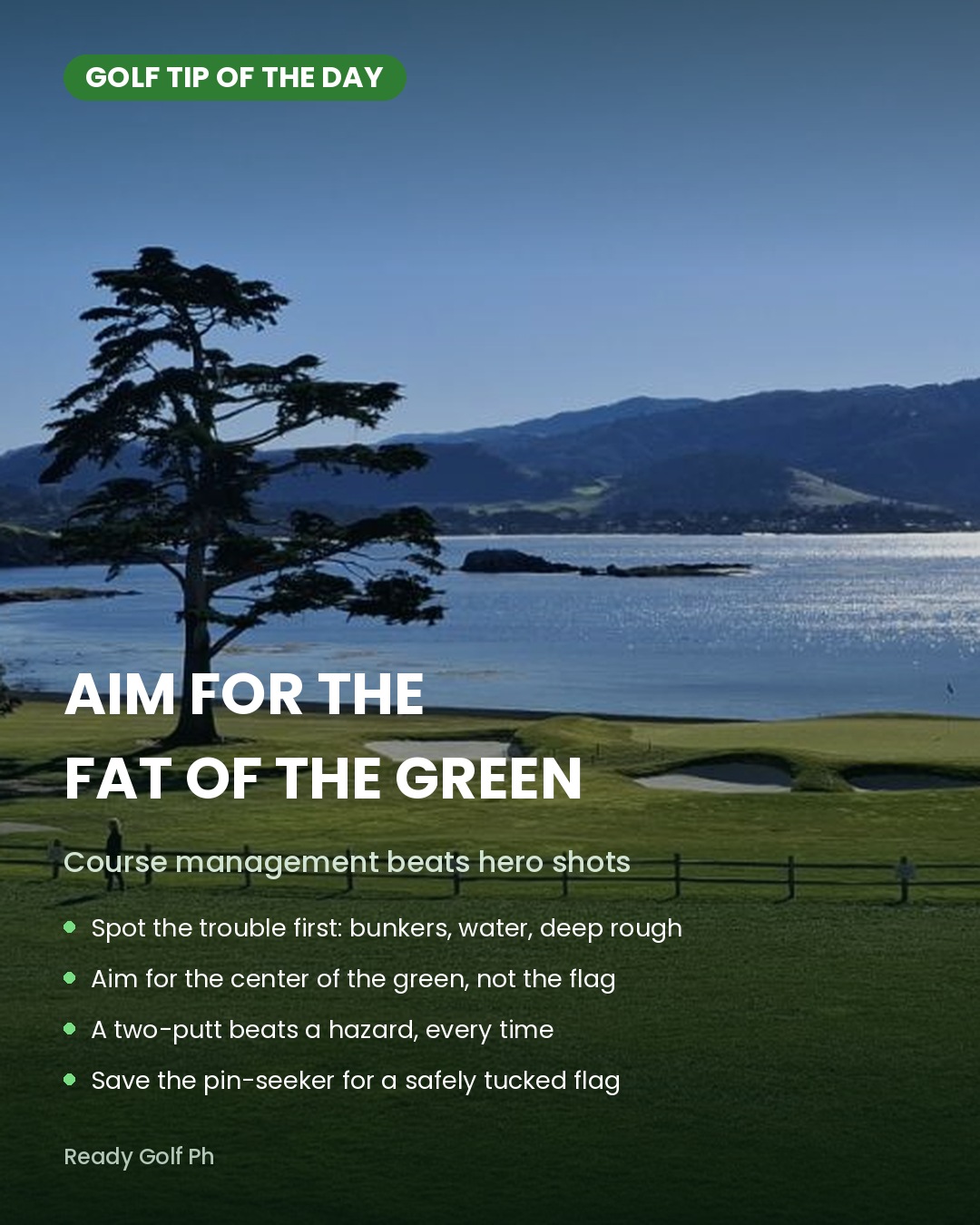
There is a particular kind of hole that shows up on almost every course worth playing: the flag tucked just behind a bunker, or perched a few paces from the water’s edge, daring you to take it on directly. It looks great in photos. It is also where a lot of good rounds quietly come apart, because the pin position is not actually the target. It just looks like one.
Course management is the unglamorous half of golf that never makes the highlight reel, but it is often the difference between a round that holds together and one that blows up on a single hole. And one of the simplest course management habits a golfer can build is also one of the most overlooked: when trouble guards the flag, aim for the center of the green instead of the pin.
Why the Flag Isn’t Always the Target
It’s an easy trap to fall into. The flag is the thing you’re looking at, so it becomes the thing you aim at, almost by default. But the flag is just where the hole happens to be cut that day. The green is the actual target, and greens are usually far more forgiving than the six feet of grass immediately around the cup.
When the pin is tucked behind a bunker or hugging a water line, the shot that finds the flag and the shot that finds the hazard often start out looking identical in the first half-second after impact. A few yards of curve, a touch of mishit, a gust of wind, and the ball that was tracking the flag is now sitting in sand or, worse, not sitting anywhere at all. The center of the green rarely punishes a small miss that harshly. Miss short, long, left, or right of center and you are usually still putting. Miss short or long of a tucked pin guarded by a hazard and you may be chipping, or worse, re-hitting.
The Fix: Play to the Fat of the Green
This is not a complicated adjustment, and it does not require a better swing. It requires a different decision before the swing even starts.
Find the hazards before you find the flag. Before picking a target, take a second to actually notice what is guarding the pin. Bunkers, water, a false front, deep rough. Knowing where the trouble sits is the first step to playing away from it on purpose instead of drifting toward it by accident.
Pick the center of the green as your default target. Unless the pin is sitting in open, unguarded territory, aim for the middle of the putting surface. It is a bigger, safer target than the flag, and it turns a risky approach into a routine one.
Let the club do the work, not the moment. Choose enough club to comfortably reach the center without forcing a swing to squeeze extra distance out of a shot. Most balls that come up short into a hazard were hit with a club that needed a perfect strike to get there.
Accept the longer putt as a win. A thirty-foot putt from the center of the green is a fine result. It is almost always a better outcome than a hazard, and it keeps the hole, and the round, moving in the right direction.
A Simple Way to Practice This
Course management habits are hard to build on the course because the moment feels high-stakes even on a casual round. Practice range sessions are a better place to install the habit before it matters. Pick an imaginary pin position tucked in a corner of the practice green, then imagine a bunker or hazard sitting just in front of it. Hit a series of approach shots aimed at the center of an imaginary green instead of the tucked pin, and pay attention to how much more freely you can swing when the target is generous instead of tight. That looser, more committed swing is usually the one that produces the better strike anyway.
On the course, a good place to start applying this deliberately is on any approach shot into a par 4 or par 5 where you can see a hazard tight to the pin from the fairway. Make the center-of-green decision before you pull a club, not after you’re already standing over the ball second-guessing it.
Why This Matters More Than It Seems
Course management rarely feels dramatic in the moment. Choosing the center of the green over the flag doesn’t feel like a bold decision, it feels almost like giving something up. But scoring well over eighteen holes is less about the handful of shots that go beautifully and more about how few shots go disastrously. Big numbers come from compounding mistakes: a missed green into a hazard, followed by a penalty drop, followed by a rushed recovery shot trying to make up for it. Taking the hazard out of play on the approach removes the entire chain before it starts.
This is also a habit that scales with how a course is set up to test golfers. Course designers put hazards next to pins specifically because they know most players will still aim at the flag anyway. Recognizing that and declining the bait is one of the quieter ways a golfer can consistently play a hole “as designed” rather than as tempted.
Common Mistakes Golfers Make With This
The most common mistake is only applying this thinking on approach shots into greens, when the same logic works for tee shots on holes with trouble down one side, and even for chips played toward a tucked pin. A second mistake is deciding to play safe but still selecting a club or swing meant for an aggressive shot, which undoes the whole decision. If you’re aiming center, commit to a swing built for that target, not a compromise between the two. A third mistake is treating this as giving up on scoring well. In practice, the golfers who play to the fat of the green consistently tend to card fewer big numbers than the ones who fire at every flag, which is usually the faster route to a lower score.
FAQ
Doesn’t aiming for the center of the green mean I’ll never make birdies?
No. You’ll still have plenty of makeable putts from the center of most greens, and you’ll have far fewer blow-up holes. Fewer big numbers usually lowers a score more than a handful of extra birdie looks raises it.
How do I know when it’s safe to aim at the flag instead?
When the pin is not closely guarded by a bunker, water, or a steep slope, and you have a comfortable club in hand, going at the flag is a reasonable, lower-risk decision.
Does this apply to short game shots too?
Yes. Chipping or pitching to the fat of the green rather than a tightly tucked pin follows the same logic and is often the smarter play around greens guarded by bunkers.
Key Takeaways
- The flag is not always the real target. The green is, and it is usually far more forgiving than the ground right around the cup.
- Spot the hazards guarding the pin before you choose a target, not after you’re already over the ball.
- Aiming for the center of the green turns a risky approach into a routine one, without requiring a better swing.
- A longer putt from the center of the green beats a short one from a hazard almost every time.
- Save the aggressive, pin-seeking shot for when the flag is genuinely unguarded.