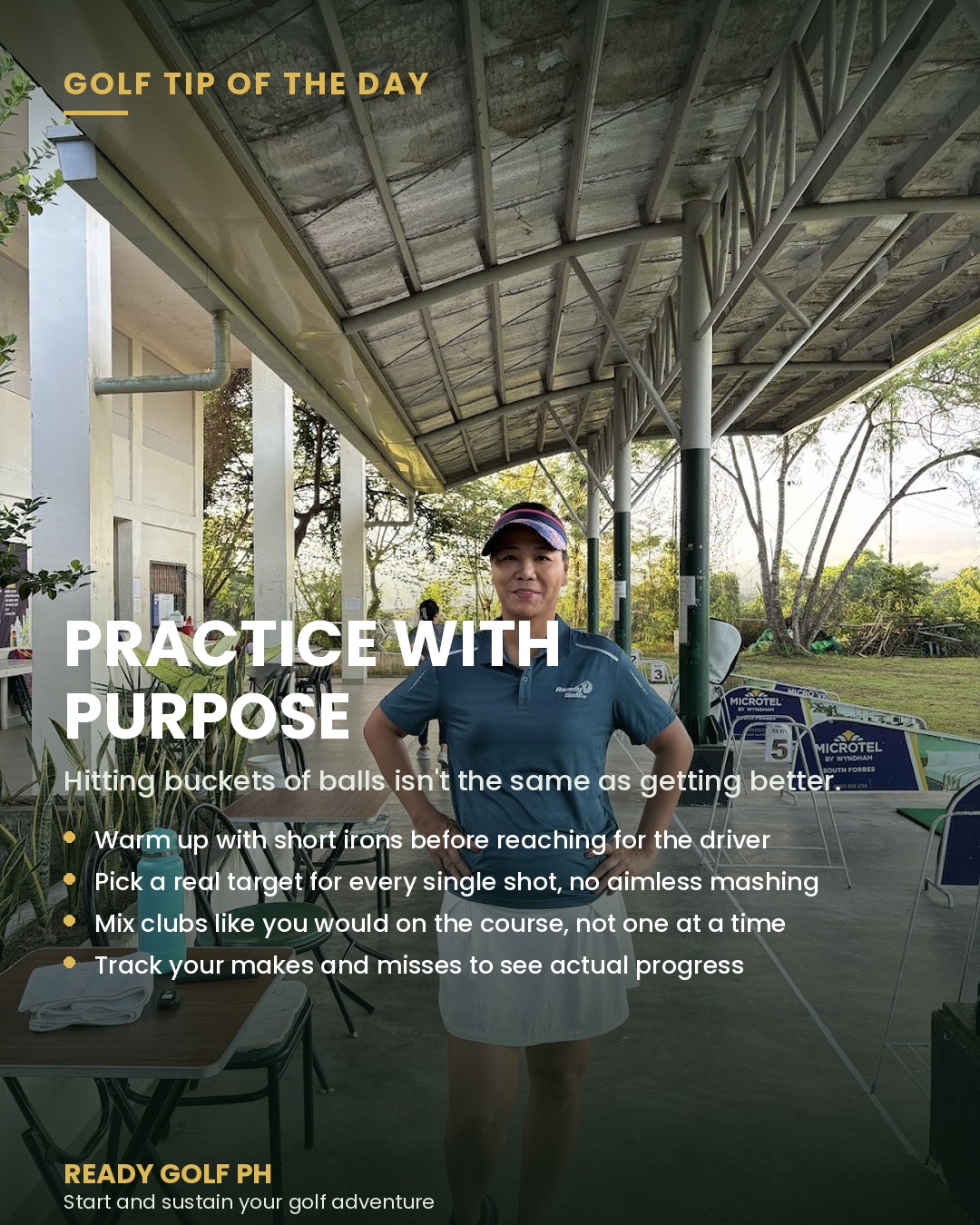
Walk onto almost any driving range and you will see the same scene repeated: golfers pulling ball after ball from a bucket, hitting the same club over and over with no particular target in mind. It feels productive because you are swinging a club and making contact, but this kind of practice rarely translates into lower scores on the course. Practicing with purpose, not just hitting balls, is what actually moves your game forward.
Why Aimless Practice Doesn’t Transfer to the Course
On the course, you never hit the same club from the same lie at the same target twice in a row. Yet most range sessions do exactly that: bucket after bucket of the same club, often without a specific target, grooved from a perfectly flat mat. This builds a swing that works well on the range but often breaks down on the course, where variety and decision-making are constant. Practice that doesn’t resemble real playing conditions produces a skill that doesn’t transfer to real playing conditions.
Four Ways to Practice With Purpose
Warm up with short irons. Starting your session with wedges and short irons activates your tempo and feel before you move to longer clubs, mirroring the natural progression of a pre-round warm-up. It also reduces the temptation to swing too hard right out of the gate, which is a common source of poor early-session contact.
Pick a real target for every shot. Never hit a ball without a specific target in mind, whether that is a flag, a yardage marker, or a section of the range. This single habit turns every rep into a decision-making exercise, not just a swing repetition, and builds the target-focused mindset you actually need on the course.
Mix clubs like you would on the course. Instead of hitting twenty balls in a row with the same club, rotate through your bag the way you would during an actual round, a driver, then a mid-iron, then a wedge, then back to a different iron. This forces your setup and swing feel to reset for each new club, which is a far more realistic simulation of real play.
Track makes and misses. Keep simple count of how many shots finish close to your target versus how many miss, and in which direction. This turns a vague sense of “practice went well” into real data about your tendencies, which tells you what to actually work on rather than guessing.
Why Tracking Matters More Than Volume
Hitting more balls is not the same as improving. A focused session of fifty shots, each with a target and a tracked outcome, will improve your game more than an unfocused bucket of one hundred fifty balls hit at no target in particular. Tracking gives you real feedback, which is the actual engine of improvement, whether that is discovering a consistent miss to one side or noticing that your short irons are far more reliable than your long irons.
A Simple Structure for Your Next Range Session
Spend the first ten minutes on wedges and short irons, picking a specific target for every shot. Move into a mixed-club section for the next twenty minutes, rotating through different clubs and targets as you would during a round, tracking your makes and misses as you go. Finish with a few minutes on your longest club, again with a specific target, ending the session the same way you would start a round: focused and intentional.
Common Mistakes at the Range
The most common mistake is treating the range as a place to only hit your favorite or best club, avoiding the clubs that feel less comfortable. Improvement usually comes fastest from deliberately practicing the shots you are weakest at, not the ones that already feel good. Another common mistake is rushing through shots without any pause between them, which skips the target-picking and routine-building that makes practice actually purposeful.
FAQ
How long should a purposeful range session take?
Thirty to forty-five minutes of focused, targeted practice is typically more valuable than an hour or more of unfocused ball-hitting.
Should I always practice with a full bag rotation?
Not always, but mixing clubs regularly, rather than exclusively grooving one club at a time, better simulates real course conditions and decision-making.
Is tracking makes and misses really necessary?
It is one of the most valuable habits you can build, since it turns practice into real feedback about your tendencies rather than a vague feeling of having “hit a lot of balls.”
Key Takeaways
- Warm up with short irons before moving to longer clubs, mirroring a real pre-round routine.
- Pick a specific target for every single shot, not just when it feels important.
- Mix clubs throughout your session instead of hitting the same club repeatedly.
- Track your makes and misses to turn practice into real, actionable feedback.