There’s a particular kind of frustration in golf that only putting can produce. You read the line, you take what feels like a smooth, committed stroke, and the ball still slides three feet wide of the hole. No wind, no bad bounce, no excuse. Just a putt that missed for reasons that aren’t immediately obvious.
Nine times out of ten, the culprit isn’t the read. It’s the putter face quietly twisting open or closed somewhere between takeaway and impact, and it’s one of the most common, most fixable faults in putting that almost nobody actually checks for.
The Putt That “Felt Fine” But Missed Anyway
Ask most golfers why they missed a putt and the answer usually points to the green: it broke more than expected, it was faster than it looked, the read was off. Green reading absolutely matters, and it deserves attention. But a huge number of missed putts have nothing to do with the read at all. They happen because the putter face wasn’t actually square to the target line at the moment it struck the ball, even though the stroke itself felt smooth and controlled.
This is a hard fault to self-diagnose because it doesn’t feel like a mistake while it’s happening. A stroke can look rhythmic and confident and still deliver the face a few degrees open or closed at impact, sending an otherwise well-paced putt off line before it ever reaches the part of the green where the break was supposed to take over. The ball doesn’t know the read was correct. It only responds to the face angle and path it actually received.
Why the Putter Face Twists in the First Place
The putter face doesn’t twist on its own. It twists because of what the hands and wrists are doing during the stroke, and understanding that connection is the whole key to fixing it.
A putting stroke is meant to be a simple pendulum, controlled by the rocking of the shoulders, with the hands and wrists staying quiet and along for the ride. The problems start when the hands take over some of that job, which happens more often than most golfers realize, especially under pressure or on longer putts where there’s a temptation to help the ball along.
Wristy hands introduce rotation. The moment the wrists start hinging or releasing through the stroke instead of staying still, the putter head has room to rotate independently of the shoulders. Even small amounts of wrist action can open or close the face by a few degrees, which is more than enough to send a six-foot putt off line.
An unstable grip pressure lets the face wander. Gripping too tightly in some fingers and too loosely in others creates uneven tension that shows up as face rotation during the stroke, particularly through impact when the putter is moving fastest.
Trying to steer the putt makes it worse, not better. Ironically, golfers who consciously try to guide the putter face toward the target with their hands often introduce more face manipulation than golfers who simply let the shoulders rock the putter back and through without interference.
What a Square Face Actually Looks Like
The fix isn’t a complicated mechanical overhaul. It’s a return to a simpler stroke where the big muscles do the work and the small muscles stay quiet.
Let the shoulders, not the hands, power the stroke. Think of the putting stroke as a rocking motion through the shoulders, with the arms and hands moving as a connected, passive unit. When the shoulders control the tempo and length of the stroke, the putter face tends to stay square through impact almost automatically, without any conscious effort to “hold it square.”
Keep the wrists quiet from takeaway through follow-through. There’s no hinge-and-release action in a good putting stroke the way there is in a full swing. The wrists should feel almost locked, moving only because the shoulders and arms are moving them, not because they’re independently flexing or rotating.
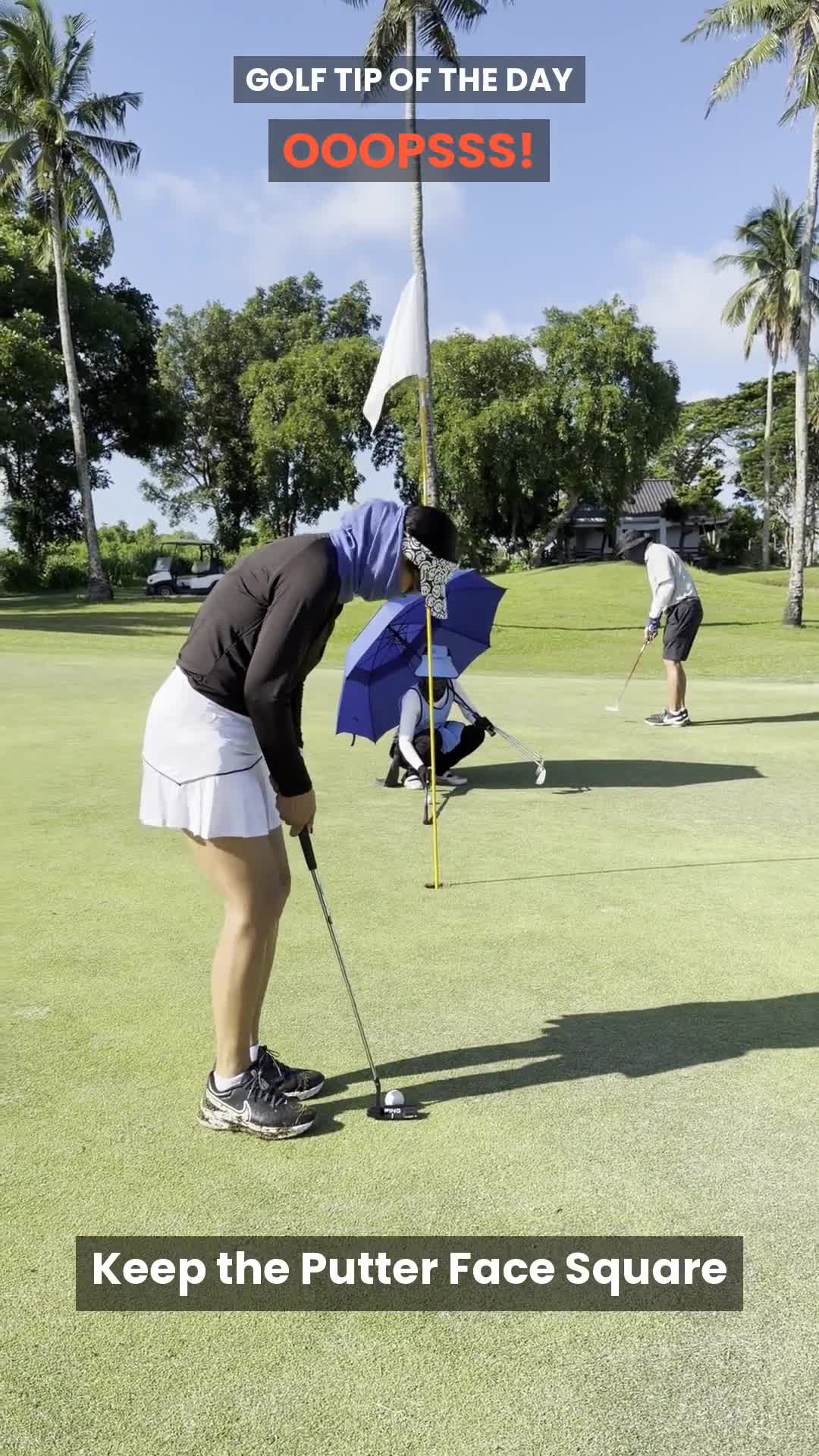
Check that the face looks the same at both ends of the stroke. At the end of the backswing and again at the finish, the putter face should appear roughly as square as it did at address. If the face has clearly opened on the way back or closed through impact, that’s a visible sign the hands are getting involved somewhere in the stroke.
Grip with light, even pressure in both hands. A grip that’s too tight, especially in the trail hand, tends to introduce tension that shows up as face rotation. Light, even pressure across both hands gives the putter head freedom to swing on a stable path without fighting against uneven tension.
A Simple Way to Practice This
This is one of the easier putting faults to actually train, because it doesn’t require new mechanics, just a return to a simpler motion and a way to get honest feedback on whether the face is staying square.
On the practice green, set up a short, straight putt of four or five feet and place two clubs or alignment sticks just outside the toe and heel of the putter at address, wide enough for the putter to move freely between them but tight enough that an obviously twisting face would catch on one of the shafts. Make slow, deliberate strokes focusing entirely on rocking the shoulders and keeping the hands passive. If the putter head brushes a shaft, that’s immediate, honest feedback that the face opened or closed somewhere in the stroke.
It also helps to practice with your eyes closed for a handful of putts on a flat section of green, focusing purely on the feeling of a quiet, shoulder-driven stroke. Without the visual feedback of watching the ball, it becomes easier to notice whether the hands are trying to take over.
Why This Matters More Than It Seems
Putting is often the most overlooked part of practice, partly because it doesn’t feel as satisfying to work on as a full swing, and partly because a missed short putt gets blamed on nerves or an unlucky read rather than a face control issue. But a huge share of strokes on the course happen on the green, and small, repeated face-angle errors compound over eighteen holes in a way that’s easy to underestimate.
A putter face that stays square through impact turns green reading into something that actually pays off. There’s little point in reading a putt perfectly if the stroke itself is going to send the ball off that line anyway. Fixing face control first makes every other part of putting, speed control, green reading, distance judgment, actually matter the way it’s supposed to.
Common Mistakes Golfers Make With This
The most common mistake is assuming a missed putt is always a read problem and never checking the stroke itself. This keeps golfers chasing better green-reading skills while the actual fault, a twisting face caused by active hands, goes untouched for years. A second mistake is trying to fix face control by consciously steering the putter face toward the target, which usually adds more hand manipulation rather than removing it. The fix is quieter hands, not more deliberate ones. A third mistake is only checking this on long, dramatic putts, when short putts under three feet are often where a twisting face costs the most strokes, precisely because there’s so little margin for error at that distance.
FAQ
How do I know if my putter face is actually twisting, or if it’s just my read that’s off?
Try the alignment-stick drill on a straight, flat putt. If a face-control issue exists, you’ll usually feel or see the putter head brush against a stick during the stroke even when your read and aim were correct.
Is a wristy putting stroke always wrong?
Not universally, some good putters do use a small amount of wrist action, but it has to be consistent and controlled. For most golfers working on face control, removing wrist action first and rebuilding from a simple, shoulder-driven stroke is the more reliable path.
Does grip style matter for this?
Grip style matters less than grip pressure and consistency. Whatever grip you use, even, light pressure in both hands tends to reduce unwanted face rotation more than any specific hand placement.
Key Takeaways
- Many missed putts are caused by the putter face twisting through impact, not by a bad read.
- Active hands and wrists are usually the reason the face opens or closes during the stroke.
- Let the shoulders rock the putter back and through, and keep the wrists quiet throughout.
- Use an alignment-stick drill to get honest, physical feedback on whether the face is staying square.
- Fixing face control first makes every other part of putting, especially green reading, actually pay off.