Tag: GolfLessons

  • Hold Your Finish: The Simple Balance Check That Fixes Your Golf Swing

    Hold Your Finish: The Simple Balance Check That Fixes Your Golf Swing

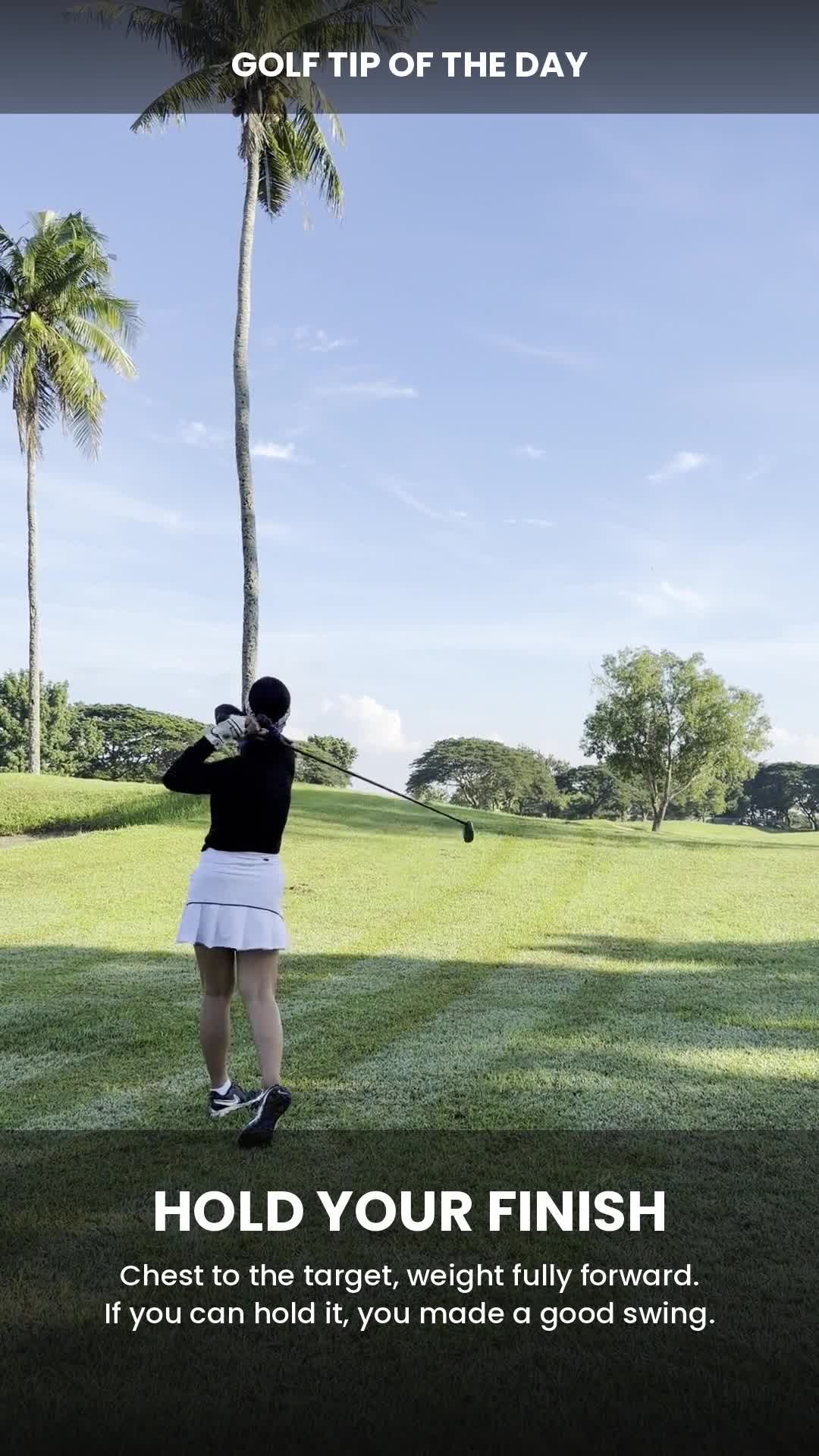
    Watch any golfer with a swing worth copying and you’ll notice something they all share, and it has nothing to do with how far the ball goes. After the ball is gone, they don’t fall over, stumble forward, or yank the club back down early to catch their balance. They finish the swing, chest facing the target, weight stacked over the front foot, back heel lifted off the ground, and they just stay there. Not because it looks good on camera, but because a swing that ends in that position almost always started correctly too.

    That held finish is one of the most useful, most ignored diagnostic tools in golf. It’s free, it requires no equipment, and it works on every single swing you take, whether you’re on the range or standing over a shot that actually matters.

    Why the Finish Position Tells the Truth

    A golf swing happens too fast to consciously control every moving part. By the time the club reaches the ball, the decisions that mattered were already made, weight shift, sequencing, spine angle, well before impact. What you can control, and what you can actually feel and check, is what your body does in the half-second after the ball is struck.

    The finish position is the receipt for everything that happened before it. If your weight is fully forward, your chest has rotated all the way to face the target, and you can hold that pose without wobbling, it means the energy in your swing moved through the ball in the right direction and at the right time. If instead you find yourself falling backward, stuck on your trail foot, or needing to take a quick step to catch your balance, that’s not a finish problem. It’s a symptom of something that broke down earlier in the swing, usually a rushed transition from backswing to downswing, or weight that never fully committed to the front side.

    This is why a held finish is such a good teaching tool. It turns an invisible, split-second event into something you can actually stand in, feel, and correct.

    What a Good Finish Actually Looks Like

    There are three checkpoints worth running through every time you swing, not just on the range but on the course too, quietly, without turning every shot into a swing analysis session.

    Weight fully on the front foot. By the time the swing is finished, the vast majority of your weight, close to all of it, should have transferred onto your lead leg. If you feel weight still hanging back on your trail foot at the finish, the hips and lower body likely didn’t lead the downswing the way they needed to.

    Chest and belt buckle facing the target. A full, committed rotation through the ball means your torso keeps turning all the way until you’re looking down the fairway, not still angled away from it. A finish where the chest is still pointed off to the side is usually a sign the swing got cut short, often from tension or a subconscious effort to steer the ball rather than swing through it.

    Back heel up, back toe lightly on the ground. This is almost automatic if the first two things happen correctly, but it’s worth checking on its own. A back foot that’s still flat on the ground at the finish often means the lower body stalled instead of rotating fully through impact.

    The Fix: Make Holding the Finish a Habit, Not an Afterthought

    The good news is that this is one of the easier things in golf to actually practice, because it doesn’t require new mechanics. It requires a new habit: finishing the swing and staying there.

    On the range, after every single shot, hold your finish position for a slow three-count before you relax or look up to check ball flight. Don’t peek early. The temptation is always to immediately crane your neck to see where the ball went, but that habit is exactly what lets golfers get away with an unbalanced finish without ever noticing it. Committing to the three-count forces you to feel whether you’re actually balanced or just barely staying upright.

    If you find yourself unable to hold the pose, don’t try to fix it by forcing a better-looking finish artificially. Instead, work backward. A wobbly finish is a downstream symptom, and the actual fix usually lives earlier in the swing, in a smoother transition, a fuller hip turn, or better weight shift starting from the top of the backswing. Holding the finish won’t fix those things directly, but it will tell you, honestly and immediately, whether whatever you just changed actually worked.

    Common Mistakes Golfers Make With This

    The most common mistake is treating the finish as decoration, something that happens after the shot is already decided, rather than as information. Golfers watch the ball, not their own balance, and miss the feedback sitting right there in their own body. A second mistake is faking a good finish, muscling the body into the right-looking position after an off-balance swing, which defeats the entire purpose of using it as a diagnostic. The finish should be the natural result of the swing, not a separate pose tacked onto the end of it. A third mistake is only checking this on the range and forgetting about it entirely once real shots are on the line, which is exactly when the feedback matters most.

    FAQ

    Do I really need to hold the finish on every single swing?

    On the range, yes, it’s worth doing every time so it becomes automatic. On the course, even a mental note of whether you stayed balanced is useful, without needing a dramatic three-count on every hole.

    What if I can make a good swing but still can’t hold the finish?

    That’s usually a balance or tempo issue rather than a mechanics issue. Slowing down your tempo slightly, especially in the transition from backswing to downswing, often solves this on its own.

    Does this apply to every club, or just the driver?

    The same checkpoints apply across the bag, though the finish will naturally look a little more compact on shorter irons and wedges than on a full driver swing.

    Key Takeaways

    • A balanced, held finish is a receipt for a well-sequenced swing, not just a good-looking pose.
    • Check three things: weight fully forward, chest facing the target, back heel lifted.
    • Practice a three-count hold after every range swing before checking ball flight.
    • A wobbly finish points to an earlier fault, usually tempo or weight shift, not something to fix at the finish itself.
    • Make it a habit on the course too, not just something reserved for range sessions.

  • Get a Second Set of Eyes on Your Swing: Why Coaching Beats Guessing

    Get a Second Set of Eyes on Your Swing: Why Coaching Beats Guessing

    Every golfer has had this moment: you hit a shot that felt perfect, only to watch it slice into the trees, or you three-putt a green you were sure you read correctly. The gap between what a swing feels like and what it actually looks like is one of the strangest things about this game, and it is also one of the main reasons golfers plateau. You cannot fix a flaw you cannot feel. That is exactly the gap a coach, a playing partner, or even your own phone camera is built to close.

    The Blind Spot Every Golfer Has

    Golf is unusual among sports in how little useful feedback your body gives you in the moment. A basketball player can see the ball miss the rim. A tennis player watches the ball sail past the line. But a golf swing happens in under two seconds, most of it outside your own field of vision, and your brain fills in the gaps with what it expects to feel rather than what actually happened. This is why a golfer can swear their weight stayed forward through impact while video shows the exact opposite, or feel like they made a full turn on the backswing when they barely rotated past parallel.

    This is not a beginner problem. It happens at every level, from first-timers to scratch players, because it is not a knowledge problem, it is a feedback problem. You are trying to fix something you cannot accurately observe about yourself. That is precisely the situation a second set of eyes is designed to solve.

    Why a Coach Sees What You Cannot

    A golf coach’s real value is not that they know more swing theory than you could look up yourself. Plenty of solid instruction is freely available. What a coach actually provides is an outside vantage point on your specific swing, in real time, with the experience to know which flaw is actually causing your miss versus which one is just a symptom.

    Take a golfer who consistently pushes the ball right. They might assume their grip is the problem and spend weeks adjusting it, when the real cause is that their hips are sliding laterally instead of rotating, something they cannot feel from the inside but a coach spots within a few swings. Without that outside perspective, it is easy to spend months chasing the wrong fix, getting frustrated, and concluding that golf just is not a game you are good at, when the actual issue was a fifteen-minute conversation away from being identified.

    A single lesson does not need to turn into a standing weekly commitment to be worth it. Many golfers get real, lasting value out of one focused session per season, ideally scheduled right when a specific problem shows up rather than as a vague tune-up. Walking in with a clear question, such as “why do my irons come out low and thin,” gets you far more useful feedback than a general “watch me hit some balls” session.

    Your Playing Partners Are an Underused Resource

    Not every round needs to end with a trip to the pro shop to book a lesson. The people you already play with are a free, constant source of the same kind of outside perspective, if you use them intentionally. Most golfers focus entirely on their own game during a round and rarely watch their playing partners closely enough to say anything useful, but a simple agreement before you tee off can change that. Ask a buddy to watch your setup and your takeaway on a few holes, and offer to do the same for them.

    This works because setup and alignment errors are some of the easiest flaws to spot from the outside and some of the hardest to feel from the inside. A closed clubface at address, a ball position that has crept too far back in your stance, shoulders that are subtly aimed right of the target, these are all things a friend standing a few feet away can see clearly in a single glance, while you have no way of checking them yourself mid-round without a mirror. Trading this kind of feedback costs nothing and turns a casual round into a genuinely useful practice session.

    Your Phone Is a Coaching Tool You Already Own

    If a lesson is not in the budget this month and your playing partners are focused on their own game, there is a third option available to every golfer with a smartphone: record your own swing. Video is uniquely valuable because it removes the guesswork entirely. You are no longer trying to reconcile what a swing felt like against what a coach or friend says they saw. You simply watch it.

    Prop your phone against a golf bag or a bench, angle it so your full swing is in frame from a face-on or down-the-line view, and record a handful of swings during a practice session or even on the range before a round. You do not need swing analysis software or slow-motion breakdowns to get value from this. Simply watching your own swing back a few times, comparing it honestly to what it felt like as you hit the shot, will surface things you had no idea were happening: a bent lead arm, a head that dips at impact, a backswing that stops well short of where it feels like it does.

    The habit matters more than the technology. A golfer who records swings every few range sessions and actually reviews them will improve their self-awareness faster than a golfer who owns expensive launch monitor data but never looks at it critically.

    Building Feedback Into Your Regular Game

    The common thread across a coach, a playing partner, and a phone camera is that all three interrupt the guessing that otherwise dominates how golfers try to improve. Left alone, most golfers make a change, hit a few good shots, assume the change worked, and move on, without ever confirming that what they did matches what they intended to do. Outside feedback, in whatever form is available on a given day, breaks that cycle.

    This does not require an overhaul of how you approach the game. It requires treating feedback as a regular ingredient rather than an occasional emergency measure reserved for when your game falls apart. Book that one seasonal lesson before frustration builds, not after. Ask a buddy to watch your setup on a normal Saturday round, not just when you are struggling. Record a few range swings the next time you are already there with your phone in your pocket. None of these require extra time carved out of your week, just a small shift in how you use the golf you are already playing.

    Common Mistakes Golfers Make With Feedback

    The most common mistake is waiting until a swing completely falls apart before seeking any outside perspective, which turns a quick fix into a much longer rebuilding process. A related mistake is only ever practicing and playing alone, which feels efficient but removes the one resource, another person’s eyes, that catches the flaws you are structurally unable to see yourself. Finally, many golfers who do record their swing on video watch it once, feel discouraged by the gap between feeling and reality, and never do it again, when the real value comes from making it a repeated habit rather than a one-time reality check.

    FAQ

    How often should I actually get a lesson if I play recreationally?

    Even one well-timed lesson per season, focused on a specific issue rather than a general checkup, delivers real value for most recreational golfers.

    What should I ask a playing partner to watch for if they are not a golf expert?

    Stick to simple, visible things: does your clubface look square at address, does your ball position look consistent, does your head or upper body sway noticeably during the swing. You do not need a technical expert to catch these.

    Is filming my swing on a phone actually useful without professional software?

    Yes. Simply watching your own swing back, without any analysis tools, is often enough to catch flaws you could not feel, especially if you compare it honestly to what the swing felt like in the moment.

    Key Takeaways

    • Golf gives you almost no reliable in-the-moment feedback about what your swing actually looks like, which is why self-diagnosis so often misses the real problem.
    • A coach’s biggest value is an outside, experienced vantage point that separates the real cause of a miss from its symptoms, not simply more swing theory.
    • Playing partners are a free, underused source of setup and alignment feedback if you agree to watch each other intentionally.
    • Recording your own swing on a phone removes the guesswork between how a shot felt and what actually happened.
    • Feedback works best as a regular habit, not an emergency measure reserved for when your game has already fallen apart.
  • Fix Your Slice: Why the Ball Curves Right and How to Stop It

    Fix Your Slice: Why the Ball Curves Right and How to Stop It

    Few things in golf are more frustrating than watching a well-struck drive start down the middle of the fairway, only to curve hard right and disappear into the trees or the rough. That shot has a name every golfer knows too well: the slice. It feels like bad luck, but it is not random at all. A slice has two very specific causes, and once you understand them, the fix becomes surprisingly straightforward.

    The Two Real Causes of a Slice

    Every slice comes down to two swing characteristics working together: an open clubface at impact and an outside-in swing path. The clubface being open relative to your swing path is what puts left-to-right sidespin on the ball, for a right-handed golfer, and the outside-in path is what produces the initial ball direction before the spin takes over and curves it further off line.

    Golfers often try to fix a slice by aiming further left to compensate, but this actually makes the outside-in path worse, not better, because it encourages an even steeper, more across-the-line motion into the ball. Understanding that the fix lives in the clubface and the path, not in where you aim, is the first step toward actually solving the problem.

    The Fix: Soften Your Grip and Swing More From the Inside

    Two simple adjustments address both causes at once. First, soften your grip pressure, especially in your trail hand. An overly tight grip restricts the natural rotation of the forearms and hands through impact, which keeps the clubface open longer than it should be. A softer grip allows the clubface to release and close naturally as it meets the ball.

    Second, feel like you are swinging more from the inside, meaning the club approaches the ball from slightly behind your body line rather than from outside your body line cutting across. A helpful image is to imagine the clubhead approaching from behind an imaginary ball placed just inside your actual ball, then swinging out toward the target. This feeling helps neutralize the outside-in path that starts most slices moving in the wrong direction from the very beginning.

    Combined, these two changes let the clubface release and close through impact while the swing path moves more from the inside, which together straighten out the ball flight and let the clubface square up naturally at the moment of contact.

    A Simple Drill to Feel the Change

    Place a headcover or a small water bottle about six inches outside your golf ball, positioned so that an outside-in swing path would strike it on the way down. Practice swinging without hitting the obstacle, which naturally trains a more inside path. Pair this with consciously loosening your grip pressure before each rep, and you will start to feel the difference between the old slicing motion and the corrected one.

    Why Grip Pressure Matters More Than Most Golfers Realize

    Grip pressure is one of the most overlooked fundamentals in golf instruction, yet it directly affects clubface rotation through impact. A grip that is too tight, often a response to nervousness or trying to “control” the shot, locks the wrists and forearms and prevents the natural release that squares the clubface. Learning to hold the club only firmly enough to maintain control, roughly a four or five on a scale of ten, is often the single biggest unlock for golfers working to fix a slice.

    Common Mistakes When Trying to Fix a Slice

    Aiming further left to “allow for” the slice is the most common compensation, and it typically makes the underlying swing path issue worse rather than better. Another common mistake is trying to consciously “hold off” the clubface at impact to prevent it from opening, which usually produces an even more restricted, handsy motion. The better long-term fix addresses the cause, grip pressure and swing path, rather than manipulating the clubface directly at the moment of impact.

    FAQ

    Why does my slice get worse with the driver than with irons?

    The driver’s longer shaft and lower loft amplify both clubface angle and swing path errors, which is why slices are often most visible and most severe with the driver.

    Will softening my grip cause me to lose control of the club?

    No. A grip that is too tight actually reduces feel and control by restricting natural wrist and forearm movement. A relaxed but secure grip typically improves both control and clubface release.

    How long does it usually take to fix a slice?

    With consistent practice on grip pressure and swing path, many golfers notice real improvement within a few range sessions, though fully ingraining the change takes ongoing repetition.

    Key Takeaways

    • A slice is caused by an open clubface combined with an outside-in swing path, not bad luck.
    • Soften your grip pressure, especially in your trail hand, to allow the clubface to release naturally.
    • Feel like you are swinging more from the inside to correct the outside-in path.
    • Aiming further left to compensate usually makes the underlying swing path issue worse.