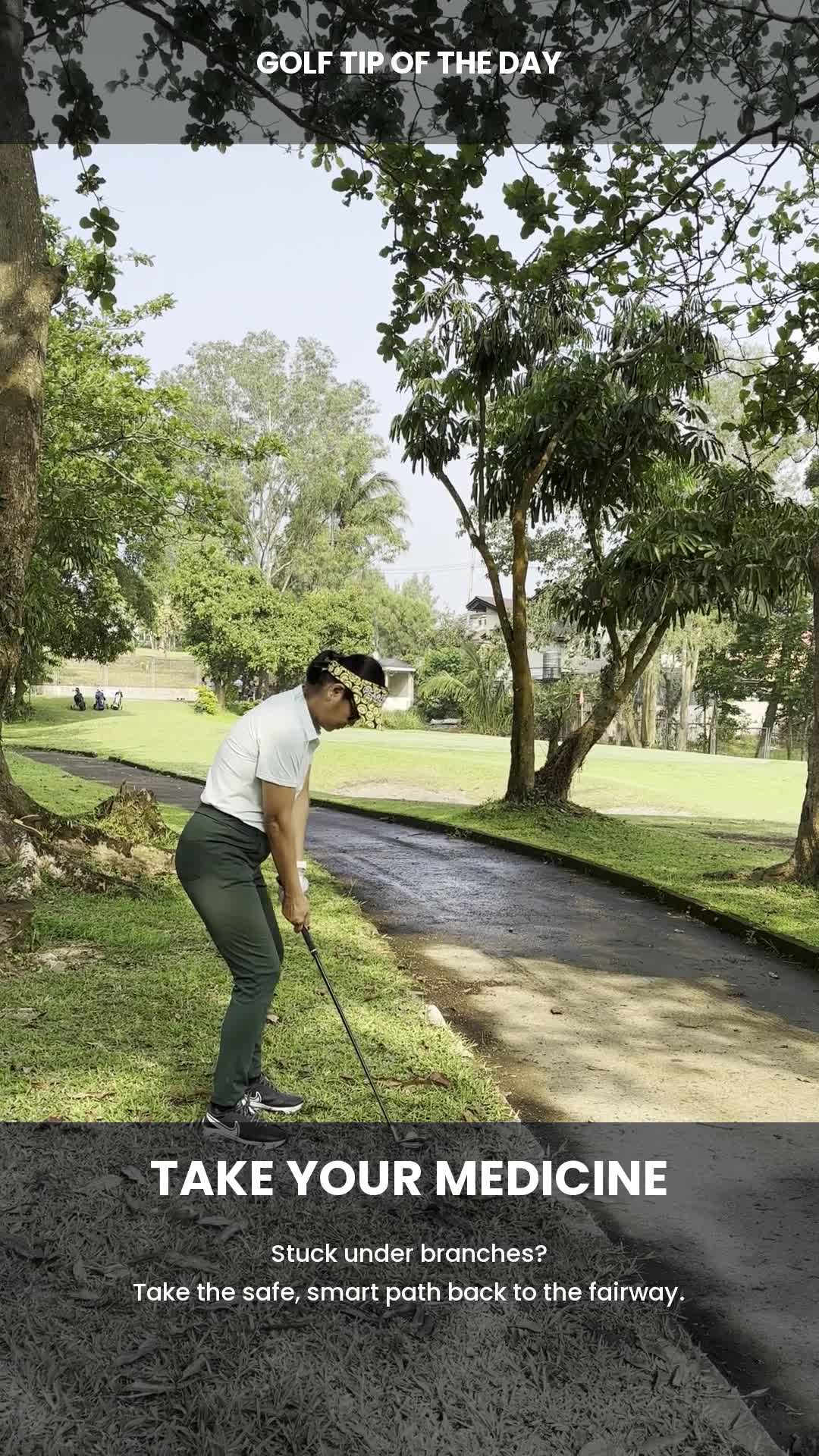
Every golfer knows the feeling. Your ball has drifted off line and come to rest somewhere it has no business being, tucked under a low canopy of branches, sitting in a stand of trees, or resting on the wrong side of a hazard entirely. You walk up, take one look at the tiny gap between two branches, and a thought creeps in: maybe I can still get there. Maybe, if the swing is just right, the ball threads the needle and the hole is saved.
That thought is where a lot of otherwise decent rounds quietly fall apart. The smarter, less glamorous option is almost always the better one: take your medicine. Punch out safely, get the ball back in play, and protect the rest of your round instead of gambling it on a low-percentage shot.
What “Take Your Medicine” Actually Means
The phrase is old golf slang, and it says exactly what it means. When you’ve hit a bad shot and ended up in trouble, the smart response is to accept the setback and take the safe way out, rather than trying to erase the mistake with an even riskier follow-up shot. It’s not a glamorous phrase, and it’s not meant to be. It’s an acknowledgment that the shot before this one already cost you something, and the only real question left is how much more it’s going to cost.
Golfers who take their medicine well tend to have something in common: they treat the recovery shot as its own separate decision, not an extension of the mistake that put them there. The tee shot that ended up under a tree is over and done. What happens next is a fresh choice, made with a clear head about what’s actually possible from that lie, not what would feel most satisfying.
Why Golfers Reach for the Hero Shot Anyway
It helps to understand why the miracle escape is so tempting in the first place, because the pull toward it is strong and it’s not really about strategy at all. It’s about ego and about the story we’d rather tell.
Standing over a ball buried under branches, most golfers do a quick mental inventory: how big is the gap, how confident do I feel, could I actually pull this off. The trouble is that this inventory almost always overestimates the golfer’s own precision under pressure. A gap that looks two feet wide from address often plays much narrower once a driver-length swing, a slightly compressed stance, and adrenaline are added to the equation. The shot that “should” work on a good day rarely accounts for the fact that this isn’t a good day. You’re off balance, rushed, and playing defense before you’ve even swung.
There’s also a scoring math problem hiding underneath the temptation. Golfers chasing the hero shot are usually thinking about the single hole in front of them, not the round as a whole. A clean escape saves one shot. A blocked branch, a shanked recovery, or a ball that ricochets even deeper into trouble can cost two, three, or more. The hero shot has a modest ceiling and a very expensive floor, and most golfers underestimate exactly how expensive that floor can get.
The Fix: Play the Percentages, Not the Moment
Taking your medicine isn’t about giving up. It’s about making the highest-percentage decision available from a compromised position, and it comes down to a few honest questions asked in order, every time.
Assess the lie and the gap honestly, not hopefully. Before picking a shot, take a genuine look at what’s actually possible, not what would be the most satisfying outcome if everything broke right. Is there truly a clean window to the green, or is that gap really only clean from where you’re standing and not from the ball’s actual flight path? A low branch that looks high enough from twenty feet away often isn’t once you account for the shot’s actual trajectory.
Identify the safest exit, not the most direct one. The safe path back to the fairway is rarely the shortest line to the pin. It might mean hitting sideways, or even slightly backward, just to get clear of trouble. That can feel like giving something away, but a clean lie in the fairway, even well short of where you’d like to be, is worth more than a repeated gamble from an even worse spot.
Pick a club and swing built for control, not distance. Recovery shots are not the moment to reach for extra club or a fuller swing trying to make up lost ground. A shorter, three-quarter swing with more club in hand almost always produces a more reliable strike than a full swing squeezed through a tight window.
Commit fully to the decision you’ve made. Once you’ve chosen the safe route, swing it like you mean it. A half-hearted punch-out, swung tentatively because part of you is still wishing you’d gone for the hero shot, often ends up worse than either full commitment option. Decide, then commit.
A Simple Way to Practice This
The instinct to take your medicine is hard to build in the moment, because every buried lie feels urgent and personal. It helps to rehearse the decision-making process away from the pressure of an actual round.
On the range, deliberately practice low, three-quarter punch shots with a mid-iron, aiming for a modest, specific landing area rather than maximum distance. Get comfortable with what a controlled, lower-trajectory swing feels like so it isn’t a foreign move when you actually need it on the course. It’s also worth mentally rehearsing the “two options” framework before you play: for any ball that ends up in trouble, name the hero shot and the safe shot out loud, even just in your head, before choosing. Making the comparison explicit, instead of drifting straight toward the exciting option, is often enough to tip the decision toward the smarter one.
Why This Matters More Than It Seems
Recovery shots don’t show up on a scorecard as their own category, but they quietly decide more rounds than most golfers realize. A single poor decision in the trees can turn a bogey into a double or worse, and those extra strokes tend to happen exactly when a round is already fragile, right after a mistake, when frustration is already creeping in.
Golfers who consistently take their medicine aren’t playing more conservatively out of fear. They’re recognizing that the round is long, that one hole rarely needs to be a hero moment, and that protecting against the big number is usually a better use of a swing than chasing a highlight. Over eighteen holes, it’s not the two or three genuinely great escapes that build a good score. It’s how rarely a single bad shot is allowed to become two or three bad shots in a row.
Common Mistakes Golfers Make With This
The most common mistake is treating this as a one-time decision made in a panic, rather than a habit built ahead of time. Golfers who haven’t decided in advance how they’ll handle trouble tend to make the call emotionally, in the ten seconds after walking up to a bad lie, which is exactly when judgment is least reliable. A second mistake is choosing the safe route but then still swinging aggressively, trying to sneak a little extra distance out of what was supposed to be a conservative shot. That undoes the whole point of the decision. A third mistake is beating yourself up over having to take the safe route at all, as if it’s an admission of failure. It isn’t. It’s simply the correct response to a shot that already went wrong, and treating it as anything else just adds unnecessary pressure to the next swing.
FAQ
Isn’t taking the safe shot just giving up on the hole?
Not really. You already gave something up when the ball ended up in trouble. Taking your medicine is about not giving up more than necessary on top of that.
How do I know when the hero shot is actually worth trying?
If the gap is genuinely clear, the lie is clean, and a miss still leaves you somewhere manageable, it may be a reasonable, calculated risk. If a miss puts you in a worse spot than you’re already in, it almost never is.
Does this only apply to shots from the trees?
No. The same logic applies to any recovery situation, deep rough, awkward stances, balls under a cart path lip, or lies close to a hazard. The core question is always the same: what’s the safest way back into play, and can I commit to it fully?
Key Takeaways
- A bad lie is a fresh decision, not an extension of the shot that put you there.
- The hero shot has a low ceiling and a very expensive floor. Most golfers underestimate how bad the miss can be.
- Choose the safest exit, not the most direct one, and pick a club and swing built for control.
- Commit fully once you’ve decided. A half-hearted safe shot is often worse than either full option.
- Protecting against the big number matters more over a full round than the occasional spectacular escape.